




Stress Testing: What Actually Happens When a Lighten Up Hammock Reaches Its Weight Limit?
Understanding what occurs when a hammock approaches its specified weight limit is crucial for safety and longevity. It's important to distinguish between the manufacturer's rated limit (a guideline for safe, long-term use) and ultimate failure stress (the point of catastrophic breakage). This analysis explores the engineering principles and real-world effects on your Lighten Up Hammock as load increases.
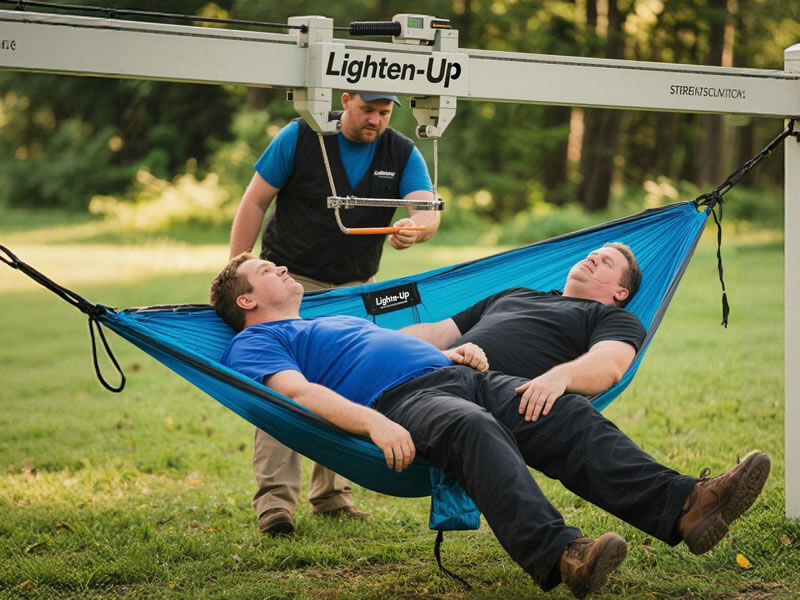
The Engineering Perspective: Safety Factors and Dynamic Loads
Reputable outdoor gear manufacturers do not set the weight limit at the point of immediate failure. They build in a safety factor—often between 2:1 and 5:1. This means a hammock rated for 400 lbs might not actually fail until 800-2000 lbs of static, evenly distributed weight is applied in controlled conditions.
However, the real world is not static. Dynamic loads—the forces generated by sitting down quickly, shifting position, or even a gentle swing—can multiply the effective weight on the system by 1.5x to 3x. The rated limit accounts for this by providing a buffer for real-world use, but consistently operating at the limit erodes this buffer entirely.
Physical Manifestations as Load Increases
As you approach and reach the stated weight limit, observable and measurable changes occur:
- Fabric Tension and "Feel": The hammock will feel extremely taut, losing the comfortable, deep sag essential for a diagonal flat lay. The fabric becomes drum-tight, creating uncomfortable pressure points and making the hammock less stable.
- Stress on Seams and Stitching: The gathered ends and ridge seams endure the greatest force. At maximum load, you may hear slight creaking or popping sounds from the stitching threads under tension. This is a clear auditory warning that the system is under extreme stress. The stitching itself can begin to slowly abrade or cut into the fabric it's securing.
- Suspension Strain: The force on the tree straps, carabiners, and attachment points increases exponentially with a tighter hang angle. Hardware may deform microscopically, and straps can show signs of elongation or fiber distortion at the points of greatest friction.
- Reduced Margin for Flaws: At the weight limit, there is zero tolerance for any pre-existing damage. A tiny, unnoticed abrasion, a small sun-rotted patch from UV degradation, or a compromised stitch that would be harmless under lighter loads becomes a critical failure point. The concentrated stress will find the weakest link.
What Does "Failure" Typically Look Like?
Catastrophic failure under slow, steady stress (a rare scenario) usually happens at one of two points:
- Gathered End Channel or Continuous Loop: The fabric or webbing at the primary attachment point tears, often where the stitching concentrates force.
- Mid-Body Fabric Tear: A sudden rip can propagate from a micro-tear or worn section, especially if the fabric has been weakened by UV exposure.
More commonly, "failure" is a process, not an event. Fatigue from repeated cycling at or near the limit—daily use by a user who weighs 390 lbs on a 400 lb-rated hammock—will gradually degrade materials. This leads to a failure that seems sudden but was actually a long time in the making, often triggered by a routine dynamic movement.
The Critical Role of Proper Hang Angle
A hammock hung too tightly (with a strap angle steeper than 30 degrees) dramatically increases the lateral forces on the entire system. A hammock at its weight limit but hung with a proper, deep sag is under significantly less stress than one hung tightly below its limit. This is why proper setup is non-negotiable for safety, especially for heavier users.
Practical Implications and Safety Advice
- The Limit is a Ceiling, Not a Target: Your total loaded weight (your body weight + clothing + sleeping bag/quilt + any gear in the hammock) should have a comfortable margin below the stated limit—15-20% is a prudent rule of thumb. This accounts for dynamic forces and material wear over time.
- Inspect Religiously: Before each use, especially if you operate near the capacity, meticulously inspect the gathered ends, seams, and fabric for any signs of wear, fading, or stitching irregularities.
- Respect the Whole System: Your hammock's rating is only as strong as the weakest component. Ensure your tree straps and carabiners are rated for equal or greater weight.
- Listen to Your Gear: A hammock that feels uncomfortably tight, makes new sounds, or shows any visible distortion under your weight should be retired from use immediately.
In conclusion, reaching the weight limit on a Lighten Up Hammock means operating at the very edge of its designed safety envelope. While it may not fail instantly, it exists in a state of heightened vulnerability where dynamic forces, material flaws, or improper setup can lead to failure. The manufacturer's limit is given to provide a safe boundary for years of reliable use; respecting that boundary with a personal margin is the hallmark of a wise and safe hammock camper. For ultimate peace of mind, always choose a hammock with a weight rating that generously exceeds your needs.




