




What Are Quickdraw Carabiners?
In the sport of lead climbing, quickdraws are not just accessories; they are the fundamental safety system connecting the moving rope to fixed protection points on the wall. A quickdraw is a pre-assembled unit consisting of two specialized carabiners connected by a robust fabric sling. Understanding the distinct roles of each carabiner in this pair is key to safe and efficient climbing.
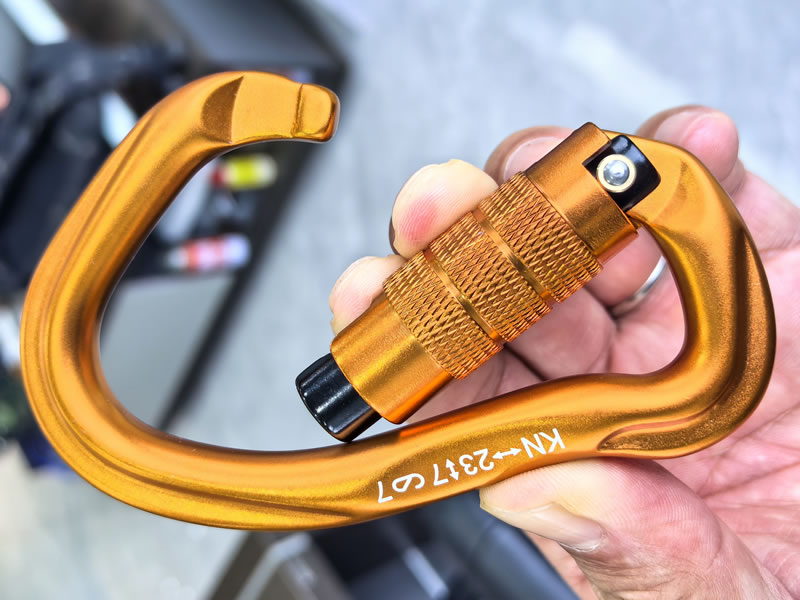
The Anatomy of a Quickdraw
A quickdraw is a purpose-built tool where each component is optimized for a specific function:
- The Bolt-Side Carabiner:Design: Typically features a straight-gate.Function: This carabiner is designed to be clipped to a bolt hanger or permanent protection point. The straight gate ensures a secure, stable fit that is less likely to rotate or unclip accidentally from the bolt.Key Trait: Reliability over speed. It often has a keylock or rounded nose to prevent snagging on the bolt or rock when being placed or removed.
- The Rope-Side Carabiner:Design: Most often features a bent-gate or a wire-gate.Function: This is the carabiner through which the climbing rope is clipped. The bent gate creates a wider, funnel-like opening that makes inserting the rope faster, easier, and more intuitive during a strenuous lead climb.Key Trait: Speed and smooth action. The design prioritizes one-handed clipping efficiency.
- The Sling (or Dogbone):This durable fabric loop, usually made of nylon or Dyneema, connects the two carabiners. Its length (typically between 10cm and 18cm) manages rope drag and allows the rope to run in a straighter, cleaner line.
Why a Specialized Pair? The Logic Behind the Design
Using two different carabiners is a result of ergonomic and safety engineering:
- Stability at the Bolt: A straight-gate carabiner sits more securely in a bolt hanger, reducing the chance of it twisting into a dangerous cross-loaded position.
- Efficiency on the Rope: The bent-gate dramatically reduces the chance of a "missed clip," where the climber fumbles to get the rope into the carabiner—a vulnerable moment. The wire-gate variant adds the benefits of lighter weight and less gate flutter.
Types and Variations for Different Climbing Styles
Quickdraws evolve to meet the demands of different disciplines:
- Sport Climbing Quickdraws:Standard: Feature a stiff, pre-sewn sling to keep the rope-end carabiner oriented for easy clipping."Skinny" or "Wire" Draws: Use ultra-thin Dyneema slings and lightweight wire-gate carabiners to minimize weight and bulk on a harness, often favored on long routes.
- Alpine or Trad Draws:Often referred to as "alpine draws," these are not pre-sewn. They consist of two non-locking carabiners and a longer, extendable sling (60cm) that can be doubled or tripled. This adjustability is crucial for reducing severe rope drag when protecting wandering traditional routes, allowing the placement to "extend" away from the rock feature.
Safety and Usage Fundamentals
- Orientation is Critical: The rope should always run from the rock, through the bolt-side carabiner, over the sling, and out through the rope-side carabiner. Reversing this ("back-clipping") creates a configuration where the rope can potentially unclip itself during a fall.
- Gate Direction: For maximum safety and to prevent the rope from hitting and opening the gate in a fall, the gates of both carabiners should face the same direction, typically away from the direction of travel.
- Inspection: Like all soft and hard gear, quickdraws must be regularly inspected. Check carabiners for gate wear and cracks, and examine slings for cuts, abrasion, or stiff, damaged sections.
Conclusion: The Essential Link
Quickdraw carabiners are a perfect example of form following function in climbing gear design. They are not two random carabiners on a loop, but an integrated system where one end is optimized for secure attachment to the rock, and the other is engineered for rapid, reliable connection to the dynamic lifeline—the rope. Mastering their use, from selecting the right type for your climb to understanding the critical importance of correct clipping orientation, is a core skill for every lead climber. They are, quite literally, the links that make ascending a protected line possible.




