




What is a Carabiner's Major Axis vs Minor Axis Strength?
Understanding the difference between a carabiner's major axis and minor axis strength is fundamental to using it safely. These two ratings, stamped on the spine of every certified carabiner, tell a story of engineered optimization versus critical vulnerability. They are not just numbers; they are a direct guide to how the tool must—and must not—be loaded.
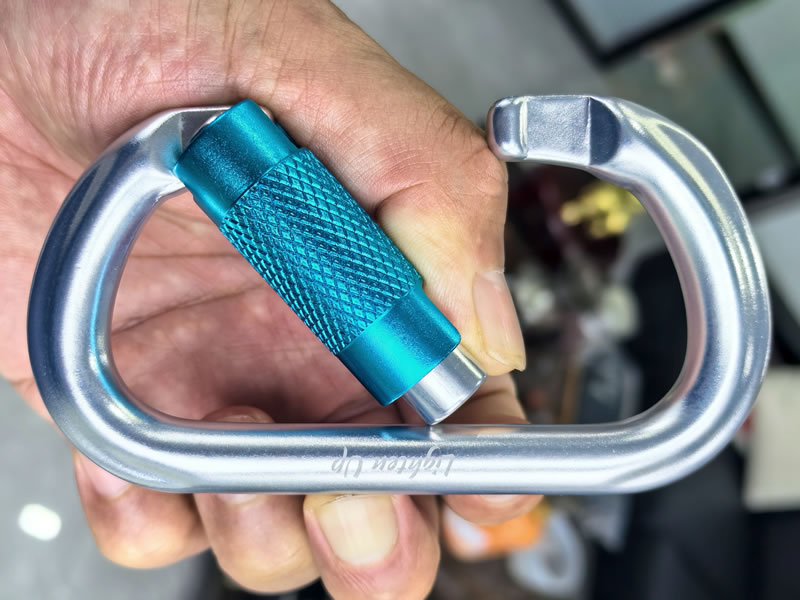
Defining the Axes: The Strong Back and the Weak Side
- The Major Axis: This refers to the carabiner's long, curved spine. It is the primary structural backbone of the device. When we visualize a carabiner bearing weight in its ideal, strongest configuration, the force runs straight down this spine.
- The Minor Axis: This is the narrow side of the carabiner, perpendicular to the spine. It is the dimension from the outside of the curved gate side to the outside of the spine. Loading in this direction is often called "cross-loading."
The Stark Numbers: A Quantitative Comparison
For a typical UIAA/CE-certified climbing carabiner, the strength disparity is dramatic:
- Major Axis (Spine) Strength: 22 kN to 28 kN (approx. 4,950 - 6,300 lbs of force).
- Minor Axis (Cross-Loaded) Strength: 7 kN to 9 kN (approx. 1,575 - 2,025 lbs of force).
This means a carabiner is approximately 70-75% WEAKER when loaded on its minor axis. A piece of gear rated to hold over 5,000 lbs can fail at under 2,000 lbs if twisted into the wrong orientation.
The Physics Behind the Disparity: Why the Difference is So Extreme
The difference isn't a manufacturing flaw; it's a consequence of physics and intentional design.
- Leverage and Bending Moment: When force is applied to the minor axis, it acts on the shortest, weakest dimension. This creates a powerful bending moment, trying to pry the "C" shape of the carabiner open. The metal is not designed to resist this type of leverage.
- Engineered Load Path: A D-shaped carabiner is specifically designed to channel force along the major axis. The straight(er) spine is the optimal load path. The curved gate side is primarily a closure mechanism, not a primary structural member. Cross-loading misdirects force away from this engineered path.
- Material Stress Concentration: Under cross-loading, stress becomes concentrated at the gate's hinge point and the opposite point on the spine, rather than being evenly distributed.
Real-World Scenarios: How Cross-Loading Happens
Cross-loading is rarely intentional. It occurs through common mistakes or oversights:
- Improper Anchor Building: A carabiner connecting two slings in an anchor can easily twist into a cross-loaded position if not managed properly.
- Misaligned Quickdraws: A quickdraw that twists against the rock can place the bolt-end carabiner in a cross-loaded orientation.
- Accidental Twisting: Simply clipping a sling or rope in a way that allows the carabiner to pivot under load can lead to a dangerous cross-loaded state.
- Using the Wrong Carabiner Shape: Using an oval or small D-shaped carabiner for belaying can increase the risk of the belay device causing a cross-load.
The Critical Safety Implications and Best Practices
This dramatic strength differential dictates non-negotiable safety protocols:
- Active Orientation Management: When setting up anchors or clipping, you must visually ensure the carabiner is oriented so the anticipated pull is directly along its major axis (spine). Techniques like aligning all carabiner spines in the same direction in an anchor are used to prevent cross-loading.
- Use the Right Carabiner for the Job: For belaying, a large HMS (Pear-shaped) carabiner is specifically designed to prevent the belay device from creating a cross-loading scenario due to its wider, rounded base.
- Inspection for Cross-Loading: Part of pre-climb or pre-use checks should include verifying that no carabiners in the system are cross-loaded. This is as important as checking that gates are locked.
- Understanding System Strength: The overall strength of any rigging or safety system is determined by its weakest point. A cross-loaded carabiner instantly becomes that weak point, potentially reducing system strength by two-thirds.
Conclusion: Strength is a Matter of Direction
The major and minor axis strengths are the carabiner's way of communicating its fundamental rule: it is a directionally dependent tool. Its phenomenal strength is conditional on proper use. The informed user respects this by developing habits—meticulous orientation, appropriate selection, and constant vigilance—that ensure every carabiner is loaded along its mighty spine, never on its vulnerable side.
Mastering this concept moves you from merely using a carabiner to understanding it, transforming raw mechanical strength into applied, reliable safety. In the end, the carabiner's stamped ratings are a promise it can only keep if you, the user, honor the conditions of that promise by loading it correctly.




