




Upgrading from Basic to Climbing-Grade Carabiners
The decision to upgrade from basic, hardware-store carabiners to certified climbing-grade carabiners is one of the most significant safety milestones for an aspiring climber. It represents a shift from using a general-purpose tool to employing a life-support device engineered for catastrophic loads. This transition is not merely about buying stronger metal; it’s about adopting an entirely new standard of trust, understanding the engineering behind your gear, and taking full responsibility for your safety system.
The Fundamental Difference: Utility Hardware vs. Life-Support Engineering
First, it’s critical to internalize the distinction:
- Basic/Utility Carabiners: These are manufactured for organization and light-duty static loads. They are made from generic alloys, have no independent certification, and their strength is unknown under dynamic forces. Their gates are simple and not tested for remaining closed under shock loads. Using them for climbing is akin to using a toy helmet for motorcycle racing—the shape is similar, but the protective function is absent.
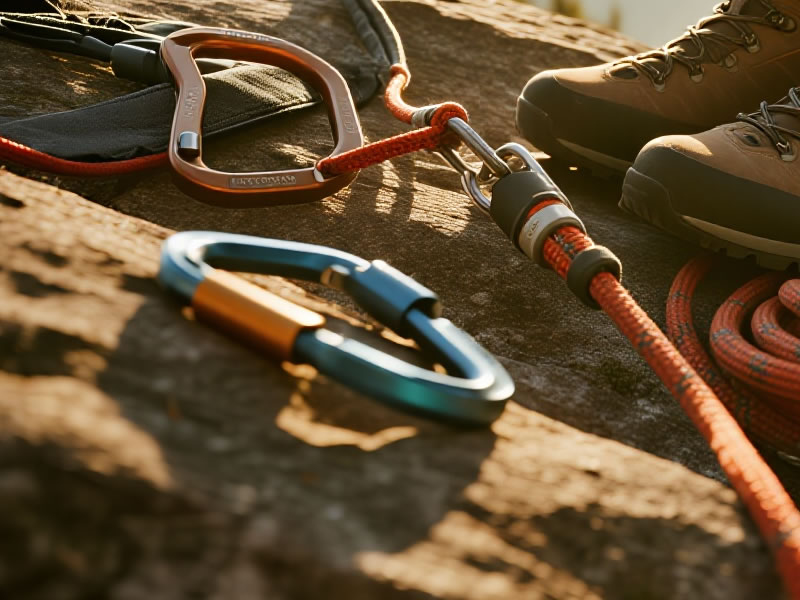
- Climbing-Grade Carabiners: These are certified life-support devices. Each batch is manufactured under strict controls, using aerospace-grade aluminum alloys (like 7075-T6) that are hot-forged for strength. Every single model is independently tested to meet UIAA (International Climbing and Mountaineering Federation) and CE EN 12275 standards. These tests verify:Major Axis Strength: Typically 20-25 kN (roughly 4,500-5,600 lbs of force).Gate-Open Strength: That the carabiner retains significant strength even if the gate is pressed open against a rock.Minor Axis Strength: Strength when loaded sideways.Durability: Performance after repeated loads.
What You Gain by Upgrading
- Certified Safety Margin: The kN rating provides a known, massive safety buffer far exceeding forces generated in most falls (which are mitigated by the rope's elasticity).
- Reliable Gate Mechanisms: Precision-engineered springs and gates that are designed to stay closed and function smoothly after repeated use and exposure.
- Durability and Consistency: Superior anodizing resists abrasion, and the manufacturing process ensures every carabiner of the same model performs identically.
- Specialized Features: Keylock noses (to prevent snagging), curved gates (for easier clipping), and technologies like Black Diamond's HoodWire or Petzl's Sm’D for optimized performance.
A Step-by-Step Guide to Your Upgrade
Step 1: Audit and Retire Your Current Gear.
Gather all carabiners you've been using for climbing-related activities. Any that lack a clear UIAA or CE mark stamped on the spine should be permanently removed from your climbing kit. These can be relegated to keychains, dog leashes, or gear organization—never again for life support.
Step 2: Understand Your New Needs.
What type of climbing will you do? Your first purchases should cover the essentials:
- Sport Climbing: You'll primarily need wire-gate carabiners for quickdraws. A starter set of 10-12 is standard.
- Top-Roping & General Use: You'll need at least two large, pear-shaped (HMS) locking carabiners for belaying and anchoring.
Step 3: Invest in Your First Core Set.
You don't need the most expensive models, but buy from reputable climbing brands. An excellent starter pack includes:
- A 6-pack of basic wire-gate carabiners (e.g., Metolius Bravo, Black Diamond HotForge). These offer certified safety at the best value for building quickdraws or general racking.
- Two sturdy locking carabiners (e.g., Black Diamond RockLock, Petzl Attache). These are non-negotiable for belaying.
Step 4: Learn the Language and Details.
- kN Ratings: Understand that higher kN doesn't mean "safer"—all certified carabiners are strong enough. A 22 kN carabiner is not "weaker" than a 25 kN in a practical sense.
- Gate Types: Know the use cases for wire gates (lightweight, less gate flutter) vs. solid gates (more durable for bolt-ends).
- Maintenance: Learn to inspect for cracks, gate wear, and sharp grooves.
Recommended Upgrade Path & Brands
- Budget-Conscious & Bomber: Metolius is the king of value. Their carabiners are fully certified, incredibly durable, and will serve you for years as you learn.
- All-Round Performance: Black Diamond and DMM offer the perfect balance of innovation, reliability, and widespread availability. The BD HotWire or DMM Shadow are iconic.
- Lightweight & High-Performance: Petzl and Camp excel here. Models like the Petzl Spirit represent the pinnacle of strength-to-weight engineering.
The Mindset Shift: From User to Steward
Upgrading your carabiners necessitates upgrading your mindset. You are no longer just a user of a tool, but a steward of a safety-critical system. This means:
- Regular Inspection: Checking your gear before and after each use.
- Continuous Learning: Understanding how and why your gear works.
- Respecting Limits: Knowing that certification has boundaries—no carving, painting, or modifying your gear.
Conclusion
Upgrading to climbing-grade carabiners is the definitive act of committing to safe climbing. It replaces unknown variables with engineered certainty. The investment is not just in aluminum, but in the peace of mind that comes from knowing the link between you and the rock is designed, tested, and certified to hold. Start with a core set from a trusted brand, educate yourself on their use and care, and leave the hardware-store biners where they belong—on your keyring, not your harness. Your safety, and that of your partners, depends on this essential upgrade.




