




Industrial Safety Carabiner OSHA Compliant: A Comprehensive Guide
Navigating the world of industrial safety equipment requires a clear understanding of regulations and standards. When it comes to carabiners used in fall protection, positioning, and restraint systems, the term "OSHA compliant" is often used, but it requires precise interpretation. The Occupational Safety and Health Administration (OSHA) does not approve or certify individual products. Instead, compliance is achieved by using equipment that meets specific, recognized consensus standards. For carabiners, this means adherence to the American National Standards Institute (ANSI) and the American Society of Safety Professionals (ASSP) Z359 series, particularly ANSI/ASSE Z359.12-2019: Connecting Components for Personal Fall Arrest Systems.
The Core Standard: ANSI Z359.12 Requirements
For a carabiner to be considered compliant for industrial fall protection, it must be designed, tested, and manufactured to meet this standard's rigorous criteria. Key requirements include:
- Minimum Strength Ratings:Major Axis (Gate Closed): 5,000 lbs (22.2 kN) minimum breaking strength.Minor Axis (Side Load): 3,600 lbs (16 kN) minimum.Gate Open (With gate depressed): 3,600 lbs (16 kN) minimum. This test is critical, as it simulates the carabiner snagging on an edge with the gate pressed open.
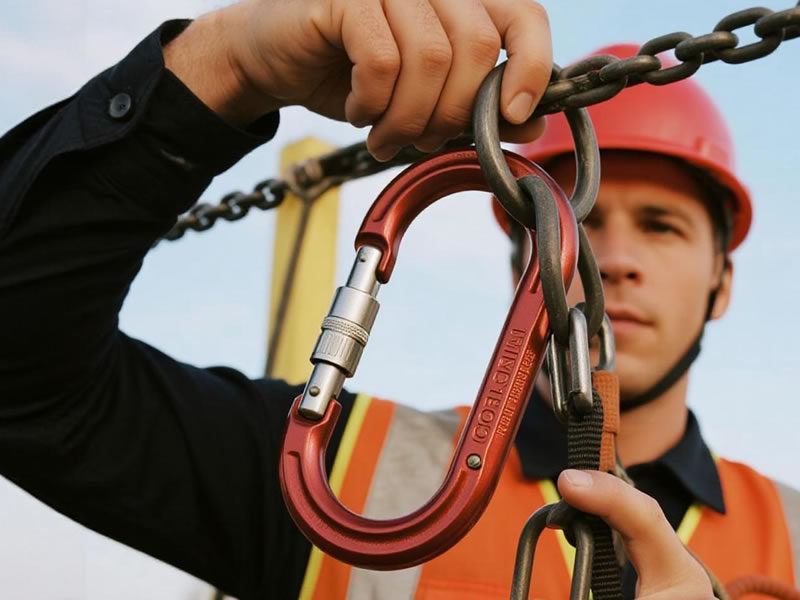
- Mandatory Locking Mechanism: The carabiner must be self-closing and self-locking. This means it requires at least two consecutive, deliberate actions to open the gate. Common compliant mechanisms include:Triple-Action Auto-Locking: (e.g., twist-lock) Requires three distinct motions (e.g., press, twist, pull).Screwgate Locking: Requires manually screwing the sleeve to unlock.Push-and-Twist (Double-Action) Locking.
- Marking and Identification: Each compliant carabiner must be permanently marked with:Manufacturer's name or trademark.Model or part number.The month and year of manufacture.The serial number or batch code.Its rated capacity (e.g., "5,000 lbs" or "22 kN").
- Material and Durability: Must be constructed from materials resistant to corrosion and environmental degradation common in industrial settings (e.g., chemical exposure, UV radiation, abrasion). Forged steel is common for high-abrasion rigging; aluminum is used for lighter-duty positioning.
OSHA's Role: The General Duty Clause and Referenced Standards
OSHA's authority comes from the General Duty Clause (Section 5(a)(1) of the OSH Act) and specific regulations like 29 CFR 1926.502 for construction and 29 CFR 1910.140 for general industry. These regulations mandate that fall protection equipment must meet the ANSI standards referenced above. An OSHA inspector will check for equipment that is:
- Properly Certified: From a reputable manufacturer with documentation (certification of compliance) showing it meets ANSI Z359.12.
- Properly Used: Within its intended application and as part of a compatible, complete system (harness, lanyard, anchor, etc.).
- Properly Inspected: Subject to pre-use and periodic inspections by a competent person, with records maintained.
- Properly Retired: Removed from service if it shows signs of damage, excessive wear, or has been subjected to a fall arrest force.
Selecting the Right OSHA-Compliant Carabiner
- For Personal Fall Arrest (Connecting a harness to a lifeline or anchor): Choose a triple-action auto-locking carabiner for maximum security against accidental opening. Size should be appropriate for the connection point.
- For Positioning/Restraint (Work positioning where fall arrest is not the primary goal): A screwgate or double-action locker may be suitable, following the manufacturer's instructions and risk assessment.
- For Rigging (Material handling, not for personal attachment): While different standards may apply, using rated, screw-locking carabiners (often steel) from reputable rigging brands (e.g., Crosby, Campbell Chain) is essential. These are not typically ANSI Z359 personal fall arrest devices but are engineered for load handling.
Top Recommendations for Compliant Carabiners
Industrial safety brands design products explicitly for this market:
- Petzl (Petzl Professional): Models like the Petzl WILLIAM'D TRIACT-LOCK offer triple-action security and are widely trusted in telecom and utilities.
- 3M/DBI-SALA & MSA Safety: Leading fall protection manufacturers whose carabiners are integral to their full-system offerings, ensuring guaranteed compatibility.
- Rock Exotica & DMM Professional: Known for high-strength, durable steel and aluminum carabiners used in technical rescue and demanding industrial applications.
The Employer's Responsibility: Beyond the Hardware
Compliance is a process, not a product. Employers must:
- Provide Training: Ensure workers understand how to inspect, use, and connect their equipment.
- Enforce Inspections: Implement a formal inspection protocol.
- Maintain Records: Keep equipment inspection logs and certification documents.
- Ensure System Compatibility: Verify that all components (harness, lanyard, carabiner, anchor) are compatible and rated for the intended use.
Conclusion
An "OSHA compliant" industrial safety carabiner is one that is certified to ANSI Z359.12, features an auto-locking gate, possesses the required strength ratings and markings, and is used correctly within a comprehensive, managed fall protection program. The ultimate responsibility lies with the employer to select certified equipment, enforce proper use, and maintain a culture of safety. By understanding and implementing these standards, you ensure that this critical link in the safety chain performs its life-saving function without fail.




