




Carabiner for Attaching a Tool Pouch to Scaffolding: The Essential Link for Safety and Efficiency
For tradespeople working at height, every movement and every piece of equipment placement carries weight. A dropped tool isn't just a nuisance; it's a severe safety hazard and a project delay. Securing your tool pouch effectively is as critical as wearing a harness. While many rely on simple hooks or carabiner-shaped clips, using a genuine, rated locking carabiner is the professional upgrade that bridges the gap between mere convenience and true, reliable safety. This article explores why a proper carabiner is the superior solution for attaching a tool pouch to scaffolding, ensuring your tools—and your worksite—remain secure.
Why a Carabiner Trumps Traditional Methods
Typical tool belt pouches come with belt loops or basic metal hooks designed for static use on a belt. On scaffolding, these methods fall short:
- Basic Hooks: Can easily snag, twist, or dislodge with body movement, leading to accidental drops.
- Improvised Straps: Lack a secure, quick-release mechanism, wasting time.
- Non-Locking Clips: May open if twisted or pressed against a scaffold tube.
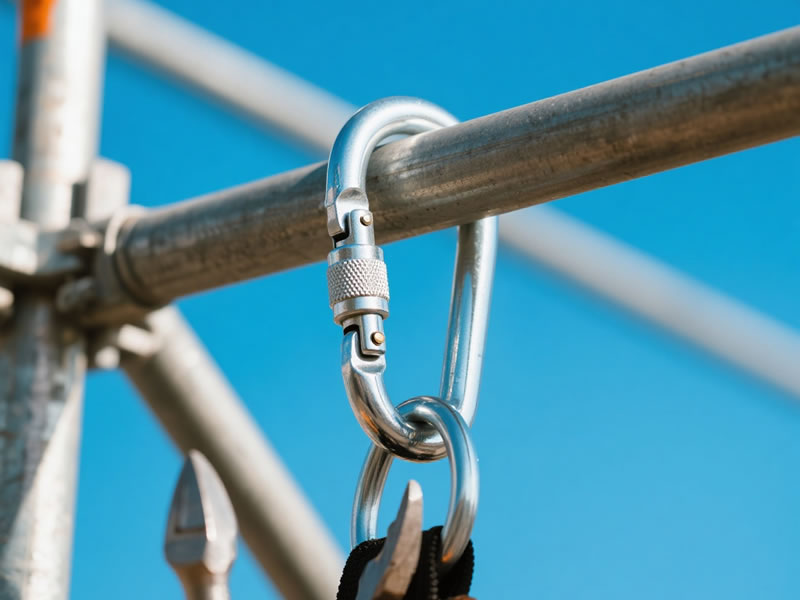
A dedicated locking carabiner solves these issues by providing a positive, mechanical connection. It acts as a secure intermediary, allowing you to clip your pouch's loop or D-ring directly onto a scaffold ledger, guardrail, or a dedicated tool lanyard point.
Key Benefits for Scaffold Work
1. Enhanced Safety and Dropped Object Prevention:
This is the foremost advantage. A locking carabiner, especially a screw-gate or auto-locking type, provides a closed system that cannot open accidentally. This "three-step" action (clip, lock, check) is a fundamental safety principle. It prevents the pouch from detaching due to bumps, wind, or awkward positioning, directly mitigating the risk of falling objects—a primary focus of modern site safety protocols like OSHA's and global Dropped Object Prevention Schemes (DROPS).
2. Unmatched Versatility and Mobility:
Scaffolding work requires constant repositioning. A carabiner allows you to quickly detach and re-clip your entire pouch as you move horizontally or vertically. You can secure it at your immediate work area for optimal access, then easily move it to a new location without emptying contents or unthreading straps. This fluidity saves significant time and reduces fatigue.
3. Superior Organization and Accessibility:
By clipping your pouch to a strategic point, you keep your immediate work platform clear of clutter and tripping hazards. Your most-used tools remain upright, organized, and within arm's reach, eliminating the need to bend over constantly or rummage through a bag on the deck. This promotes a cleaner, more efficient, and safer workspace.
4. Durability Under Rigorous Conditions:
Industrial-grade carabiners, typically made from anodized aluminum or steel, are built to withstand harsh job site environments—exposure to dust, moisture, UV light, and incidental impacts. They far outlast the plastic clips or thin metal hooks found on many pouches, providing a reliable connection point for the long term.
Choosing and Using the Right Carabiner
Not all carabiners are created equal. For professional tool attachment, follow these guidelines:
- Choose Locking Over Non-Locking: Always select a carabiner with a secure locking mechanism. Screw-gate (manual twisting) and auto-locking (spring-loaded with a safety sleeve) are the two main types suitable for this task.
- Check the Load Rating: Look for a carabiner rated for at least 10 kN (approximately 2,248 lbs). While your pouch won't weigh near this, the rating indicates a industrially tested, reliable piece of hardware. Avoid unrated keychain or decorative carabiners.
- Size and Shape Matter: A medium-sized, pear-shaped or D-shaped carabiner often offers the best balance of easy clipping and a wide gate opening to accommodate thick pouch loops or multiple attachment points.
- Inspect Regularly: Make a habit of checking the carabiner for cracks, gate stickiness, or undue wear, just as you would with any safety-critical piece of equipment.
Best Practice Implementation
- Identify a Secure Anchor Point: Clip the carabiner to a robust part of the scaffold structure, such as a horizontal ledger or guardrail, ensuring it's stable.
- Use a Dedicated Attachment Point on the Pouch: If your pouch doesn't have a robust D-ring, consider adding a heavy-duty one to serve as the carabiner connection.
- Never Overload: While secure, the carabiner is for holding your frequently used hand tools, not for storing excessive weight that could strain the pouch or unbalance you.
- Combine with a Lanyard for Critical Tools: For especially heavy or expensive individual tools (e.g., drills, levels), use a separate tool lanyard in addition to the secured pouch.
Conclusion: A Small Investment for a Significant Safety Upgrade
In the ecosystem of height safety, every link in the chain must be reliable. Attaching your tool pouch to scaffolding with a proper locking carabiner strengthens a crucial link. It moves tool management from an afterthought to an integrated part of your safety system, directly preventing accidents, boosting productivity, and promoting professional best practices. For any tradesperson working above ground, this simple, low-cost adaptation is not just a tip—it’s a fundamental component of working smart and safe.




