




Carabiner that Fits Through a Specific Size Chain Link: A Precision Guide to Secure Connection
Selecting a carabiner to fit through a specific chain link—rather than simply clipping onto it—is a common requirement in rigging, anchoring, marine applications, and tactical setups. This task demands precision, as an improper fit can lead to a stuck carabiner, damaged equipment, or a dangerous point-loading scenario. Success hinges on understanding two sets of dimensions: the internal clearance of the chain link and the physical profile of the carabiner.
Understanding the Core Challenge
The goal is to pass the body of the carabiner through the internal space of the chain link to create a secure, inline connection. This is fundamentally different from clipping a carabiner's gate onto a link. The primary obstacle is rarely the carabiner's length, but rather its width and depth—the cross-sectional thickness of its spine and gate assembly.
Step 1: Measure the Chain Link's True Internal Diameter (I.D.)
You cannot guess this measurement. Use a caliper for accuracy.
- Critical Measurement: Measure the clear opening between the inner walls of the chain link. For welded steel chain, this is often the smallest point. Note that a "1/4-inch chain" refers to the diameter of the metal rod itself, not the inner opening. The I.D. will be larger.
- Example: A common 5/16" (8mm) welded steel chain might have an I.D. of approximately 18-22mm.
Step 2: Decode the Carabiner's Key Dimensions
For this application, a carabiner's kN rating is secondary to its physical geometry. You must examine:
- Maximum Width/Thickness: This is the most critical dimension. Measure the thickest part of the carabiner's cross-section, which is usually the spine (the solid curved back). On many carabiners, this is where the strength rating is stamped, creating a slightly raised area. This thickness must be at least 2-3mm (approx. 1/8 inch) SMALLER than the chain link's I.D. for easy passage.
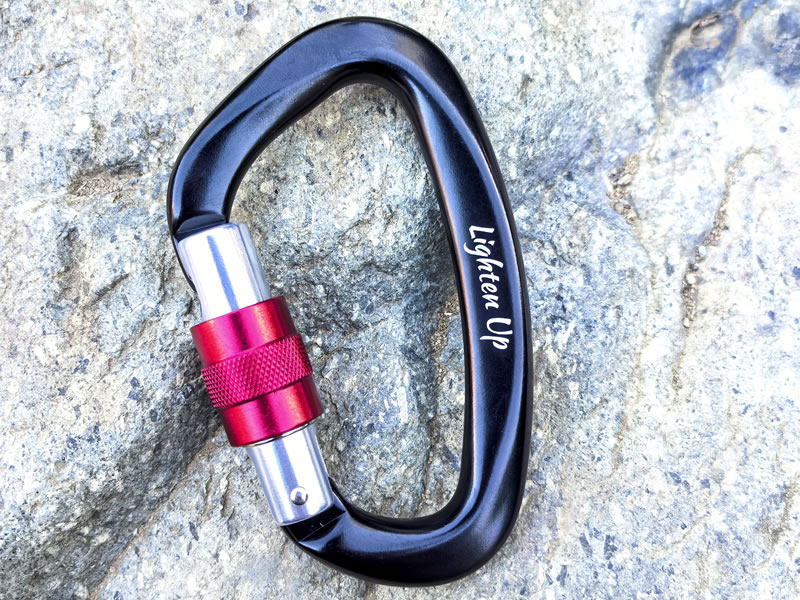
- Gate Side Profile: Some carabiner gates, especially locking models with a screw sleeve, have a bulbous end that can be wider than the spine. This must also clear the chain link's opening.
- Overall Shape: Long, oval, or pear-shaped (HMS) carabiners often have a slender, rounded profile that is easier to thread through a chain link than a short, stocky D-shape.
Critical Safety and Functional Considerations
Even with a perfect fit, these factors are paramount:
- Point Loading and Wear: The hard, sharp edges of a chain link can create point loads on the softer aluminum of a climbing carabiner, causing excessive wear, grooving, and potential weakening over time. For permanent or frequent use with steel chain, a steel carabiner is often a better choice for material compatibility, despite the weight penalty.
- Cross-Loading Risk: Once threaded, ensure the chain link sits properly in the carabiner's basket (the curve of the spine). If the connection allows the chain to press against the gate, the carabiner is cross-loaded and can fail at a fraction of its rated strength.
- Strength Rating (kN or WLL): Once you've found a carabiner that fits, you must verify its load rating is suitable for your application. Remember, the system's strength is now limited by the weaker component—the chain or the carabiner.
Practical Selection and Alternatives
- Best Carabiner Types for This Task:Steel Screwgate Ovals: Their symmetrical shape and robust steel construction resist abrasion from the chain. The screwgate ensures security.Long-Axis Aluminum Ovals or HMS Carabiners: Their elongated, rounded profile facilitates threading.
- The Superior Alternative: The Quick Link (Screw Link):Often, the best tool for this job is not a carabiner at all, but a quick link. This is a solid, screw-together oval link made of steel.Advantages: It can be unscrewed, threaded through the chain link, and re-closed, creating a perfectly fitted, semi-permanent connection with no gate to cross-load. It is typically stronger, more abrasion-resistant, and often has a stated Working Load Limit (WLL).Sizing: Quick links are sized by their inside length and width. Choose one whose body diameter easily fits through your chain link.
Step-by-Step Selection Process
- Measure: Precisely determine the chain link's Internal Diameter (I.D.).
- Profile Match: Identify carabiners (or quick links) whose maximum thickness is 2-3mm less than the I.D. Consult manufacturer spec sheets for "spine thickness" or "major axis width."
- Material Match: For heavy or abrasive use with steel chain, prefer steel connectors.
- Security Check: Ensure the connector has a locking mechanism (screwgate for carabiners, threaded collar for quick links).
- Load Check: Verify the rated load of your chosen connector exceeds your maximum expected load with a significant safety margin.
Conclusion: Precision Over Force
Finding a carabiner that fits through a specific chain link is an exercise in mechanical compatibility. It requires moving beyond casual selection to precise measurement and an understanding of how materials and shapes interact under load. While a suitable locking carabiner can work, never overlook the quick link as a potentially simpler, stronger, and more reliable solution.
By prioritizing the correct physical dimensions and material pairing, you ensure the connection is not just possible, but also safe, durable, and fit-for-purpose. Never force a fit; if the carabiner binds, it is the wrong tool. The integrity of your entire system depends on this clearanced connection being both smooth and secure.




