




Carabiner with a Stainless Steel Spring: The Unseen Component of Long-Term Reliability
In the evaluation of a carabiner, attention naturally focuses on the spine's kN rating, the gate's locking mechanism, and the overall material—aluminum or steel. Yet, a critical component often overlooked is the spring, the small, coiled heart of the gate's action. A carabiner equipped with a stainless steel spring represents a significant investment in long-term durability and consistent performance, especially in environments where corrosion is a silent killer of gear.
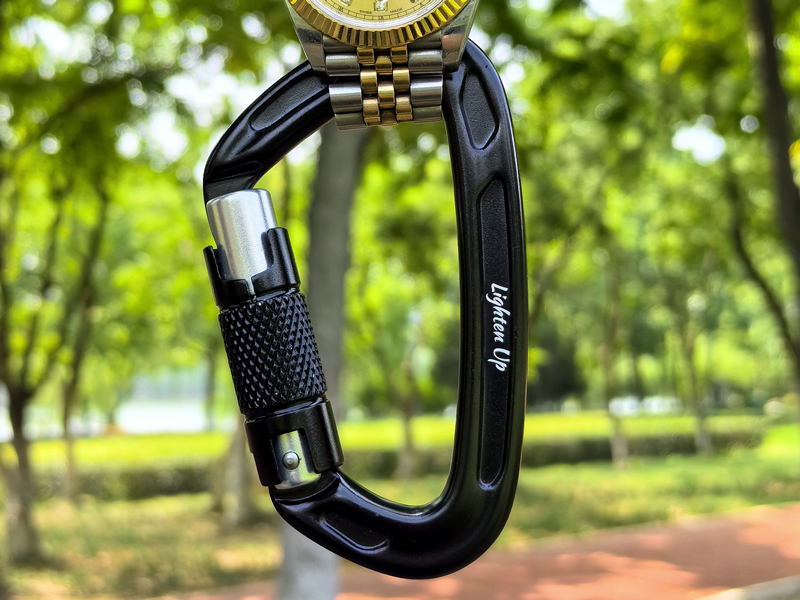
The Role of the Spring: More Than Just a "Click"
The spring is not merely responsible for the satisfying snap of the gate; it is a fundamental safety component. Its core functions are:
- Positive Gate Closure: It provides the constant tension that keeps the gate firmly seated against the nose, preventing accidental snagging and opening.
- Consistent Action: It ensures the gate operates smoothly and predictably throughout the carabiner's lifespan, whether in freezing cold or sweltering heat.
- Fatigue Resistance: It must withstand millions of open-close cycles without losing its elastic properties (a failure known as "spring fatigue").
Why Material Matters: The Corrosion Problem
Most standard carabiners use high-carbon steel or music wire springs. These are strong and cost-effective but have a critical vulnerability: they are susceptible to corrosion (rust). This corrosion can occur from:
- Environmental Moisture: Rain, humidity, and persistent dampness.
- Salt Exposure: Ocean spray, salty sweat, or coastal environments.
- Chemical Exposure: Certain cleaning agents or industrial atmospheres.
When a standard steel spring rusts, two primary failures occur:
- Loss of Tension: Rust degrades the spring's material, causing it to weaken and lose its ability to keep the gate firmly closed. This results in a "mushy" or loose gate that can open too easily.
- Galvanic Corrosion: In an aluminum carabiner, a corroding steel spring in contact with aluminum can set up a galvanic cell, accelerating corrosion of the aluminum housing around the spring pin—a hidden and potentially catastrophic point of failure.
The Stainless Steel Advantage: Engineered Immunity
A stainless steel spring (typically made from 300-series austenitic stainless, like Type 316) is specifically chosen for its passive layer of chromium oxide. This layer makes it highly resistant to corrosion from moisture, salt, and a wide range of chemicals. The benefits are direct and measurable:
- Predictable Performance in Humid/Wet Environments: For canyoneers, sea cliff climbers, sailors, and rescue teams operating near water, the gate action remains reliable season after season.
- Elimination of Internal Rust: The spring chamber and pivot point remain clean and functional. There is no rust debris to gum up the mechanism.
- Long-Term Consistency: The spring retains its designed tension and elastic properties over a vastly extended service life, independent of climate.
- Synergy with Marine-Grade Designs: On titanium or stainless steel carabiners designed for marine use, a stainless spring is a non-negotiable part of a fully corrosion-proof system.
Identifying and Selecting a Carabiner with a Stainless Spring
This feature is rarely a flashy marketing point on the carabiner itself. It is a mark of refined engineering found in higher-tier models. To identify them:
- Consult Manufacturer Specifications: Reputable brands like DMM, Petzl (in specific models like the 'Am’D Ball Lock'), and certain industrial lines explicitly list "stainless steel spring" or "corrosion-resistant spring" in their technical datasheets.
- Look for "Marine" or "Coastal" Models: Carabiners marketed for these environments almost invariably include stainless springs.
- Recognize the Brand Philosophy: Companies renowned for meticulous engineering and durability often use stainless springs as standard in their flagship products.
A Note on Context and Necessity
For the average climber who stores gear indoors and uses it in predominantly dry climates, a standard spring may last for decades without issue. Regular drying and light lubrication can mitigate much of the corrosion risk. The stainless steel spring is therefore not an absolute necessity for all, but rather a critical enhancement for:
- Professionals and frequent users who demand maximum gear longevity.
- Anyone operating in persistently wet, tropical, or coastal environments.
- Users who may not be perfect in their gear maintenance routines.
- Applications where the carabiner is part of a semi-permanent installation.
Conclusion: The Hallmark of Holistic Engineering
Choosing a carabiner with a stainless steel spring is a decision that prioritizes long-term functional integrity over initial cost. It reflects an understanding that true durability encompasses every component, down to the smallest pin and spring.
While the kN rating on the spine assures you of its ultimate strength, the stainless spring quietly assures you of its enduring reliability. It is a feature that speaks to a manufacturer's commitment to building gear for a lifetime of service, not just a season of use. In the meticulous world of safety-critical equipment, such attention to detail is what separates adequate tools from exceptional ones. For those who venture where moisture is a constant companion, specifying a stainless spring is not just a detail—it is a wise and fundamental specification for preserving the safety and function of your most critical connectors.




