




Best Carabiner for Cold Weather (Material Performance)
Selecting the right carabiner for cold weather—be it ice climbing, alpine mountaineering, or winter rescue—requires moving beyond standard specifications. In frigid environments, material properties change dramatically, and the paramount concerns shift from pure strength to reliability, ice resistance, and retained ductility. The optimal choice is a careful balance of metallurgy and mechanical design.
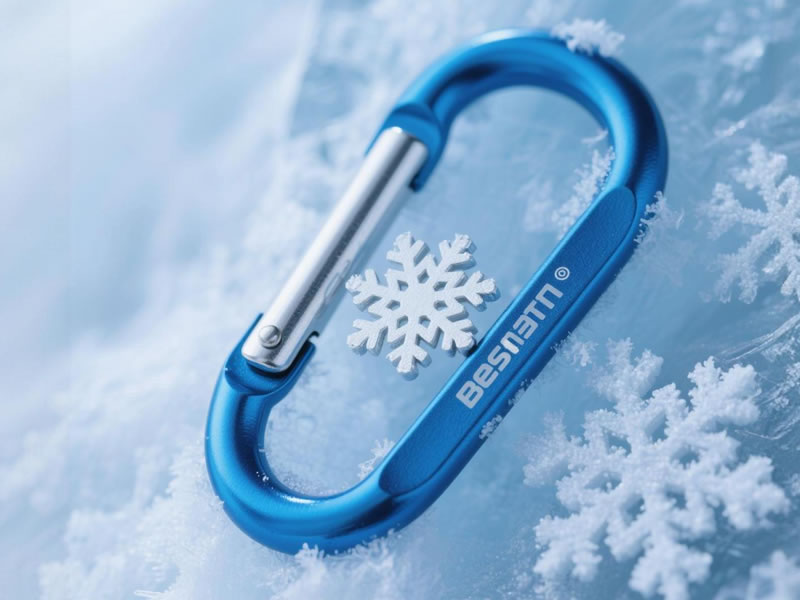
The Core Challenge: How Cold Affects Materials
Extreme cold (below -20°C / -4°F) fundamentally alters material behavior:
- Loss of Ductility: Metals can transition from being ductile (able to deform without breaking) to brittle (prone to sudden fracture). This is measured by a Ductile-to-Brittle Transition Temperature (DBTT).
- Ice Accumulation and Binding: Moisture freezes in mechanisms, locking gates shut or preventing them from closing fully.
- User Dexterity: Thick gloves make operating small components difficult.
Material Showdown: Aluminum Alloy vs. Steel
- Aerospace Aluminum Alloy (7075-T6): The Premier ChoicePerformance: This remains the gold standard for cold-weather climbing carabiners. Its DBTT is exceptionally low, meaning it retains excellent toughness and impact resistance far below temperatures encountered in terrestrial mountaineering.Advantage: It is less thermally conductive than steel, so it feels slightly less cold to the touch and draws less heat from your hands during brief manipulation.Weight: Its superior strength-to-weight ratio is even more critical in demanding alpine scenarios.Verification: Ensure it is from a reputable brand (Petzl, Black Diamond, DMM, etc.) and UIAA/CE certified. The UIAA test includes a mandatory cold-condition inspection.
- Steel: A Niche, High-Strength OptionPerformance: The quality of steel is paramount. High-grade, heat-treated steels (like those used in some ice screws or locking biners) can perform well. However, many generic steels have a higher DBTT and can become unacceptably brittle.Drawback: Steel is an excellent thermal conductor, making it painfully cold to handle. It is also significantly heavier.Use Case: A stainless steel screwgate might be chosen for a critical, infrequently manipulated anchor point where its corrosion resistance and absolute strength are valued, but it is not the best choice for a carabiner that will be handled repeatedly.
Gate Design: The Critical Differentiator
This is often more important than the base metal in freezing conditions.
- Wire Gate: The Cold-Weather SpecialistWhy it Excels: It has a minimal surface area for ice to adhere to and no enclosed spring mechanism to freeze solid. Its simple, open design allows ice to be easily knocked off or flexed free. It is the most reliable design for preventing freeze-ups.Consideration: Ensure it's from a quality manufacturer, as the wire itself must be made from a high-toughness alloy.
- Solid Gate (Especially Locking): The Frost RiskThe Hazard: Traditional solid gates with internal coil springs and locking sleeves (screw or auto) are ice magnets. Water can seep into the spring channel and gate interface, freezing the mechanism completely shut or making it incredibly stiff.If You Must Use One: Modern designs from top brands often incorporate drainage holes and anti-icing features (e.g., Petzl's anti-freeze system on certain models). These are mandatory for cold-weather use. Avoid basic solid gates without these features.
Selection Criteria: Your Cold-Weather Checklist
When choosing your winter carabiner, prioritize in this order:
- Certification & Brand: Start with a UIAA/CE-certified carabiner from a leading mountaineering brand. Their alloys and treatments are proven.
- Gate Type: Prefer a Wire Gate for any carabiner that will be actively clipped and manipulated (e.g., quickdraw ends). Its ice-shedding ability is unparalleled.
- For Locking Carabiners (Belay/Rappel): If a locker is required, seek out models specifically marketed for ice or alpine use. Look for:Anti-Freeze Features: Clear labeling indicating design for cold.Large, Glove-Friendly Locking Sleeve: A screwgate sleeve that can be operated with a heavily gloved hand.Keylock Nose: Reduces snagging with bulky gloves.
- Finish: A smooth, hard-anodized finish (Type III) helps shed frost and ice better than a textured one.
Field Practices: Maximizing Performance
The best gear can still fail without proper practice:
- Pre-Click Inspection: Before a critical clip, visually and manually check that the gate moves freely. Tap the carabiner against your tool or harness to dislodge any ice.
- Storage: Keep carabiners inside your jacket when not in immediate use to prevent them from reaching ambient temperature.
- Avoid Condensation: Do not breathe directly onto carabiners to "warm them up," as this introduces moisture that will instantly freeze.
- Post-Use Care: Dry all gear thoroughly before storing it to prevent internal corrosion.
Conclusion: The Integrated System
The best cold-weather carabiner is not defined by a single attribute but by a system of compatible features: a low-DBTT aluminum alloy for retained toughness, a wire gate design for mechanical ice resistance, and a glove-friendly form factor from a trusted manufacturer.
For the vast majority of winter alpinists and ice climbers, a 7075-T6 aluminum wire-gate carabiner represents the optimal balance of lightweight performance and frozen reliability. Reserve complex locking carabiners only for absolutely necessary stations, and even then, select only purpose-built, anti-freeze models. In the cold, simplicity isn't just elegant—it's safe. Your gear choices should reflect the environment's demand for robust, fault-tolerant systems that perform when temperatures plummet.




