




Accessible Carabiner for One-Handed Operation (Disability-Friendly): Engineering Independence, One Clip at a Time
In a world designed primarily for two-handed dexterity, the simplest daily tasks can present significant barriers for individuals with limited hand mobility, strength, or coordination. Fastening a keyring, securing a bag to a wheelchair, or managing a dog leash often requires a frustrating, sometimes impossible, two-step process. This is where universal design intervenes, transforming everyday objects into tools of empowerment. The accessible carabiner for one-handed operation is a profound example—a meticulously engineered device that moves far beyond a simple clip to become a vital instrument of autonomy and ease. It is not merely a product; it is a commitment to inclusivity, redefining what it means to build functional independence.
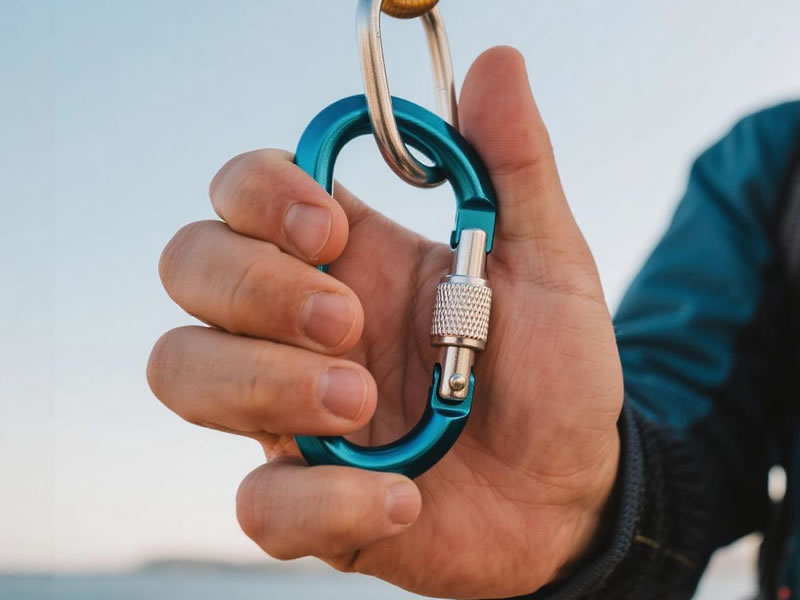
The core philosophy behind a disability-friendly carabiner is to eliminate complexity and physical demand. Traditional carabiners require a user to pinch a small gate lever with one hand while stabilizing the body with the other—an action that assumes precise fine motor skills and bilateral coordination. For someone with hemiplegia, arthritis, neuropathy, or a temporary injury, this can be a prohibitive challenge. The accessible carabiner is engineered from the ground up to circumvent these barriers through intelligent, user-centric design.
Key features distinguish this specialized tool and illustrate its thoughtful engineering:
- Oversized, Ergonomic Gate Mechanism: The most critical element is an enlarged, often textured or ridged, gate lever. This design provides a large, easy-to-find surface area that can be operated with a palm press, the side of a hand, a thumb, or even a finger with limited grip strength. The required actuation force is drastically reduced, prioritizing ease over the extreme tensile strength needed in climbing gear.
- Intuitive Locking Systems: Instead of complex screw-locks or double-action gates, these carabiners employ user-friendly locking methods. Magnetic locking gates are a standout feature, where a simple push opens the gate and a strong magnet seamlessly pulls it closed and securely holds it. This provides clear auditory and tactile feedback (“snap”) and requires no secondary locking step. Alternatively, smooth-action, high-tension spring gates are calibrated for easy opening yet secure closure.
- Strategic Leverage and Geometry: The entire shape is optimized. A wide, rounded “D” or oval shape offers a stable hook that is easy to catch onto a loop or bar. The gate opening is often extra-wide to accommodate thicker attachment points without fiddling. The materials, while durable, are chosen for being lightweight to minimize fatigue.
- Non-Slip and Tactile Components: Many models incorporate rubberized or silicone sleeves on the spine. This not only provides a secure, high-friction grip but also adds a distinct tactile element for users with visual impairments, making the carabiner easy to identify by touch.
The practical applications are vast and life-enhancing. It can transform a set of keys into a manageable, dropproof system that can be easily clipped to a belt loop or bag with one motion. It becomes an essential tool on a wheelchair or walker for securing a purse, shopping bag, or water bottle, keeping essentials within reach without risk of loss. For pet owners, it offers a reliable way to attach a leash without a struggle. In occupational therapy, it serves as an assistive technology (AT) device for building routines around organization and carrying items.
Ultimately, the accessible one-handed carabiner represents a powerful principle: that good design is invisible until it removes a barrier. Its value extends beyond the disability community to benefit parents holding a child, workers with their hands full, or seniors experiencing age-related strength decline. By centering the needs of those facing the greatest physical challenges, it creates a superior, more intuitive product for everyone. Investing in such a tool is an investment in self-reliance, reducing daily friction and restoring a sense of effortless control over one’s environment and belongings. It proves that true innovation lies not in adding complexity, but in engineering elegant simplicity that opens up the world.




