




Can Trekking Poles Help with Balance on Rocky Trails? The Science of Stability on Unstable Ground
Unequivocally, yes. Trekking poles are not merely helpful for balance on rocky trails; they are a transformative tool that fundamentally alters your biomechanics and safety margin in technical terrain. On smooth pavement, their benefit is incremental; on a field of unstable, angular, or slippery rocks, they become indispensable extensions of your own nervous system, actively preventing falls and injuries. The assistance they provide goes beyond simple support—it’s about active stability management.
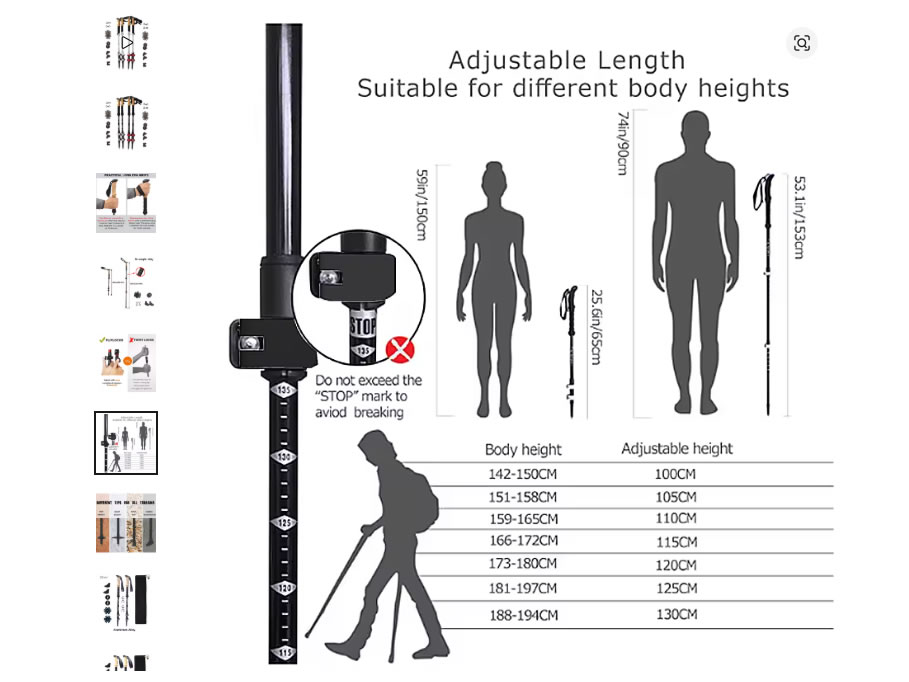
Recommended trekking pole purchase link: https://s.click.aliexpress.com/e/_c4M7OWaN
The Biomechanics of a Wider Base: From Biped to Quadruped
Humans are inherently unstable bipeds. On flat ground, this is efficient. On a shifting surface like a scree field or boulder garden, two points of contact are insufficient for dynamic correction. Trekking poles instantly grant you two additional, controllable points of contact.
With each step, you create a tripod or quadpod stance. When one foot is in the air, the two poles and the other foot form a stable triangle. When both poles are planted with feet stable, you have a solid, four-cornered base. This geometric advantage dramatically lowers your center of gravity and provides multiple leverage points to catch and correct a stumble before it becomes a fall.
Key Mechanisms of Balance Enhancement on Rocks:
- Proactive Stability Testing (The "Tap Test"): Before committing your full weight to a potentially wobbly or slick rock, you can tap it with a pole tip. The feedback through the shaft tells you if the surface is solid, loose, or will shift. This pre-load testing prevents catastrophic ankle rolls and slips that are the leading cause of trail injuries.
- Active Center of Gravity Control: On a narrow line across a rocky section, poles allow for subtle, continuous weight shifts. You can lean slightly away from a drop-off or over a large step, using opposite pole pressure to counterbalance your body mass. This is a dynamic, active process that walking sticks or a single pole cannot replicate.
- Leverage and Power for Negotiation: Rocky trails often require stepping up or down significant heights. Poles provide the critical leverage to push yourself up onto a high step or to lower yourself down with control, taking the explosive strain off your knees and quads. This controlled movement is inherently more stable than a lunge or jump.
- Rhythm and Pacing: A consistent planting rhythm with your poles establishes a predictable, stable cadence. This prevents hesitation and hurried, unstable foot placements. The poles become metronomic guides, allowing you to flow over the terrain with more confidence and less mental fatigue.
Correct Technique for Maximum Benefit on Rocky Terrain:
- Keep Your Hands in Front: On technical descents, plant both poles slightly ahead and to the side of your next foot placement. This creates a secure "handhold" to move your body toward.
- Shorten Your Grip for Precision: In very technical sections, you may choke down on the grips, holding the shaft below the grip for finer, more precise pole placements. This is common in scrambling or on steep, rocky stairs.
- Use a Wider Stance: Don't plant the poles directly in front of your feet. A wider planting angle (pole tips farther out to the sides) creates a more stable, supportive base, especially on side slopes or when traversing.
- Trust the Carbide Tips: The hardened tungsten carbide tips are designed to bite into rock and gravel. Apply firm, confident pressure to engage this bite and prevent the pole from skittering away.
The Mental Advantage: Confidence Equals Stability
Perhaps the most underrated benefit is psychological. Knowing you have two immediate points of corrective contact reduces anxiety and hesitation. This mental confidence leads to smoother, more deliberate footwork. You look ahead at the route, not directly down at your next immediate foothold in fear. This forward vision is itself a critical component of good balance.
Conclusion: An Essential Tool, Not an Accessory
On a smooth forest path, trekking poles are helpful. On a rocky trail, they are a critical safety and performance system. They transform an inherently unstable bipedal posture into a dynamic, stable, four-point contact system. They provide pre-emptive information about the terrain, active control over your center of gravity, and the leverage needed to move with intention rather than reaction.
For anyone venturing onto talus slopes, scree, boulder fields, or wet, rocky riverbeds, a pair of sturdy trekking poles is not just recommended—it is essential gear. They don't just help with balance; they redefine what balance means on unstable ground.




