




Common Mistakes Beginners Make with Hiking Poles?
Hiking poles are powerful tools for efficiency and safety, but their benefits are entirely contingent on correct use. Many beginners, eager to reap the rewards, unwittingly fall into predictable traps that turn these aids into cumbersome liabilities. Recognizing and correcting these common errors is the fastest path to transforming your poles from clumsy sticks into essential gear.
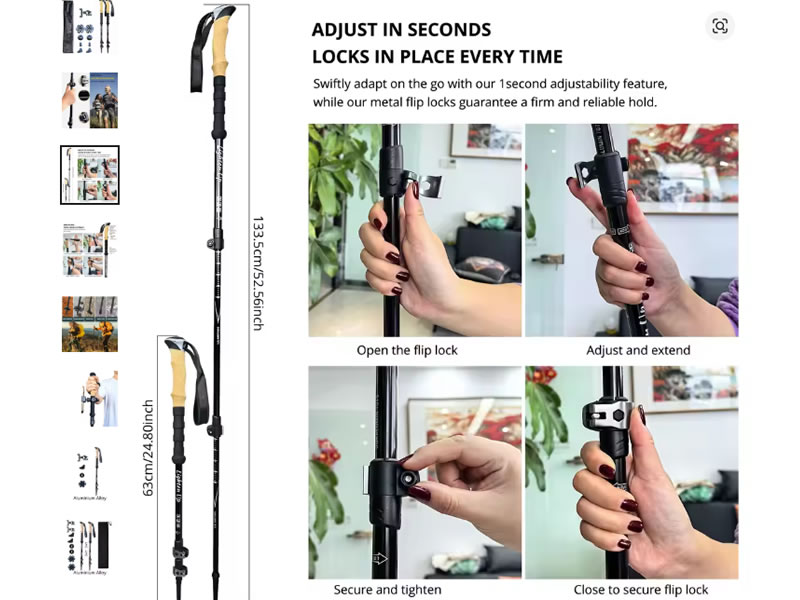
Recommended trekking pole purchase link: https://s.click.aliexpress.com/e/_c4M7OWaN
1. The Death Grip and Improper Strap Use
The Mistake: Clutching the handle in a white-knuckled fist with the wrist strap dangling unused or threaded incorrectly (typically from the top down).
The Consequence: This quickly fatigues the forearm muscles, reduces circulation, and prevents efficient power transfer. The pole becomes an object to be carried, not a lever to be used.
The Fix: Always insert your hand upwards through the strap from the bottom, then rest the strap across the back of your palm before gripping. Push down through the strap with a relaxed grip, allowing your skeleton to bear the load.
2. Incorrect Length Adjustment
The Mistake: Using the same pole length for all terrain—often set too long.
The Consequence: On flat ground, poles that are too long cause awkward, inefficient elbow angles and shoulder hunching. On climbs, they force an overreach; on descents, they prevent proper forward placement for braking.
The Fix: Use the 90-degree rule as a baseline: on level ground, your elbow should form a right angle with your forearm parallel to the floor. Shorten poles for uphill, lengthen them for downhill. Dynamic adjustment is non-negotiable for proper technique.
3. Poor Planting Rhythm and Placement
The Mistake: "Tapping" the poles randomly beside the feet, planting them too close to the body, or failing to synchronize with the opposite leg.
The Consequence: This provides minimal stability or propulsion, wasting the kinetic potential. Planting too close offers no forward or braking assistance.
The Fix: Adopt the natural opposite arm/leg rhythm (right pole plants with left foot). Plant the pole tip firmly at a point that would be level with your opposite foot’s mid-step, creating a effective lever arm to push against or brake with.
4. Using Poles as Crutches or Leaning Excessively
The Mistake: Placing excessive weight on the poles with arms fully extended, often while leaning back on descents or hunching forward on climbs.
The Consequence: This strains shoulder and wrist joints, compromises core engagement, and can lead to pole failure or slippage on unstable surfaces. It defeats the goal of balanced, upright posture.
The Fix: Poles are for balance and power transfer, not full weight support. Maintain a slight bend in the elbow even at the bottom of the stroke. Keep your torso centered over your feet.
5. Neglecting Terrain-Specific Techniques
The Mistake: Using the same swinging motion on technical rocky terrain, scree, or stream crossings.
The Consequence: On rocks, a careless plant can cause the pole to slip or jam, potentially leading to a fall. In streams, a deep plant can get stuck in current.
The Fix: On unstable ground, use a shorter, quicker, and more probing plant, testing stability before committing weight. In water or deep mud, plant at a shallower angle and be prepared to release your grip quickly if it gets caught.
6. Improper Carrying and Storage
The Mistake: Letting poles dangle from wrist straps during scrambling sections, or attaching them loosely to a backpack where they can snag or fall.
The Consequence: Dangling poles are a major tripping hazard and can get caught on vegetation. Poorly secured poles can be lost or damage other gear.
The Fix: In technical sections, collapse and stow poles properly. When attaching to a pack, use designated loops and compression straps, ensuring tips are covered and grips are secured to prevent swinging.
7. Over-Reliance and Ignoring Basic Footwork
The Mistake: Assuming poles eliminate the need for careful foot placement and balance.
The Consequence: This leads to preventable slips and falls. Poles are supplemental; your legs and judgment are primary.
The Fix:Look at your feet and choose solid footing first. Use poles to enhance stability for that good footing, not to compensate for a bad step.
Conclusion: From Hindrance to Help
The journey from novice to proficient pole user is paved with awareness. These common mistakes often stem from viewing poles as simple stability crutches rather than the sophisticated, dynamic extensions of the body they are designed to be. By focusing on foundational skills—proper strap engagement, rhythmic planting, and active length adjustment—you unlock their true potential: a significant reduction in full-body fatigue, enhanced joint protection, and a more confident, powerful connection to the trail. Begin by correcting one error at a time, and soon your poles will feel less like equipment and more like a natural part of your stride.




