




Hiking Poles for Balance on Uneven Terrain?
For anyone who has ever navigated a rocky descent, crossed a slippery stream, or picked their way across a scree field, the challenge is universal: maintaining balance. On uneven terrain, your two-legged stance becomes a precarious proposition. This is where hiking poles transition from optional accessories to essential safety equipment. They are not just for propulsion or saving your knees; their primary and most immediate benefit is dramatically enhancing stability and balance, effectively giving you two extra points of contact with the ground. This guide explores why and how poles are indispensable for navigating rough ground and how to choose and use them effectively.
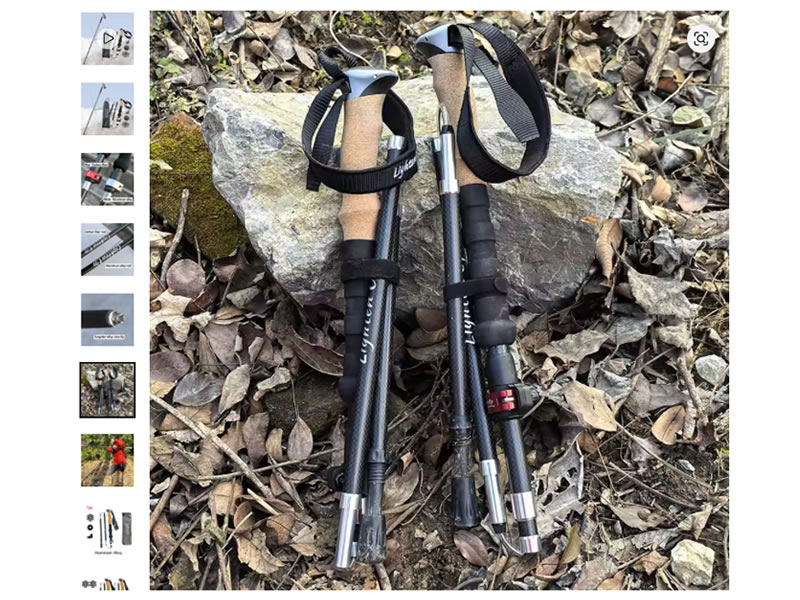
Recommended trekking pole purchase link: https://s.click.aliexpress.com/e/_c4M7OWaN
The Science of Stability: From Two Legs to Four Points of Contact
Your body's natural balancing act relies on a complex system of proprioception (knowing where your limbs are in space), vision, and quick muscular adjustments. Uneven terrain disrupts this system by providing an unstable platform and forcing rapid, unexpected corrections.
Hiking poles intervene in this process by:
- Increasing Your Base of Support: By planting a pole ahead or to the side, you instantly widen your effective base. This is a fundamental principle of stability—think of a tripod being vastly more stable than a bipod.
- Providing Proactive Input: Instead of just reacting to a slip or stumble, you can proactively plant a pole to test the stability of an upcoming rock or muddy patch.
- Reducing Load on Legs: With each step on a descent, a significant portion of your weight can be transferred through your arms to the poles, reducing the shearing and impact forces on your knees and ankles, which are already working hard to stabilize you.
Key Features of Poles for Optimal Balance
Not all poles are equally effective for balance on technical terrain. Prioritize these features:
- Adjustability is Non-Negotiable: To function as proper extensions of your arms, poles must be the correct length for the slope. On flat ground, your elbow should be at a 90-degree angle. On descents, lengthen them by 5-10cm to keep your torso upright and allow you to reach for stable placements ahead without bending over. On ascents, shorten them slightly for efficient pushing. Three-section poles with external flip locks are ideal for this on-the-fly adjustment.
- Secure and Reliable Locking Mechanism: The worst time for a pole to collapse is when you're leaning on it for balance on a steep step. External lever locks (flip locks) are superior to twist locks for reliability, ease of adjustment with cold or muddy hands, and visible confirmation they are locked. Models like the Black Diamond Trail Pro with its FlickLock Pro system are benchmark examples.
- Durable and Responsive Shaft Material: You need confidence that the pole will hold.7075 Aluminum: Offers the best blend of durability, predictable flex, and cost. It can take a side impact against a rock without catastrophic failure (it will bend before it snaps).High-Quality Carbon Fiber: Provides excellent vibration dampening, which reduces fatigue in your hands and arms over long, rocky sections. It is lighter but requires more care to avoid sharp side impacts.
- The Right Tip for the Task: The standard carbide/tungsten tip is crucial for biting into dirt, rock, and ice, providing the secure anchor you need. In softer terrain like deep mud or sand, a larger trekking basket can prevent the pole from sinking too deeply, maintaining its utility.
Technique: The Art of Poling for Balance
Owning great poles is only half the battle; using them correctly is key.
- The Rhythmic Plant: Develop a natural, opposite-arm-to-leg rhythm. As your right foot steps forward, your left pole plants slightly ahead and to the side. This creates a continuous, stable triangle of support.
- Use the Straps Correctly: Insert your hand up through the strap from below, then let the strap cradle across your palm before gripping. This allows you to transfer weight through your wrist and skeleton, enabling you to momentarily relax your grip without losing the pole.
- Double Planting for Extreme Terrain: In very steep, loose, or technical sections (like a boulder field or a steep, gravelly descent), plant both poles simultaneously for maximum stability before taking your next step. This "four-wheel-drive" mode is incredibly secure.
- Probing and Testing: Use a pole to probe the depth of a water crossing, test the firmness of a muddy section, or check if a rock is loose before committing your weight to it.
Top Pole Recommendations for Technical, Uneven Terrain
- Black Diamond Trail Pro 3: The industry standard for reliable performance. Its durable aluminum construction and foolproof FlickLock system inspire total confidence when you need to lean hard on a pole.
- Komperdell Powerlock Alpine: Built for alpine and off-trail use, these poles are incredibly robust, with a secure locking mechanism and often feature an angled grip for a more natural wrist position on steep side-hills.
- LEKI Micro Vario Carbon: For those who want the vibration-dampening and weight savings of carbon fiber without sacrificing security. LEKI's SpeedLock 2 system is one of the most reliable in the industry.
Conclusion: An Investment in Confidence and Safety
On smooth, flat paths, you can debate the necessity of poles. On truly uneven terrain—the kind filled with roots, rocks, streams, and exposure—that debate ends. Hiking poles are a transformative tool for balance. They prevent falls, reduce fatigue, and provide the psychological confidence to tackle sections of trail that might otherwise be intimidating or unsafe.
By choosing adjustable, reliable poles and practicing proper technique, you equip yourself not just with gear, but with a fundamental skill for safer and more enjoyable exploration of the wild, unpredictable, and beautifully uneven places we love to hike.




