




How to Use Hiking Poles for Navigating Scree and Loose Rock?
Scree slopes, talus fields, and trails of loose rock represent some of the most physically demanding and potentially hazardous terrain for a hiker. Each step is uncertain, and stability is fleeting. In these environments, trekking poles transition from helpful aids to essential safety equipment. Their proper use can prevent falls, conserve energy, and reduce the strain of constant micro-adjustments. Mastering a few key techniques will transform your poles into vital tools for conquering unstable ground.
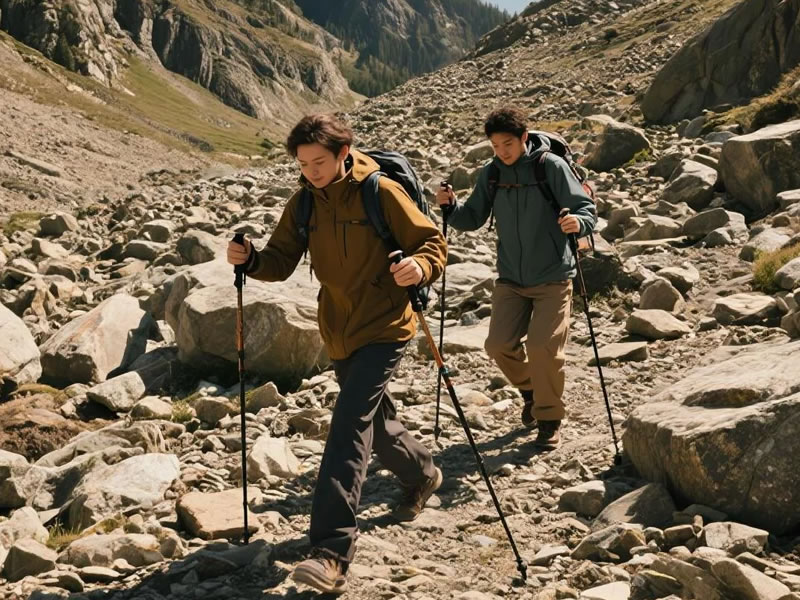
Recommended trekking pole purchase link: https://s.click.aliexpress.com/e/_c4M7OWaN
The Core Challenge: Instability and Fatigue
Scree—the shifting blanket of small, broken rock fragments—and larger loose rock (talus) present two main problems:
- Unstable Footing: The surface gives way under weight, causing slips and slides.
- Constant Muscle Tension: Your legs and core are perpetually engaged to maintain balance, leading to rapid fatigue.
Poles directly combat these issues by providing probes for testing, anchors for stability, and a means to redistribute weight.
Essential Techniques for Scree and Loose Rock
1. The Double-Plant & Triangular Stability Method
This is the fundamental technique for steep or treacherous sections.
- Action: Before taking a step, plant both poles securely downhill or to your side (forming a wide base). Apply downward pressure to set them, ideally finding purchase on a more stable rock beneath the loose surface.
- Purpose: This creates a stable, three-point triangle (two poles + two feet as one unit) from which you can then move one foot. You always have at least three points of solid contact.
2. Probing and Testing
Use your poles as sensory extensions.
- Action: Before committing your weight to a foot placement, gently tap or probe the spot with a pole tip. Listen and feel for a hollow sound or shifting rock that indicates instability.
- Purpose: Identifies hidden holes, unstable rocks, or deep scree before your foot sinks or slips, preventing twisted ankles or falls.
3. Weight Distribution and Uphill/Descent Strategy
- On Ascents: Shorten your poles slightly. Focus on using them for balance and forward propulsion. Plant the pole behind you and push forward, helping to drive your weight upward off your back foot.
- On Descents (Critical): Lengthen your poles significantly. This allows you to keep your torso more upright and your center of gravity back. Plant the poles ahead and below you, then lower your body down to meet them. They act as brakes and stabilizers, absorbing impact and preventing a forward tumble. Never "run" down scree relying solely on poles.
4. The "Third and Fourth Leg" Mentality
On very steep, loose terrain, move one limb at a time with deliberate slowness: right pole, left foot, left pole, right foot. This methodical pace maximizes stability.
Pole Setup and Gear Considerations for Scree
- Pole Length: As noted, adjust dynamically. For descents, err on the longer side to keep you upright.
- Sharp, Durable Tips: Ensure your tungsten carbide tips are sharp and in good condition. They need to bite into hard rock that may lie beneath the loose surface. Worn, smooth tips will skid.
- Baskets: Remove small trekking baskets. On scree, they can catch on rocks and are unnecessary. In deep, soft scree, some prefer a small basket to prevent the pole from plunging in too far.
- Locking Mechanisms: Check that all flip locks are fully secure. A collapsing pole on a steep scree slope is extremely dangerous. Lever locks (like Black Diamond's FlickLock) are generally more reliable in gritty conditions than twist locks.
What to Avoid: Common Mistakes
- Leaning Too Heavily on a Single Pole: If that pole slips or the rock beneath it gives way, you will fall. Use poles for balance and partial weight, not full support.
- Planting the Pole Too Far Away: This pulls you off your center of balance. Poles should be planted naturally within your arm's reach.
- Gripping Too Tightly: Maintain a relaxed grip using the wrist straps correctly to avoid hand and forearm fatigue.
- Rushing: Speed is the enemy of stability on loose rock. Deliberate, planned movements are safer and often faster overall.
Advanced Tip: The "Scree Glissade"
On long, uniform scree slopes, some experienced hikers use a controlled slide or "glissade." In this case, poles are used behind the body as rudders and brakes, not for forward planting. This is an advanced technique requiring practice and appropriate conditions (clear run-out, no large rocks).
Final Verdict: Confidence Through Technique
Navigating scree and loose rock is as much a mental challenge as a physical one. Your hiking poles are the key tools to manage both. By employing the double-plant for stability, using poles as probes, and adjusting length for descent control, you transform loose, intimidating terrain into a manageable, even enjoyable, puzzle.
Remember: on unstable ground, slow is smooth, and smooth is fast. With practiced pole technique, you can move across loose rock with confidence, preserving energy for the miles ahead and drastically reducing your risk of a punishing fall.




