




Best Method to Use Hiking Poles When Wearing a Heavy Backpack?
Carrying a heavy backpack fundamentally changes your center of gravity, balance, and the stress placed on your joints. In this scenario, trekking poles evolve from helpful accessories into critical, load-bearing tools. Using them correctly is essential for safety, efficiency, and preventing injury. The best method combines precise adjustments, proper biomechanics, and strategic techniques to transform your poles into extensions of your skeletal system, sharing the burden of your pack.
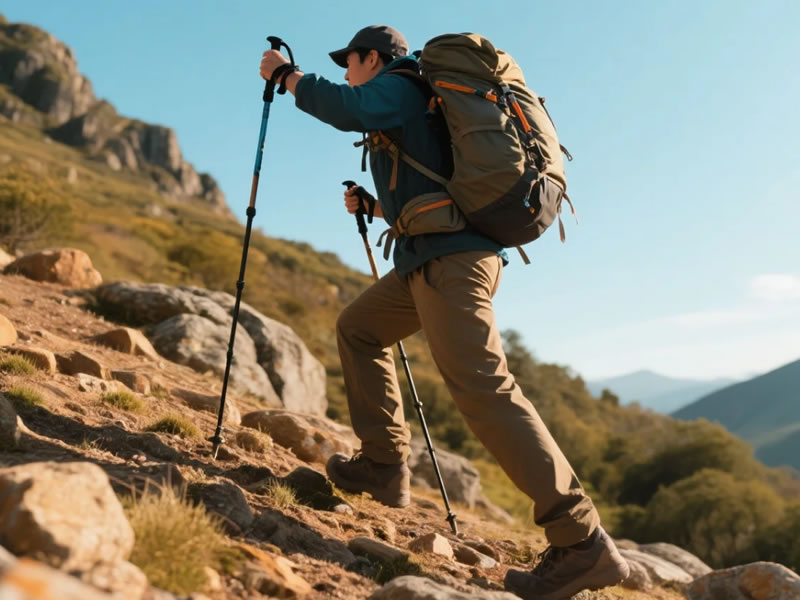
Recommended trekking pole purchase link: https://s.click.aliexpress.com/e/_c4M7OWaN
Core Principle: The Poles Become Load-Bearing Extensions
With a heavy pack, your poles are no longer just for light balance. They must be trusted to support a significant portion of your weight during steep descents, tricky steps, and fatigue. This demands both correct gear setup and disciplined technique.
Step 1: Foundational Adjustments & Setup
- Pole Length is Dynamic: Your standard flat-ground length (elbow at 90°) is just the starting point.For Uphills: Shorten your poles by 5-10 cm (2-4 inches). This prevents overreaching and allows for a powerful, efficient push-off that engages your core and legs, helping to drive the weight of your pack upward.For Downhills (Most Critical): Lengthen your poles by 5-15 cm (2-6 inches). This is paramount. It allows you to keep your torso more upright, preventing you from being pitched forward by the pack. The extended poles reach the ground ahead of you, creating a braking effect and allowing you to transfer up to 25% of your body and pack weight through your arms, sparing your knees and quadriceps.
- Master the Wrist Straps: This is non-negotiable for heavy loads.Technique: Insert your hand from the bottom of the strap and let it cradle the back of your wrist. Grip the handle lightly over the strap. This allows you to transfer weight through your skeleton (from your hand, through the strap, to your wrist and arm) rather than relying on grip strength alone.Benefit: It drastically reduces hand and forearm fatigue, enables more powerful poling, and provides security—you can open your hand without dropping the pole.
- Secure Your Backpack: Before relying on poles, ensure your backpack is properly fitted. The hip belt should carry 80-90% of the weight, snugly on your hip bones. A stable, well-balanced pack is the foundation that allows your poles to work effectively.
Step 2: The Walking Technique Under Load
- Rhythm and Planting: Maintain a natural, opposite arm/leg rhythm (right pole forward with left foot). With a heavy pack, focus on a slightly more deliberate and powerful rearward push. Plant the pole firmly and push your body past it, using the momentum to propel the weight you’re carrying.
- Posture: Resist the urge to hunch forward. Look ahead, not at your feet. The poles, when correctly lengthened for descent, will help you maintain a safe, upright torso position.
- Stance: Adopt a slightly wider stance for better lateral stability under the burden of the pack.
Step 3: Advanced Techniques for Challenging Terrain
- Steep, Loose Descents: Use the "Double Plant" technique. Plant both poles securely ahead and below you, then carefully step down to meet them. This creates a stable, three-point anchor (two poles + two feet as one unit) before you move your weight.
- Sidehilling: On traverses, adjust the poles to different lengths—the uphill pole shorter, the downhill pole longer—to maintain a level posture and prevent ankle roll.
- Stream Crossings: Lengthen poles for deeper water. Plant them upstream and brace against the current, using them to feel for solid footing before committing your weighted body.
What to Avoid: Common Mistakes with Heavy Packs
- Using Poles That Are Too Short: This forces you into a forward hunch, exacerbating back strain and removing the mechanical advantage for descents.
- Death Gripping the Handles: This causes rapid fatigue. Trust the straps.
- Neglecting to Adjust Length: Using one length for all terrain wastes energy and increases injury risk.
- Relying on Faulty Locks: Ensure your lever locks (preferred for heavy use) are fully engaged. A collapsing pole under a heavy load is dangerous.
The Verdict: A Synergistic System
The best method for using hiking poles with a heavy backpack is to view your body, pack, and poles as a single integrated load-management system.
- The hip belt transfers pack weight to your powerful leg muscles.
- The poles, dynamically adjusted, transfer impactful and stabilizing forces to your upper body.
- Your technique synchronizes the system for efficient, safe movement.
By lengthening poles for descents, using straps correctly, and employing a powerful, rhythmic push, you actively use your poles to bear weight, not just touch the ground. This transforms your hike, reducing debilitating knee pain, preventing falls from fatigue-induced instability, and allowing you to travel farther and more comfortably with a heavy load. In essence, you are not just carrying a backpack with poles; you are using four-wheel drive for your body.




