




How to Cross a Log Bridge Safely Using Hiking Poles?
A log bridge—whether a placed backcountry feature or a natural tree fall across a stream—presents a unique challenge: a narrow, often slippery, and unstable surface with consequences for a misstep. In this scenario, your hiking poles are not just helpful; they are critical safety tools for maintaining balance and preventing a fall. The key to crossing safely lies in a deliberate technique that prioritizes stability over speed, using your poles to create a stable, multi-point anchor system off the log itself.
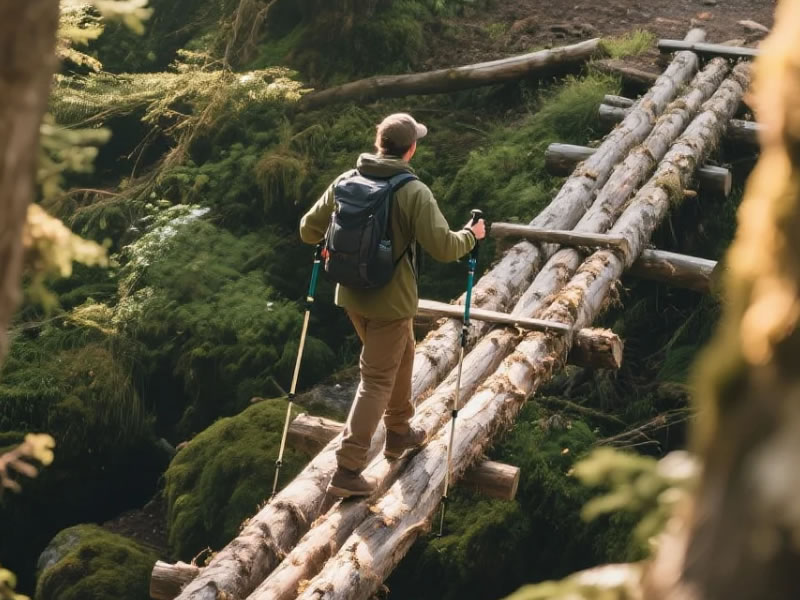
Recommended trekking pole purchase link: https://s.click.aliexpress.com/e/_c4M7OWaN
Phase 1: Preparation and Assessment (Before Stepping On)
- Scout the Crossing: Don't rush. Examine the log's condition. Is it wet, mossy, barkless, or rotting? Is it wide and flat or narrow and round? Identify the most stable, textured section for your feet.
- Secure Your Gear: Ensure your backpack's hip belt and sternum strap are unbuckled. In a fall, you need to be able to shed your pack quickly to avoid being trapped underwater.
- Adjust Your Poles: Shorten them slightly (2-3 inches/5-8 cm from your flat-ground length). This provides better control and a more upright posture on the elevated, narrow surface. Ensure all locks are fully secured.
Phase 2: The Crossing Technique
The core principle is to maintain three points of solid contact at all times and to use your poles as anchors on stable ground, not on the log.
- The Initial Anchor:Stand beside the log at your chosen starting point.Plant both poles firmly on the stable ground on the downstream side (if crossing water) or the side offering the most support. They should be planted wide for a solid base, angled slightly away from the log.
- The Mount and Stance:Place your first foot securely on the log. Use a sideways or diagonal foot placement for better stability on round logs, distributing weight across your foot.Keep your center of gravity low by slightly bending your knees. Look forward at your exit point, not down at your feet, to maintain balance.
- The Crossing Sequence (The "Three-Point Shuffle"):This is a methodical, slow process:Step 1: Move one pole forward and plant it securely on the stable ground or bank ahead of you. You now have three contacts: two feet (one on log, one on ground) and one pole ahead.Step 2: Carefully move your trailing foot onto the log, next to or past your lead foot, using a shuffling motion. Avoid crossing your feet. You now have two feet on the log and one pole ahead.Step 3: Move your rear pole forward to become the new leading anchor. Re-establish your three-point stance.Repeat this slow, deliberate shuffle: Pole, Feet, Pole.
- Pole Philosophy: Why Not on the Log?Never rely on a pole planted on the log. On a wet, mossy, or rounded surface, the pole tip will almost certainly slip, causing a catastrophic loss of balance.Your poles are your stable, external anchors. They should always be seeking solid earth, rocks, or the far bank.
Phase 3: Special Considerations & Hazards
- Wide or Flat Logs: If the log is very wide and stable, you may walk normally, but still use poles on the ground for lateral balance.
- High or Long Bridges: The psychological factor is real. Focus on your next small move, not the drop below. Breathe steadily.
- Crossing in a Group: Only one person on the log at a time. The most experienced person should go first to test stability and spot others if needed.
- If You Start to Fall: Try to fall toward the log to grab it, or push away to avoid striking it. Let go of your poles to use your hands.
Equipment Check
- Tips: Sharp carbide tips are best for biting into dirt or rock on the banks.
- Baskets: Small trekking baskets are fine; large snow baskets can get in the way.
- Straps: Consider slipping your hands out of the straps for this maneuver to avoid entanglement if you drop a pole.
Final Verdict: Deliberate Anchoring Over Speed
Crossing a log bridge safely is an exercise in patience and technique, not bravery. By using your hiking poles to create fixed anchor points on solid ground and moving with a slow, three-point shuffle, you systematically manage your balance and mitigate the primary risk of slipping.
Remember: The log is for your feet. The earth is for your poles. By separating these roles and refusing to rush, you turn a potentially hazardous obstacle into a manageable—and even confidence-building—part of your hike.




