




Hiking Poles with a Built-in Compass or Whistle: Useful or Gimmick?
In the quest to create multi-functional gear, manufacturers have equipped some hiking poles with added features like a built-in compass in the handle or an integrated whistle on the strap. At first glance, these additions promise enhanced safety and convenience. But do they represent genuine innovation that aids the hiker, or are they merely marketing gimmicks that compromise the core function of the pole? A closer examination reveals a clear divide between a potentially life-saving tool and a nearly useless novelty.
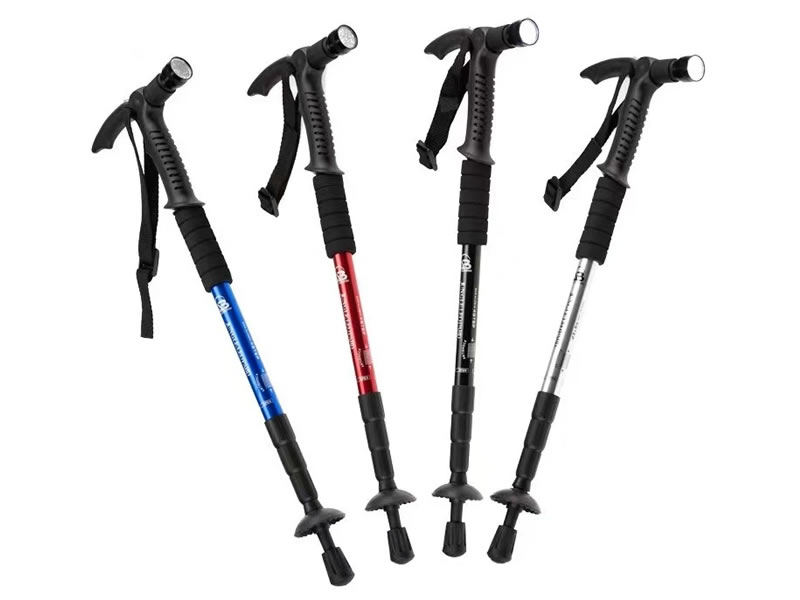
Recommended trekking pole purchase link: https://s.click.aliexpress.com/e/_c4M7OWaN
The Built-in Whistle: A Legitimate Safety Asset
The Case for Usefulness:
The integrated whistle is almost universally a valuable feature. Its benefits are straightforward and align with essential safety principles:
- Always Accessible: In a genuine emergency—a fall, injury, or getting lost—your poles are likely in your hands or attached to your pack. The whistle is immediately available without fumbling through pockets for a separate one.
- Effective and Low-Energy: A whistle's sound carries much farther than the human voice, especially in wind or dense forest. It requires minimal energy to use, which is critical if injured or fatigued. The international distress signal (three sharp blasts) is easily communicated.
- No Significant Drawback: Adding a whistle to the strap buckle or handle cap adds negligible weight or cost and does not interfere with the pole's primary function. It’s a classic example of smart, passive safety design.
Verdict:Useful. It’s a simple, reliable backup that adheres to the hiker's adage of "always carry a whistle." Having one on your pole ensures you likely always will.
The Built-in Compass: A Problematic Gimmick
The Case for It Being a Gimmick:
While the intention might be good, a tiny compass embedded in the top of a pole handle suffers from critical flaws that severely limit its practical utility:
- Accuracy and Calibration Issues: These compasses are almost always inexpensive, fluid-filled "button" or "bubble" compasses. They are notoriously prone to inaccuracy. They can be easily affected by magnetic interference from the metal in the pole itself, your watch, phone, or other gear, giving false readings that could be dangerously misleading.
- Poor Usability: To use it, you must hold the pole perfectly level and still—a challenge in wind or on uneven terrain. You also cannot sight a bearing or align it with a map while it's attached to a pole you're holding. It requires removing the pole from your hand and placing it on a stable surface, negating any claimed convenience.
- The "Wrong Tool" Problem: Serious navigation requires a baseplate compass used with a topographic map. This allows for taking precise bearings, adjusting for declination, and triangulating your position. A tiny pole-top compass cannot perform these functions. It may offer a vague sense of north, but in a survival situation where precise navigation is critical, "vague" is not good enough. Relying on it could instill a false sense of security.
The Potential (But Narrow) Niche:
There is one scenario where it has marginal utility: on a well-defined trail, a quick glance can confirm a general cardinal direction (e.g., "the sun is setting west, and my compass agrees this trail is heading north"). However, even here, a basic wristwatch compass or smartphone is more convenient and likely more accurate.
The Core Principle: The Right Tool for the Job
This debate underscores a fundamental rule of hiking and preparedness: specialized tools almost always outperform integrated multi-tools for critical functions.
- Your primary navigation system should be a dedicated baseplate compass (like a Suunto or Silva) and a map, supplemented by a GPS device or app with offline capabilities.
- Your primary safety gear should include a separate, high-decibel whistle on your person (e.g., on a backpack strap or around your neck), ensuring you have it even if separated from your poles.
What to Prioritize When Choosing Poles
Instead of being swayed by add-ons, focus on the attributes that make a pole functional and reliable:
- Material & Weight: Aluminum for durability, carbon for light weight.
- Locking Mechanism: Secure, mud-resistant flick locks or reliable twist locks.
- Grip Comfort: Cork, foam, or rubber suited to your climate and hand.
- Adjustability & Packed Size.
A well-designed whistle is a welcome bonus; a built-in compass should be ignored in your decision-making process.
Conclusion: A Clear Divide
In summary, the verdict is split:
- The whistle is a useful, low-cost safety enhancement that intelligently leverages the pole's constant presence.
- The compass is largely a gimmick that fails under the demands of real-world navigation and risks compromising safety if relied upon.
When selecting your next pair of hiking poles, welcome the whistle as a thoughtful extra, but view the built-in compass with skepticism. Your navigation—and ultimately your safety—deserves dedicated, reliable tools, not an afterthought embedded in your gear. Invest in a quality pole for its support and stability, and carry a real compass for finding your way.




