




How to Use Hiking Poles Correctly
Mastering the use of hiking poles transforms them from awkward accessories into powerful extensions of your body, offering unparalleled stability, endurance, and joint protection. Correct technique is not instinctive but is easy to learn and vital for reaping the full benefits. Here is your definitive guide to using hiking poles correctly.
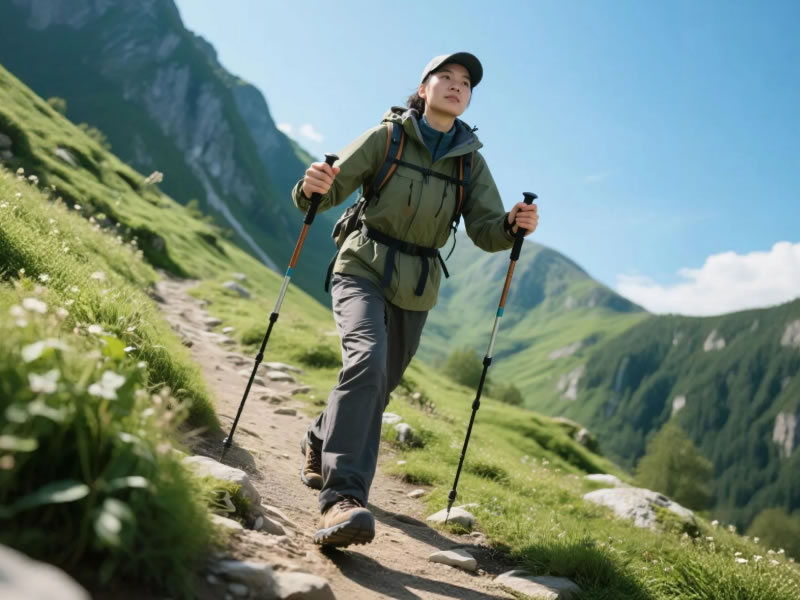
Recommended trekking pole purchase link: https://s.click.aliexpress.com/e/_c4M7OWaN
The Foundation: Grip, Strap, and Posture
- Proper Strap Use (The Most Common Mistake): Do not simply grip the handle. Thread your hand upwards through the bottom of the wrist strap. Then, place your palm over the grip and let the strap cradle the back of your hand. This allows you to transfer weight through your arm bones and the strap itself, enabling a relaxed, open-palm grip that minimizes fatigue and prevents blisters.
- Establishing Correct Posture: Stand tall with relaxed shoulders. Your grip should be firm but not tense. The poles should feel like a natural part of your stride, not an obstacle.
The Core Technique: The Natural Rhythm
The fundamental movement is the opposite arm/leg rhythm. As your right foot steps forward, your left pole swings forward and plants near that foot. As your left foot steps forward, your right pole moves with it. This creates a stable, balanced, and efficient four-point gait that mimics your natural walking pattern. Avoid the "double planting" of both poles at once unless navigating a very steep or technical section requiring extra stability.
Terrain-Specific Techniques
- On Flat & Rolling Terrain: Plant the pole tip beside or slightly behind your corresponding foot. Push back and down as you step through, propelling yourself forward. Keep your elbows close to your body at roughly a 90-degree angle.
- Uphill: Shorten your poles slightly. Plant the tip behind you and use a powerful push to help propel your body upward, engaging your triceps and chest. Lean slightly into the slope. This takes significant load off your quadriceps.
- Downhill: Lengthen your poles. Plant the tip ahead of your body and use it to carefully bear weight before your foot lands. This controls speed, provides crucial stability, and allows your arms to absorb up to 25% of the impact that would otherwise slam into your knees.
- On Steep or Uneven Ground: You may use a "double plant" for maximum security. Place both poles ahead, ensure they are stable, and then step forward between them. This is excellent for descending very steep sections or crossing unstable surfaces.
Advanced Maneuvers & Common Mistakes to Avoid
- Stream Crossings & Loose Terrain: Always keep two points of contact with the ground. Move one pole and one foot at a time. Probe uncertain footing with the pole tip first.
- Do Not Plant Too Far Forward: This reduces leverage and can throw you off balance. The pole should be a support close to your center of gravity, not a reaching tool.
- Avoid a Death Grip: Constant tight gripping leads to forearm fatigue. Trust the strap system to transfer weight.
- Maintain Your Poles: Regularly check that locking mechanisms are tight and tips are in good condition. Worn-out tips can slip dangerously on rock.
Conclusion: Practice Makes Perfect
Using hiking poles correctly is a skill that quickly becomes second nature. Start by practicing the strap technique and opposite-arm rhythm on a flat, easy trail. Focus on a relaxed grip and let the poles do the work. As you gain confidence, experiment with adjustments and techniques for hills.
The payoff is immense: reduced fatigue, protected joints, and the confidence to tackle more challenging terrain. By investing a small amount of time in learning proper technique, you unlock the full potential of your poles, making every hike safer, more efficient, and more enjoyable.




