




Do Hiking Poles Improve Balance? A Scientific and Practical Analysis
The question of whether hiking poles improve balance is one of the most fundamental for new and experienced hikers alike. The answer, supported by biomechanics, anecdotal evidence, and practical experience, is a resounding yes. However, understanding how and why they work reveals that their impact is far more profound than simply providing a steadying hand. They fundamentally alter your body's mechanics, sensory perception, and psychological confidence on unpredictable terrain.
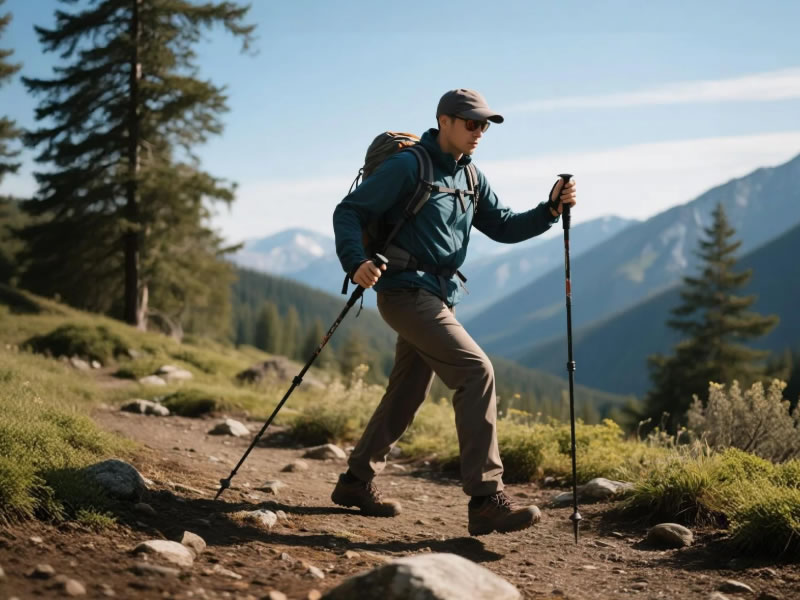
Recommended trekking pole purchase link: https://s.click.aliexpress.com/e/_c4M7OWaN
The Biomechanical Shift: From Bipedal to Quadrupedal Stability
Human locomotion is inherently a series of controlled falls, with balance maintained through constant micro-adjustments on two points of contact. Hiking poles transform this dynamic system.
- Expanded Base of Support: The most immediate effect. With two poles, you create two additional points of contact with the ground. This effectively widens your base of support, moving you from a precarious bipedal stance to a far more stable quadrupedal (four-point) or tripodal (three-point) posture. This geometric advantage is crucial on side slopes, where a downhill pole acts as an outrigger, and on traverses, where it prevents lateral slips.
- Enhanced Proprioception and Sensory Feedback: Your hands are rich with nerve endings. When a pole tip contacts the ground, it sends instant tactile information—vibration, slip, firmness—to your brain before you commit your full weight to your next step. This acts as a sophisticated terrain "probe," allowing your nervous system to pre-adjust muscle tension and foot placement. This advanced warning system is invaluable on loose rock, hidden roots, or unstable stream beds.
- Active Engagement of the Upper Body: Balance is not passive; it requires muscular engagement. Using poles correctly recruits your core, shoulders, back, and arms into a continuous cycle of stabilization. This creates an integrated kinetic chain, where your upper body actively participates in maintaining an upright, centered posture, rather than your legs working in isolation.
The Psychological Dimension: Confidence as a Catalyst
The physical benefit is powerfully augmented by a psychological one: reduced fear of falling. Anxiety on steep or exposed terrain leads to a defensive, hunched posture, shortened strides, and tense muscles—all of which actually decrease balance and efficiency. The mere presence of poles provides a psychological safety net. This increased confidence allows a hiker to stand more upright, take more natural strides, and focus on the trail ahead rather than obsess over the next footfall. Confidence, in turn, enables smoother, more fluid movement, which is intrinsically more stable.
Where the Balance Benefit is Most Critical
The degree of improvement is most dramatic in specific, high-risk scenarios:
- Uneven and Technical Terrain: Navigating talus fields, boulder hops, and root-infested paths becomes a controlled process of testing and weighting, rather than a series of leaps of faith.
- Loose Surfaces (Scree, Gravel, Mud): On descents, poles allow you to "set" anchors to control your slide. On ascents, they provide purchase where feet might spin out.
- Water Crossings: This is the ultimate balance test. Poles provide a stable, three-point contact system in fast-moving water with unseen, slippery bottoms, preventing disastrous falls.
- Fatigue and Low-Light Conditions: When muscles are tired or visibility is poor, reaction times slow and proprioception dulls. Poles become essential external stabilizers, compensating for diminished internal systems.
Maximizing the Benefit: Technique is Key
Simply dragging poles will not confer these advantages. Proper technique is the amplifier:
- Correct Strap Use: Weight should be borne through the wrist strap, not by a tight grip. This allows for efficient force transfer and prevents hand fatigue.
- Rhythmic Planting: The opposite arm/leg rhythm (right pole with left foot) engages the core and promotes a balanced, efficient gait.
- Purposeful Placement: Poles should be actively planted, not trailed. On descents, plant ahead to act as a brake; on side slopes, plant downhill as a brace.
A Nuanced Consideration: Balance vs. Agility
It is worth noting a key distinction: poles enhance stability and preventative balance but can slightly reduce ultimate agility. In situations requiring explosive, rapid changes of direction or highly precise, contorted foot placements (e.g., advanced rock scrambling), unencumbered hands and a lower center of gravity may be preferable. For the vast majority of trail hiking and backpacking, the stability gained overwhelmingly outweighs this minor trade-off.
Conclusion: An Essential Tool for Modern Trail Safety
The evidence is clear: hiking poles are not just for the elderly or infirm; they are a performance and safety tool for any hiker. They improve balance through a powerful combination of biomechanical advantage, enhanced sensory feedback, and psychological confidence. By transforming your relationship with the ground from reactive to proactive, they actively prevent slips and falls, reduce joint impact, and empower hikers to safely explore more challenging environments. In the quest for stability on an unstable trail, they are one of the most effective and accessible tools available. Investing time in learning to use them correctly is an investment in safer, more confident, and more enjoyable miles in the wilderness.




