




Hiking Poles for Trail Running: The Ultimate Efficiency Tool for Steep Terrain
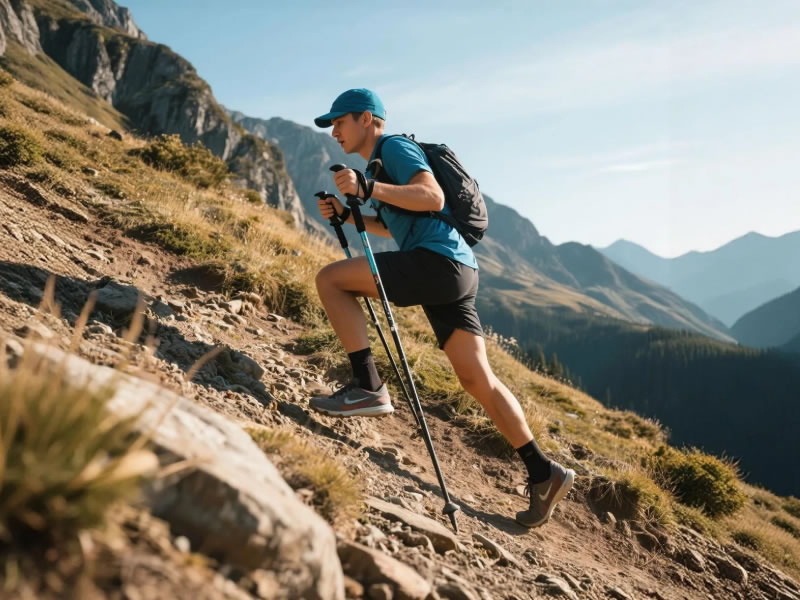
For many, the image of a trail runner is one of unencumbered speed and fluid movement. However, on steep, technical, or ultra-distance terrain, that image is evolving. Hiking poles—or more accurately, trail running poles—have become essential performance gear for a growing number of athletes. They are no longer just for hiking; they are sophisticated tools that enhance power, improve efficiency, and increase safety when running demands meet mountain ascents.
Recommended trekking pole purchase link: https://s.click.aliexpress.com/e/_c4M7OWaN
Why Trail Runners Use Poles: The Performance Advantage
The benefits are tangible, especially in races or training sessions with significant vertical gain.
- Power and Propulsion on Climbs: On steep inclines, running often transitions to power hiking. Poles allow you to engage your upper body—lats, triceps, shoulders, and core—to actively pull and push yourself uphill. This redistributes effort away from fatigued leg muscles, conserving quadriceps strength for later descents and flat sections. Studies suggest they can improve uphill efficiency by up to 20-25%.
- Enhanced Stability and Reduced Impact: Technical descents on tired legs are a prime cause of falls and injuries. Poles provide two additional points of contact, creating a stable tripod for navigating loose rock, scree, and root networks. They also act as brakes and shock absorbers on downhills, reducing the jarring impact on knees and joints.
- Endurance Management in Ultra-Running: In events lasting hours or days, energy conservation is paramount. Poles facilitate a more sustainable pace on long climbs, help maintain better running form when fatigue sets in, and can even provide a psychological boost by changing the muscle groups being utilized.
Critical Design Features: Not Your Average Hiking Poles
Trail running poles are engineered for a different purpose and must meet specific criteria:
- Ultralight Weight: Every gram matters. Carbon fiber is the undisputed material of choice, offering the best strength-to-weight ratio. Swing weight (the feeling of moving the pole) is a crucial factor, and carbon minimizes it.
- Folding (Z-Pole) Design: This is the standard. Poles collapse into three or four compact segments via an internal tension cord, allowing them to fold down to ~35-40cm. They can be quickly stowed in a running vest's quiver or side pocket when not in use, a non-negotiable feature for runnable sections.
- Rapid, One-Handed Adjustment: The ability to change length on the move is critical. The best systems use external levers or speed-adjust triggers that can be operated with one hand while running, allowing quick shortening for climbs and lengthening for descents.
- Ergonomic, Minimalist Grips: Grips are smaller, often contoured, and made of lightweight foam or cork. Many omit bulky wrist straps in favor of simple, lightweight loops, as the aggressive, rapid planting of running requires a different grip technique than hiking.
- Durable, Low-Profile Baskets: Small, rubberized "trail" baskets prevent the tip from sinking into soft ground without catching on roots or rocks.
Mastering the Technique: Running with Poles
Using poles effectively while running requires practice and a modified technique.
- The Plant and Push: The motion is more aggressive and forward-focused than hiking. Plant the pole tip at an angle beside or slightly behind your foot, and execute a brief, powerful push that propels you forward. The grip is often more in the fingers than the full palm.
- Rhythm and Coordination: The classic opposite arm/leg rhythm is key. As your left foot strikes, your right pole plants. This creates a natural, efficient cadence that integrates with your running gait. On very steep climbs, a "double plant" (both poles together) may be used for maximum power.
- Stowing and Deploying Fluidity: Practice transitioning. The goal is to fold and stow poles in under 10 seconds when hitting a flat or downhill section, and to unfold and adjust them just as quickly at the base of the next climb. This fluidity prevents disruption to your run's rhythm.
Choosing Your Poles: A Runner's Checklist
When shopping, prioritize this order:
- Weight & Packability: Can you carry them comfortably for hours? Do they fit securely in your pack?
- Adjustment Speed: Can you change the length easily and reliably mid-stride?
- Feel and Grip: Do they feel like an extension of your arm? Is the grip comfortable for a sweaty, dynamic handhold?
- Durability: While lightweight, can they withstand the inevitable drops and strikes against rocks?
Top brands like LEKI (with its Trigger Shark system), Black Diamond Distance Z, and Salomon S/Lab are industry leaders, offering models specifically refined for running.
Important Considerations and Common Mistakes
- They Are a Skill: Don't expect to use them perfectly on race day without training with them. Practice on varied terrain.
- Not for Every Run: On gentle, non-technical trails, they are unnecessary weight and can disrupt your arm swing. They are a strategic tool for specific terrain.
- Potential Hindrance: On very technical, rocky, or narrow singletrack where quick hand placements are needed for balance, poles can sometimes get in the way. Judgment is required.
Conclusion: A Strategic Power Boost
For the trail runner tackling mountains, vert-heavy ultras, or simply seeking an efficiency edge on long climbs, dedicated running poles are a transformative piece of gear. They are the embodiment of the alpinist's ethos: "going faster by moving more efficiently." By shifting workload to the upper body, enhancing stability, and allowing for active recovery of leg muscles, they enable runners to maintain pace over more demanding terrain with greater control and reduced injury risk. When chosen wisely and practiced diligently, they cease to be an added piece of equipment and become a seamless part of the runner's kinetic chain, powering them toward the summit and beyond.




