




How to Stop Walking Poles from Sinking in Mud? The Complete Guide to Flotation and Traction
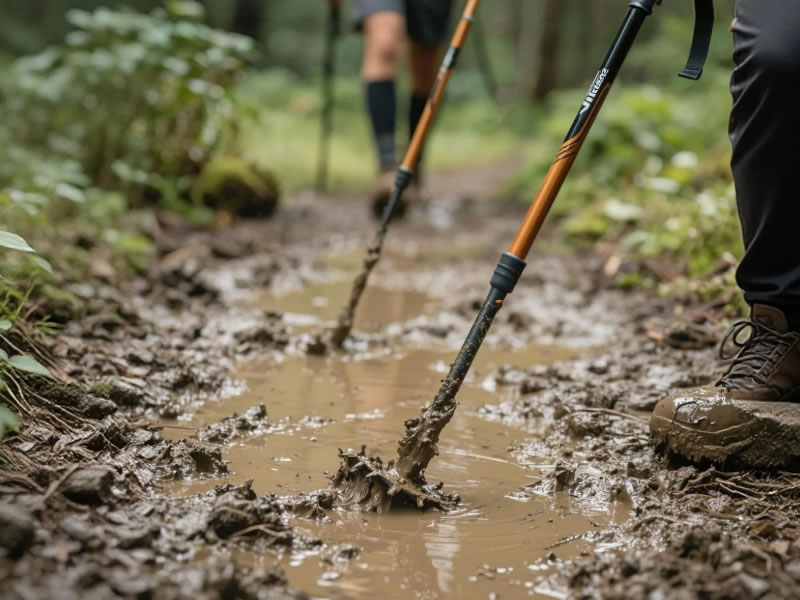
Muddy trails present one of the most frustrating challenges for walkers. With every step, your poles plunge deep into the muck, requiring exhausting effort to extract them and providing little to no support. The problem is not your poles—it's the baskets. This comprehensive guide explains why poles sink, how to prevent it, and what to do when you find yourself slogging through boot‑sucking mud without the right equipment.
Recommended trekking pole purchase link: https://s.click.aliexpress.com/e/_c4M7OWaN
Why Poles Sink: The Physics of Flotation
A walking pole sinks when the downward force applied exceeds the buoyant support provided by the surface. In technical terms, the pole's tip concentrates your weight into a tiny area. Without a basket, that pressure punches through soft surfaces like mud, snow, or sand.
The solution: Increase the surface area at the point of contact. This is precisely what baskets do.
Part I: The Primary Solution – Larger Baskets
The most effective way to prevent sinking is to equip your poles with larger baskets appropriate for the conditions.
Basket Types Compared
| Basket Type | Diameter | Best For | How It Prevents Sinking |
|---|---|---|---|
| Summer / Trekking | 1.5–2 inches | Packed trails, hard ground | Minimal flotation; useless in mud. |
| Mud / All‑Terrain | ~3 inches, often petal‑shaped | Mud, bogs, soft soil | Larger surface area; open design sheds mud. |
| Snow / Winter | 4–5+ inches | Deep snow | Maximum flotation; also works in mud. |
Recommendation: For muddy conditions, mud baskets are ideal. They provide significantly more flotation than summer baskets while being smaller and less cumbersome than snow baskets. Their petal‑shaped design also helps shed sticky mud.
How to Install Mud Baskets
- Remove existing summer baskets by compressing the collar and sliding them off.
- Slide the new basket onto the pole above the tip.
- Push firmly until it snaps into place over the groove.
- Test by pulling gently—it should be secure.
Note: Baskets are not universal. Ensure you purchase baskets compatible with your pole's shaft diameter (typically 16mm or 18mm).
Part II: If You Don't Have Large Baskets – Temporary Solutions
Sometimes you find yourself in mud without the right baskets. These techniques can help.
1. The Twist Plant
As you plant the pole, give it a quarter‑twist. This creates a slightly wider hole, reducing suction and providing a bit more surface area. It won't match a proper basket, but it helps.
2. The Double Plant
Plant both poles simultaneously and move them together. This distributes your weight across two points, reducing sink depth for each. Use this technique for short muddy sections.
3. Quick, Firm Plants
Hesitation allows mud to flow around the tip, increasing sink depth. Plant decisively and quickly—a firm plant often sinks less than a tentative one.
4. Seek Solid Ground
Use your poles to probe for firmer footing. In many muddy areas, there are patches of firmer ground hidden beneath the surface. Let your poles be your scouts.
5. Improvise a Larger Basket
In an emergency, you can create a temporary larger basket:
- Cut a section from a plastic bottle and slide it over the pole above the tip.
- Use a large leaf or piece of bark pressed against the pole.
- Not ideal, but better than nothing.
Part III: Technique Matters – Even with the Right Baskets
Proper planting technique enhances the effectiveness of any basket.
The Mud‑Optimized Plant
- Scout ahead with your pole before committing weight. Find the firmest spot.
- Plant firmly and decisively. A quick plant disturbs less mud.
- Minimize lateral movement after planting. Twisting the pole increases the hole size and suction.
- Lift cleanly when extracting—pull straight up to minimize disturbance.
The Tripod Stance
In deep mud, maintain three points of contact at all times:
- Two poles and one foot planted.
- Move one foot, then reposition poles.
- This distributes weight and prevents over‑reliance on any single point.
Part IV: After the Mud – Essential Cleanup
Mud is abrasive and corrosive. After any muddy hike:
- Rinse poles thoroughly with fresh water. Pay special attention to locking mechanisms and joints.
- Extend sections to clean between them.
- Dry completely before storing.
- Lubricate with dry silicone spray to prevent grit from causing sticking.
Critical: Mud left in twist‑lock mechanisms can cause them to seize permanently. Clean immediately.
Part V: Choosing the Right Poles for Muddy Conditions
If you frequently encounter mud, consider these features when purchasing poles:
| Feature | Why It Helps in Mud |
|---|---|
| External lever locks | Easier to clean; less likely to jam than twist locks. |
| Interchangeable baskets | Allows quick switch to mud baskets. |
| Aluminum construction | More forgiving of impacts with hidden rocks. |
| Carbide tips | Bite through mud to find purchase on subsurface. |
Part VI: What About Snow Baskets in Mud?
Snow baskets (4–5 inches) provide even more flotation than mud baskets and work excellently in deep, soft mud. However:
- They are larger and more cumbersome.
- They may snag on roots or rocks hidden beneath the mud.
- They can be overkill for shallow mud.
Verdict: Snow baskets are a valid option for very deep, boot‑sucking mud, but mud baskets are better all‑rounders.
Part VII: Common Mistakes to Avoid
| Mistake | Consequence | Correction |
|---|---|---|
| Using summer baskets in mud | Poles sink deeply; useless support. | Switch to mud or snow baskets. |
| Hesitant, slow planting | Mud flows around tip; deeper sink. | Plant firmly and decisively. |
| Twisting pole after planting | Enlarges hole; increases suction. | Lift straight up; avoid twisting. |
| Not cleaning after mud | Locks jam; corrosion accelerates. | Rinse and dry thoroughly. |
| Relying on a single pole | More sinking; less stability. | Use double‑plant technique. |
Part VIII: Quick‑Reference – Muddy Trail Tips
| Situation | Action |
|---|---|
| Before the hike | Install mud baskets (∼3 inches) or snow baskets (4–5 inches). |
| During the hike | Plant firmly and quickly; use double‑plant in deep sections. |
| No large baskets | Twist plant; probe for firm ground; double‑plant. |
| After the hike | Rinse thoroughly; dry; lubricate. |
| Permanent solution | Purchase poles with interchangeable baskets. |
Conclusion: Don't Let Mud Stop You
Muddy trails are inevitable for anyone who walks in wet climates, spring conditions, or boggy terrain. With the right equipment and technique, they need not be a misery. The key is understanding that your poles are only as good as their baskets.
- Invest in mud baskets (or snow baskets for extreme conditions).
- Master the firm, quick plant.
- Use double‑plant technique in deep sections.
- Clean meticulously after every muddy hike.
With these strategies, you'll float over mud that once swallowed your poles—and enjoy trails that others avoid.
Happy (muddy) trails!




