




Are There Walking Poles Specifically for Runners? The Complete Guide to Trail Running Poles
The image of a runner is often one of unencumbered speed—light shoes, shorts, and little else. Yet on steep, technical trails, that image shifts. Increasingly, runners—especially trail runners and ultramarathoners—are incorporating poles into their kit. But these are not the walking poles you see on casual hikers. Yes, there are walking poles specifically designed for runners, and they are fundamentally different from standard trekking poles. This comprehensive guide explains what makes running poles unique, why runners use them, and which models dominate the sport.
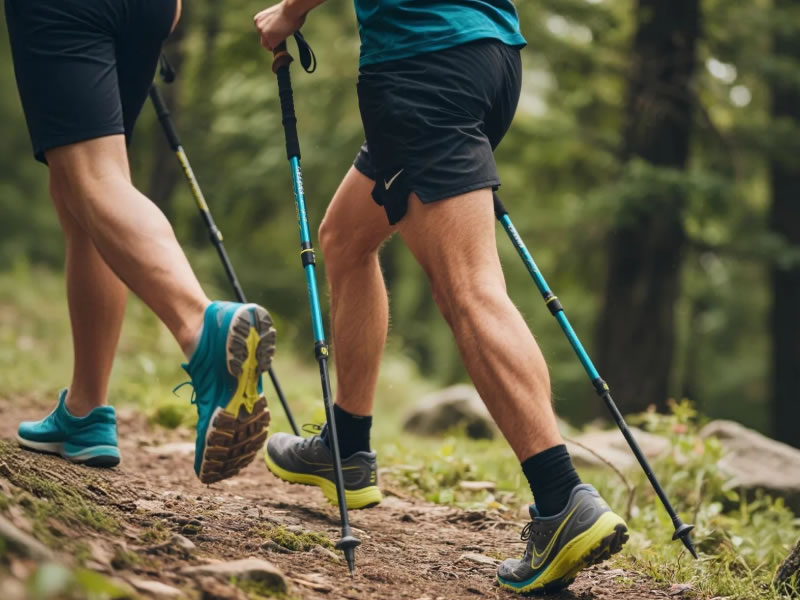
Recommended trekking pole purchase link: https://s.click.aliexpress.com/e/_c4M7OWaN
The Core Difference: Running Poles vs. Hiking Poles
| Feature | Hiking / Trekking Poles | Trail Running Poles |
|---|---|---|
| Primary goal | Stability, load support, joint protection | Speed, efficiency, lightweight performance |
| Weight | Moderate (16–24 oz per pair) | Ultralight (10–14 oz per pair) |
| Material | Aluminum or carbon fiber | Almost exclusively carbon fiber |
| Design | Telescoping (adjustable) or folding | Folding (Z‑pole) for packability |
| Grips | Full-size cork or foam | Minimalist, streamlined |
| Straps | Padded, adjustable | Lightweight, often detachable |
| Adjustability | Continuous (lever locks) | Fixed length or minimal adjustment |
| Packability | Moderate | Collapse to 13–15 inches |
Part I: Why Runners Use Poles
1. Uphill Efficiency
On steep climbs, running becomes power hiking. Poles engage the upper body—arms, shoulders, back, and core—to assist the legs, reducing the workload on quads and calves. Studies suggest this can improve uphill efficiency by 20–25% , allowing runners to maintain pace with less perceived effort.
2. Stability on Technical Terrain
Trail running often involves uneven, rocky, root‑filled terrain. Poles provide two additional points of contact, dramatically improving balance and reducing the risk of falls—especially on tired legs late in a race.
3. Reduced Joint Impact
Downhill running is punishing on knees and quads. Poles act as brakes and shock absorbers, reducing impact and allowing faster, more controlled descents with less muscle damage.
4. Energy Conservation in Ultra‑Distance Events
In races lasting hours or days, energy management is everything. Poles allow runners to rotate muscle groups, giving legs a partial rest while still making forward progress. Many ultrarunners consider poles essential gear.
5. Probing and Stability in Variable Conditions
Poles are used to test snow depth, probe mud, and maintain balance on slippery surfaces—valuable in mountain running where conditions change rapidly.
Part II: Essential Features of Running Poles
1. Ultralight Carbon Fiber Construction
Weight is the single most important factor for runners. Every gram carried is lifted thousands of times during a race.
- Carbon fiber is the only material that delivers the necessary strength at ultralight weights (10–14 oz per pair).
- Swing weight (the feeling of moving the pole) is also critical; carbon fiber minimizes it.
2. Folding (Z‑Pole) Design
Running poles must be packable because they are not used continuously. On flat sections or downhills where poles are unnecessary, they must stow quickly and compactly.
- Folding poles collapse into 3–4 short segments, typically 13–15 inches long.
- They fit easily into a running vest's quiver or side pocket, or can be strapped to a pack.
3. Fixed Length or Minimal Adjustment
Most running poles are fixed length to save weight and complexity. You choose your size based on height and terrain. However, some models offer minimal adjustment (e.g., a small lever lock on the lower section) for fine‑tuning.
4. Minimalist, Ergonomic Grips
- Grips are smaller and streamlined compared to hiking poles, reducing bulk and weight.
- Materials are often lightweight foam or thin cork.
- Straps are minimalist—some runners prefer simple loops or detachable systems (e.g., LEKI's Trigger Shark) for quick release.
5. Secure, Low‑Profile Locks
When poles are extended, they must be rock solid. There is no room for slippage when you're leaning into a steep climb at speed.
- External cam locks (similar to hiking poles but smaller) are used on adjustable models.
- Fixed‑length poles have no locks—simplicity and reliability.
6. Carbide Tips and Interchangeable Baskets
- Carbide tips provide traction on rock and hardpack.
- Small baskets are used to reduce snagging; large baskets are not needed for running.
Part III: Top Recommendations for Running Poles
🥇 Black Diamond Distance Carbon Z – The Ultralight Benchmark
- Type: Fixed‑length folding (Z‑pole)
- Weight: 341g / 12.1 oz per pair – among the lightest available
- Collapsed length: 34 cm / 13.4 in
- Sections: 4
- Grip: Foam (lightweight, comfortable)
- Tips: Interchangeable carbide; rubber tips included
- Best For: Trail runners, ultramarathoners, anyone prioritizing absolute minimum weight and pack size.
Why it wins: The Distance Carbon Z is the pole you see on every ultra start line. It is phenomenally light, disappears into any running vest, and deploys instantly. The fixed length means no adjustments—simply unfold and go. Available in multiple lengths to match your height.
Considerations: No on‑trail adjustability. If you encounter extreme grades, you cannot shorten for climbs or lengthen for descents.
🥈 LEKI Micro Vario Carbon – The Adjustable Perfectionist
- Type: Folding + adjustable (Speed Lock 2 on lower section)
- Weight: 460g / 16.2 oz per pair
- Collapsed length: 38 cm / 15 in
- Sections: 4
- Grip: Cork (superior comfort, moisture‑wicking)
- Tips: Interchangeable carbide; rubber tips included
- Best For: Runners who want packability and the ability to fine‑tune pole length for varied terrain.
Why it excels: The Micro Vario uniquely combines a folding design with a genuinely adjustable lower section. The Speed Lock 2 lever provides continuous adjustment, allowing you to shorten for steep climbs and lengthen for knee‑saving descents. The cork grip is supremely comfortable. It is the only pole that offers true versatility in a running‑optimized format.
Considerations: Heavier and slightly bulkier than the fixed‑length BD Carbon Z, but the adjustability is worth the trade‑off for many.
🥉 Black Diamond Distance FLZ – The Hybrid Choice
- Type: Folding + adjustable (FlickLock on lower section)
- Weight: 397g / 14 oz per pair
- Collapsed length: 38 cm / 15 in
- Sections: 4
- Grip: Foam
- Tips: Interchangeable carbide; rubber tips included
- Best For: Runners who want some adjustability without the full weight of the LEKI.
Why it’s included: The FLZ sits between the fixed‑length Z and the fully adjustable LEKI. It offers a small range of adjustment (about 5 cm) via a FlickLock on the lower section—enough to fine‑tune for different conditions, but not continuous adjustment. It's lighter than the LEKI but heavier than the fixed Z.
Considerations: Limited adjustment range; not as versatile as the LEKI for extreme terrain changes.
🏆 Also Worthy: Cascade Mountain Tech Carbon Fiber Running Poles
Why Consider:
- Budget‑friendly carbon folding poles (under $50).
- Lightweight (∼15 oz per pair).
- Cork grips – surprising at this price.
- Folding design – packs small.
Best For: Runners on a tight budget who want to try running poles without a major investment.
Considerations: Quality control can be inconsistent; not as rigorously tested as premium brands. Heavier than top‑tier options.
Part IV: Technique for Running with Poles
1. The Uphill Drive
- Shorten poles (if adjustable) or use a slightly shorter fixed length for climbs.
- Plant the tip beside or slightly behind your trailing foot.
- Push down and back through the strap, engaging your upper body to propel yourself upward.
- Maintain a quick, light cadence.
2. The Downhill Brake
- Lengthen poles (if adjustable) for descents.
- Plant ahead of your body to create a braking action.
- Transfer weight through the straps to reduce knee impact.
3. Stowing and Deploying
- Practice one‑handed stowage. You should be able to fold and stow a pole while still running with the other.
- Most running vests have dedicated pole quivers—use them.
4. The Double Plant on Steep Sections
- On very steep, technical terrain, plant both poles simultaneously for maximum stability.
Part V: When Not to Use Running Poles
| Situation | Why Not |
|---|---|
| Flat, non‑technical trails | Poles are unnecessary weight; stow them. |
| Very technical, hands‑on scrambling | Poles are a hindrance; stow them. |
| Crowded race starts | Poles can be a hazard to other runners. |
| Short, fast races | The time lost deploying/stowing may outweigh benefits. |
Part VI: Care and Maintenance
- Rinse after muddy or salty runs – grit damages mechanisms.
- Dry thoroughly before storing.
- Check tension cords on folding poles; replace if frayed.
- Inspect tips for wear; replace carbide tips when rounded.
Part VII: Comparison at a Glance
| Model | Type | Weight (pair) | Adjustable | Grip | Price | Best For |
|---|---|---|---|---|---|---|
| Black Diamond Distance Carbon Z | Fixed folding | 341g | No | Foam | $$$ | Ultralight purists, minimalists |
| LEKI Micro Vario Carbon | Adjustable folding | 460g | Yes (continuous) | Cork | $$$ | Runners needing terrain adaptability |
| Black Diamond Distance FLZ | Limited adjust folding | 397g | Yes (5 cm range) | Foam | $$ | Compromise between weight and adjustability |
| Cascade Mountain Tech Carbon | Fixed folding | ∼450g | No | Cork | $ | Budget‑conscious runners |
Conclusion: A Specialized Tool for a Specialized Sport
Yes, there are walking poles specifically for runners—and they are as different from standard hiking poles as racing flats are from hiking boots. Trail running poles prioritize ultralight weight, packability, and efficiency above all else. They are designed to disappear into a vest when not needed and provide a powerful assist when the terrain turns upward.
Black Diamond Distance Carbon Z remains the gold standard for its incredible lightness and simplicity. LEKI Micro Vario Carbon offers invaluable adjustability for those who encounter varied terrain. And Cascade Mountain Tech proves that running poles need not break the bank.
For any runner tackling mountains, ultramarathons, or technical trails, these specialized poles are not a luxury—they are a performance tool that can mean the difference between a strong finish and a DNF.
Choose wisely, practice your technique, and let your poles carry you to new heights.




