




Are Walking Poles Necessary for Via Ferrata? A Complete Guide to Gear Decisions
Via ferrata—Italian for "iron path"—offers a unique mountain experience that combines hiking with protected climbing. Steel cables, iron rungs, and ladders are fixed to rock faces, allowing adventurers to traverse exposed terrain with relative safety. For those preparing for their first via ferrata, a common question arises: are walking poles necessary? The answer requires understanding the distinct phases of a via ferrata day and the specific demands of this hybrid activity.
Recommended trekking pole purchase link: https://s.click.aliexpress.com/e/_c4M7OWaN
The Short Answer
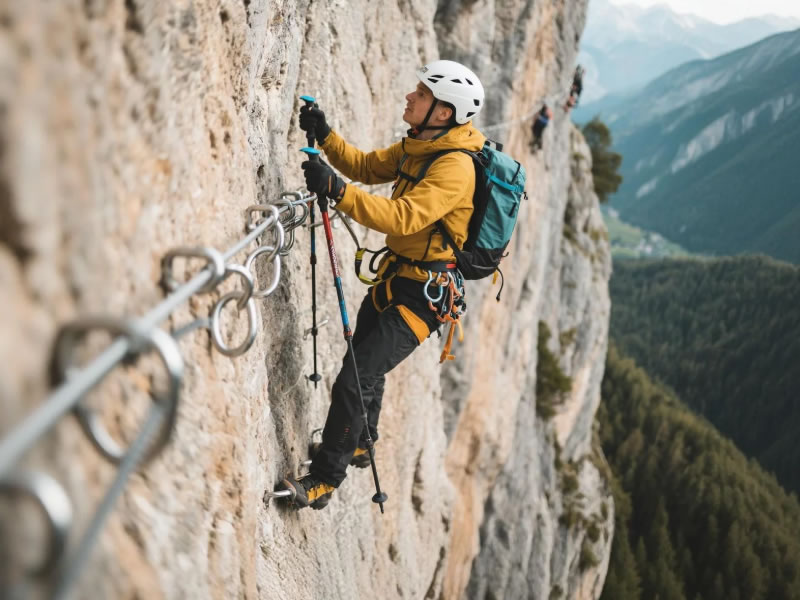
Walking poles are not necessary for the via ferrata route itself, and in fact, they can be impractical and even dangerous during the climbing sections. However, they can be extremely useful for the approaches and descents on trails leading to and from the via ferrata. The key is knowing when to use them and when to stow them away.
Why Poles Are Impractical on the Route
During a via ferrata, both hands are required for safety and progression. You will need to:
- Grip Steel Cables: Maintaining hold on the cables provides stability and security, especially on exposed traverses.
- Clip and Unclip Lanyards: Your via ferrata lanyards (often called "Y-lanyards" or "energy absorbers") must be clipped to the cable at all times. This requires frequent handling with both hands.
- Grasp Rungs and Ladders: Iron rungs, steps, and ladders demand secure handholds—you cannot hold a pole and a rung simultaneously.
- Maintain Three Points of Contact: Standard via ferrata safety practice recommends keeping two hands and one foot, or two feet and one hand, in contact with the rock or cable at all times. Poles interfere with this principle.
Attempting to hold walking poles while navigating a via ferrata creates several problems:
- Reduced Grip Security: You cannot properly grip cables or rungs with a pole in your hand.
- Lanyard Interference: Poles can tangle with your via ferrata lanyards, potentially compromising your safety system.
- Dropped Gear Hazard: Dropping a pole on a via ferrata means watching it bounce down the mountain—retrieval is often impossible.
- Distraction: Managing poles diverts attention from critical safety tasks like proper clipping.
The Role of Poles for Approaches and Descents
Most via ferratas are not accessed directly from the road. They typically involve significant hiking on trails to reach the start of the iron path, and similar hiking to return afterward. These approaches and descents can be steep, rocky, and strenuous. For these sections, walking poles offer genuine benefits:
- Reduced Fatigue: Poles transfer weight from legs to arms, conserving energy for the climbing ahead.
- Improved Stability: On uneven trail terrain, poles provide balance and reduce fall risk—important when you are carrying a via ferrata helmet and harness.
- Knee Protection: Descending steep trails after a via ferrata places heavy impact on knees. Poles absorb some of this force.
- Stream Crossings: Many via ferrata approaches involve crossing streams or wet terrain where poles provide valuable support.
Choosing Poles for Via Ferrata Days
If you decide to bring poles for the approach and descent, select them carefully:
Collapsible Design: Your poles must pack away completely when you reach the via ferrata start. Three-section or four-section poles that collapse to under 40cm are ideal for fitting inside or attaching to your backpack.
Lightweight Construction: You will carry these poles on your back during the climb. Carbon fiber models save significant weight compared to aluminum.
Secure Locking Mechanisms: Poles that collapse accidentally while stowed are annoying; poles that collapse during use on the approach are dangerous.
Compatible with Pack Attachment: Consider how you will carry the poles during the via ferrata. Some packs have dedicated pole attachment points; otherwise, ensure they can be secured to your pack without dangling where they might catch on cables.
Recommended Poles for Via Ferrata Approaches
Black Diamond Distance Carbon Z
These fixed-length, collapsible poles are incredibly lightweight (under 10 ounces per pair) and pack down to a compact size using a simple cord system. They are ideal for stashing in or on a pack during the via ferrata itself. Available in multiple lengths to match your height.
LEKI Micro Vario Carbon
These three-section carbon poles collapse to just 36cm, making them exceptionally packable. The Speed Lock system is reliable, and the overall weight is minimal. They perform well on approaches and disappear into a pack when climbing begins.
Cascade Mountain Tech Carbon Fiber
For a budget-friendly option, these carbon poles collapse to a reasonable length and offer good value. They are lightweight enough for carry and perform adequately on trails. The flick-lock mechanisms are generally reliable.
How to Manage Poles on Via Ferrata Day
Follow this sequence for smooth gear management:
- Approach Hike: Use poles normally, enjoying the stability and reduced fatigue.
- Transition Point: Before reaching the via ferrata start, find a safe spot to stop. Collapse and secure your poles to your pack. Put on your helmet and ensure your via ferrata lanyards are accessible.
- Via Ferrata Climb: Poles remain stowed. Both hands are free for cables, clipping, and climbing.
- Descent Transition: At the via ferrata exit, find another safe spot. Retrieve and extend your poles for the hike down.
- Return Hike: Use poles for stability and knee protection on the descent.
When You Might Skip Poles Altogether
For some via ferratas, poles may be unnecessary:
- Short Approaches: If the via ferrata starts practically from the parking area, poles add little value.
- Extremely Technical Terrain: Some via ferratas involve scrambling from the very beginning—poles would be useless immediately.
- Guided Groups: If you are with a guide who manages logistics, you may prefer traveling light.
Essential Gear for Via Ferrata
While poles are optional for approaches, these items are non-negotiable:
- Via Ferrata Lanyards (Energy Absorber): Specifically designed for via ferrata use, with shock-absorbing capabilities.
- Climbing Helmet: Protects from falling rocks and impacts during falls.
- Climbing Harness: Must be compatible with via ferrata lanyards.
- Appropriate Footwear: Stiff-soled approach shoes or light hiking boots with good edging capability.
- Gloves: Protect hands from cables and provide better grip.
The Bottom Line
Are walking poles necessary for via ferrata? No—not for the climbing route itself. In fact, using poles during the via ferrata would be unsafe and impractical. However, poles can be valuable tools for the hiking sections that bookend your via ferrata adventure. The ideal approach is to bring collapsible, lightweight poles that pack away completely when you transition to the iron path. This combination gives you the best of both worlds: supported hiking on approaches and descents, with completely free hands for the climbing that matters most. Choose your poles wisely, manage them thoughtfully, and focus your attention where it belongs—on the incredible experience of traveling the iron paths.
Disclaimer: This article provides general information about gear selection. Via ferrata involves significant risks requiring proper training, equipment, and safety protocols. Always climb with appropriate gear and, if inexperienced, hire a qualified guide.




