




3-Section vs 4-Section Folding Poles – Pros and Cons? A Complete Comparison
When choosing folding walking poles, one of the most fundamental decisions is the number of sections. Both 3-section and 4-section designs have passionate advocates, and each offers distinct advantages depending on your priorities. This comprehensive guide compares these two popular configurations to help you choose the right poles for your adventures.
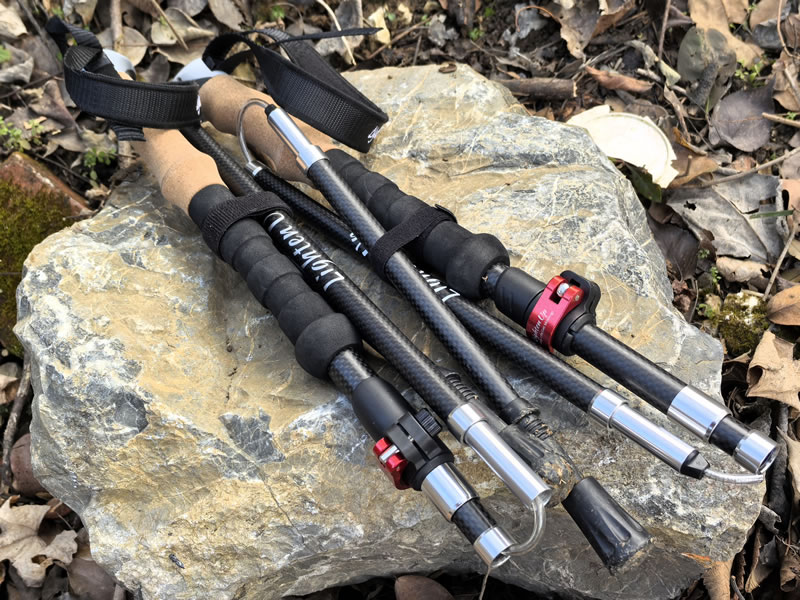
Recommended trekking pole purchase link:https://s.click.aliexpress.com/e/_c4M7OWaN
Understanding the Basics
Both 3-section and 4-section poles are "folding" or "Z-pole" designs that use a cord-and-ferrule system to collapse into compact bundles. The number refers to how many pieces each pole breaks into.
3-Section Poles: Collapse into three pieces, typically packing to 60-70cm (24-28 inches) when folded.
4-Section Poles: Collapse into four pieces, packing significantly smaller at 35-40cm (14-16 inches).
3-Section Poles: Advantages
Greater Stability: Fewer joints mean less flex and more rigidity when planted. The pole acts as a more unified structure, providing confidence on technical terrain and when bearing significant weight.
Lighter Weight: With fewer locking mechanisms and joints, 3-section poles are generally lighter than comparable 4-section models—an important consideration for weight-conscious hikers.
Simpler Mechanism: Fewer moving parts means less that can go wrong. The cord-and-ferrule system has fewer potential failure points.
Better Power Transfer: The more continuous structure transfers energy more efficiently from your arms to the ground, making each plant feel solid and responsive.
Quieter Operation: Fewer joints mean less potential for rattling or clicking during use.
3-Section Poles: Disadvantages
Larger Packed Size: At 60-70cm folded length, these poles may be too long for some luggage, daypacks, or for attaching to smaller packs.
Less Travel-Friendly: The longer folded length makes them more cumbersome for air travel and may exceed some airline carry-on size restrictions.
Limited Adjustment: While many are fixed-length, those with adjustment add weight and complexity.
3-Section Poles: Best For
- Hikers prioritizing performance and stability
- Those who don't need ultra-compact packing
- Backpackers who can attach longer poles to packs
- Technical terrain where rigidity matters
- Hikers who prefer lighter weight over packability
4-Section Poles: Advantages
Ultra-Compact Packed Size: At just 35-40cm folded, these poles fit easily in carry-on luggage, daypacks, and even large purses. This is their defining advantage.
Travel-Friendly: Ideal for air travel, fitting within most airline carry-on size restrictions. Perfect for international adventures.
Versatile Storage: Can be stowed in smaller packs, attached unobtrusively, or even carried in everyday bags for urban use.
Adaptable: Some 4-section designs include limited adjustability, allowing fine-tuning of length despite the folding design.
Great for Mixed Use: Transitions seamlessly from hiking to travel to everyday walking.
4-Section Poles: Disadvantages
Slightly Heavier: The additional joint and locking mechanism add grams. While modern designs minimize this, 4-section poles are typically a bit heavier.
More Flex: Each additional joint introduces a potential flex point. Under heavy load, 4-section poles may feel less rigid than their 3-section counterparts.
Complexity: More sections mean more potential failure points and more parts to maintain.
Higher Cost: Generally, 4-section poles are more expensive due to the additional engineering and components.
Potential for Rattle: More joints can mean more potential for noise over time, though quality designs minimize this.
4-Section Poles: Best For
- Frequent flyers and international travelers
- Hikers with limited pack space
- Day hikers who want poles that disappear into small packs
- Urban hikers transitioning between trails and cities
- Those who prioritize packability above all else
Head-to-Head Comparison
| Feature | 3-Section | 4-Section |
|---|---|---|
| Packed Length | 60-70cm | 35-40cm |
| Weight | Lighter | Slightly heavier |
| Stability | More rigid | Slightly more flex |
| Travel-Friendly | Less | More |
| Cost | Generally lower | Generally higher |
| Complexity | Simpler | More complex |
| Adjustment Options | Limited | Some models offer adjustment |
Top Recommendations by Category
Best 3-Section Folding Poles:
- Black Diamond Distance Carbon Z: Ultralight gold standard, fixed length, exceptional performance
- LEKI Micro Vario Carbon: 3-section with limited adjustment, premium quality
- Cascade Mountain Tech Carbon Fiber: Budget-friendly 3-section option
Best 4-Section Folding Poles:
- LEKI Micro Vario Carbon (4-section): Premium 4-section with adjustment, exceptional packability
- Black Diamond Distance FLZ: Hybrid with flick-lock for fine adjustment
- Cascade Mountain Tech 4-Section: Affordable entry to ultra-compact packing
Hybrid Options: Best of Both Worlds?
Some manufacturers offer innovative designs that blur the lines:
Black Diamond Distance FLZ: A 3-section folding pole with an additional flick-lock adjustment section. Offers the packability of 3-section with length adjustability. Effectively a hybrid.
LEKI Micro Vario Series: Available in both 3 and 4-section versions, both with Speed Lock adjustment for fine-tuning length.
These hybrids offer the packability of folding poles with the adjustability of traditional telescoping poles—a compelling compromise.
Making the Right Choice
Choose 3-Section Poles If:
- Hiking performance is your top priority
- You don't need ultra-compact packing
- You're willing to manage longer poles on travel days
- Weight matters more than packability
- You hike primarily on technical terrain
Choose 4-Section Poles If:
- You travel frequently by air
- Pack space is limited
- You want poles that disappear into daypacks
- You do mixed urban and trail hiking
- Packability trumps marginal weight savings
Consider Hybrid Options If:
- You want both packability and adjustability
- You're willing to carry slightly more weight for versatility
- Your needs vary across different adventures
The Bottom Line
The choice between 3-section and 4-section folding poles ultimately comes down to your priorities. If hiking performance, weight savings, and rigidity matter most, 3-section poles are the clear winner. If packability, travel convenience, and storage versatility are paramount, 4-section poles deliver unmatched compactness.
Both designs have proven themselves on trails worldwide. Quality brands like Black Diamond, LEKI, and Komperdell offer excellent options in both configurations, ensuring that whichever you choose, you're getting reliable performance.
Consider your typical adventures honestly. Do you fly to hiking destinations? Do you have limited pack space? Do you prioritize the lightest possible gear? Answer these questions, and the right choice becomes clear.
Whichever you choose, you'll be equipped with folding poles that collapse for convenience and extend for adventure—ready for whatever trails await.
Disclaimer: This article provides general information about gear selection. Individual needs and preferences vary; the "best" pole is the one that works for your specific hiking style and priorities.




