




Trekking Pole Convertible grips for different hand positions?
Terrain rarely stays the same for long. One moment you are on a gentle incline, the next you are traversing a steep sidehill or descending a rocky slope. Each of these scenarios benefits from a different hand position on your trekking pole. Standard fixed grips force you to adapt your body to the pole; convertible grips allow you to adapt the pole to your body. This deep dive explores the world of convertible grip systems—from extended grips to adjustable-angle designs—and examines whether they are a worthwhile investment for your hiking style.
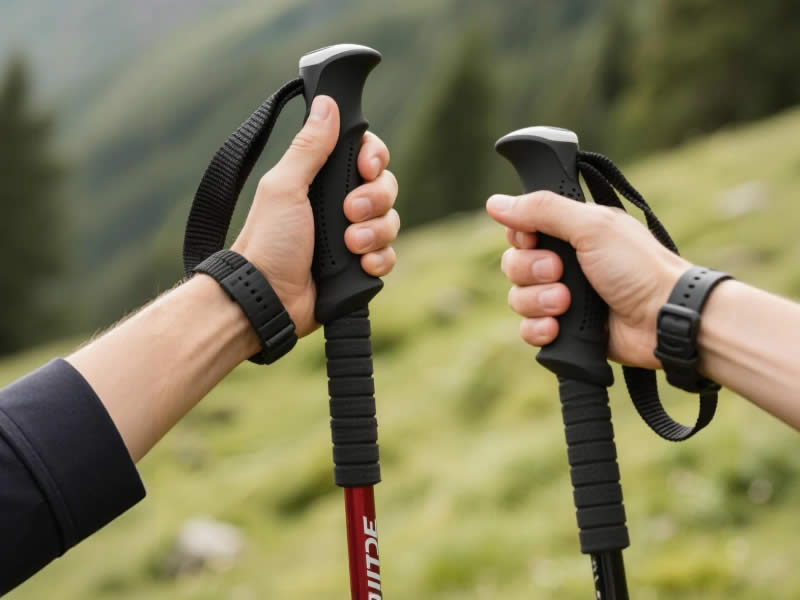
Recommended trekking pole purchase link: https://s.click.aliexpress.com/e/_c4M7OWaN
What Are Convertible Grips?
Convertible grips are trekking pole handle systems designed to accommodate multiple hand positions or angles. Unlike standard grips that offer a single, fixed interface, convertible grips give you options:
- Vertical position changes: Gripping higher or lower on the pole
- Angular changes: Tilting the grip forward or backward to maintain wrist neutrality
- Terrain-specific configurations: Adjusting the grip angle for ascents, descents, or traverses
The goal is simple: reduce fatigue, improve control, and maintain ergonomic efficiency across varied terrain.
Extended Grips: The Most Common Convertible Feature
The simplest and most widely available convertible grip feature is the extended grip—a secondary gripping surface below the main handle.
Design:
A foam or rubber extension—typically 4 to 8 inches long—extends down the shaft from the main grip. This section is often made of softer, insulating material and may be textured for grip.
How it works:
When you encounter a steep traverse or sidehill, you can “choke down” on the extension, lowering your hand position. This allows you to shorten the effective pole length without adjusting the locks, keeping your wrist in a neutral position while maintaining plant efficiency.
Benefits:
- Quick terrain adaptation without stopping to adjust telescoping sections
- Reduced wrist strain on traverses
- Warmth (foam extensions insulate better than bare metal or carbon)
- No moving parts to break
Limitations:
- Provides only vertical adjustment, not angular
- Adds minimal weight (typically 0.5–1 ounce per pole)
- May not suit hikers with very small or very large hands
Availability: Extended grips are common on mid-range to premium poles from brands like Black Diamond (Trail Ergo series), Leki (with their “Extended Grip” models), and REI.
Adjustable-Angle Grips: The Ergonomic Upgrade
A more sophisticated convertible system allows the grip angle to change relative to the shaft. These are less common but offer significant ergonomic benefits for technical terrain.
Design:
The grip attaches to the shaft via a pivot mechanism, often with a locking lever. The user can tilt the grip forward (for ascents) or backward (for descents) and lock it at the desired angle. Some designs offer preset positions; others allow infinite adjustment within a range.
How it works:
- Ascents: Tilting the grip forward aligns your wrist with the uphill plant, reducing strain on the extensor muscles.
- Descents: Tilting the grip backward (or keeping it neutral) provides better leverage for braking and stability.
- Flat terrain: Return to neutral for efficient walking.
Benefits:
- Maintains neutral wrist position across all terrain types
- Reduces fatigue on long, steep days
- Particularly beneficial for hikers with wrist issues or arthritis
- Can improve pole plant precision on technical terrain
Limitations:
- Adds weight and complexity (pivot mechanism)
- Moving parts can wear or fail over time
- More expensive than fixed-grip poles
- Adjustment requires stopping (unlike extended grips)
Availability: Adjustable-angle grips are niche. Leki has offered models with adjustable-angle grips in their premium lineup. Other manufacturers occasionally release such systems, but they remain specialty products rather than mainstream.
Hybrid Approaches
Some brands combine extended grips with ergonomic shaping to offer convertible functionality without moving parts. For example:
- Anatomic grips with forward rake: The grip itself is angled, providing a neutral wrist position for general walking. The extended lower grip allows choking down for traverses.
- Modular grip systems: Grips that can be swapped or repositioned along the shaft (rare in consumer poles).
Real-World Benefit Assessment
| Terrain Type | Standard Grip | Extended Grip | Adjustable-Angle Grip |
|---|---|---|---|
| Gentle flat/mild hills | Adequate | Adequate | Adequate |
| Steep ascents | Wrist strain | Minor improvement | Significant improvement |
| Steep descents | Wrist strain | Minor improvement | Significant improvement |
| Sidehill traverses | Poor | Excellent | Excellent |
| Technical scrambling | Poor | Good | Very good |
Who Benefits Most?
Extended grips are worthwhile for:
- Hikers who frequently traverse steep sidehills
- Those who prefer not to adjust pole length frequently
- Anyone looking for a simple, durable convertible feature
Adjustable-angle grips are worthwhile for:
- Hikers with wrist or elbow issues
- Those tackling sustained steep terrain (mountaineering, alpine hiking)
- Hikers who prioritize ergonomics over simplicity
- Technical terrain specialists
The Verdict
Convertible grips—whether extended grips or adjustable-angle systems—offer genuine benefits for hikers who encounter varied terrain. Extended grips provide a simple, durable, lightweight solution for the most common hand-position challenge: sidehill traverses. Adjustable-angle grips offer more comprehensive ergonomic benefits but add weight, complexity, and cost.
For most hikers, extended grips deliver the best balance of functionality and practicality. They require no learning curve, add negligible weight, and provide immediate benefit on traverses and steep terrain. Adjustable-angle grips remain a niche solution for those with specific ergonomic needs or those tackling extreme terrain.
Your hands should work with the terrain, not against it. Choose a grip system that gives you options.




