




Trekking poles Rolling tips for Nordic walking – do they work?
Nordic walking is distinct from traditional trekking. Born from summer training for cross-country skiers, it emphasizes a powerful push-off, full-body engagement, and a smooth, gliding motion. Standard trekking pole tips—whether carbide or rubber—are designed for planting and lifting, not for the continuous contact and rolling action that defines proper Nordic walking technique. Enter rolling tips (also called Nordic walking tips or articulated tips). But do they actually work, or are they a niche accessory with limited real-world benefit? This deep dive examines the technology, performance, and value of rolling tips for Nordic walking.
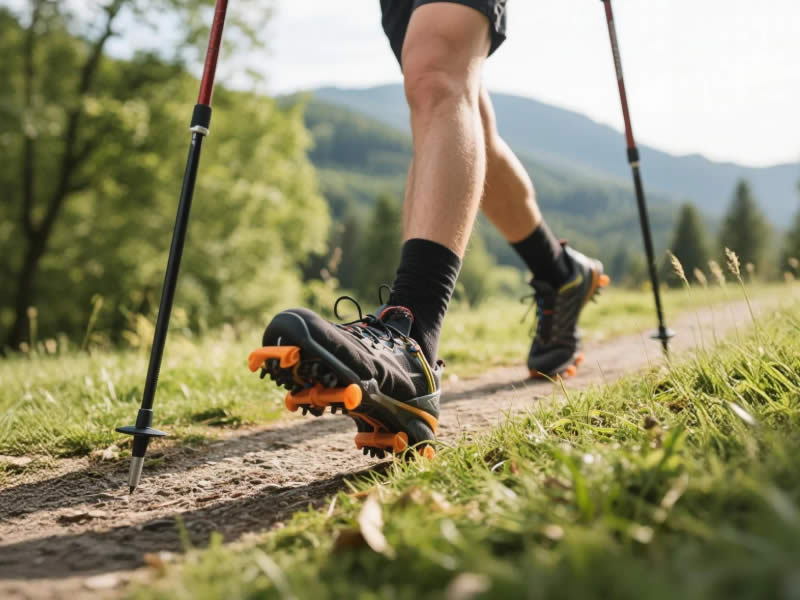
Recommended trekking pole purchase link: https://s.click.aliexpress.com/e/_c4M7OWaN
What Are Rolling Tips?
Rolling tips are specialized attachments for walking poles designed specifically for Nordic walking on hard surfaces. Unlike standard rubber boots (which simply slip over carbide tips), rolling tips feature an articulated or pivoting mechanism—typically a ball-and-socket joint or a flexible rubber hinge—that allows the tip to maintain flat contact with the ground throughout the entire stride.
Key components:
- Carbide or steel core: Embedded in the tip for durability and grip
- Rubber or composite body: Provides traction and absorbs shock
- Pivoting joint: Allows the tip to tilt forward and backward, staying flush with the pavement
How They Work
In traditional trekking, the pole is planted, pushed off, and lifted—a series of discrete impacts. In Nordic walking, the pole remains in contact with the ground longer, rolling from the heel of the tip to the toe as you push back. Standard fixed tips cannot do this effectively; they strike, pivot awkwardly, and lift off, disrupting the smooth transfer of power.
Rolling tips solve this by articulating. As you plant the pole ahead of your body, the tip tilts back to meet the ground flat. As you push through the stride, the tip pivots forward, maintaining full contact until the final release. The result is a fluid, continuous motion that mirrors the poling action of cross-country skiing.
Do They Actually Work?
Yes—for their intended purpose. Users consistently report:
- Smoother technique: The rolling action encourages proper Nordic walking form, reducing the temptation to “stomp” the poles.
- Reduced impact: The pivot absorbs shock that would otherwise transmit through fixed tips into wrists and shoulders.
- Better power transfer: Continuous contact allows you to push through the full range of motion, engaging core and upper body more effectively.
- Quieter operation: Rolling tips produce a soft, consistent sound rather than the sharp click-click of fixed tips.
Rolling Tips vs. Standard Rubber Boots
| Feature | Rolling Tips | Standard Rubber Boots |
|---|---|---|
| Articulation | Yes (pivoting joint) | No (fixed) |
| Technique support | Encourages rolling push-off | Basic impact cushioning only |
| Surface contact | Continuous throughout stride | Point contact, lifts between steps |
| Durability | Moderate (moving parts) | Good (simple construction) |
| Cost | Higher ($15–$30 per pair) | Lower ($5–$10 per pair) |
| Terrain suitability | Pavement, hardpack | Pavement, light trails |
Standard rubber boots reduce noise and protect carbide tips but do not facilitate the rolling motion essential to proper Nordic walking technique.
Limitations and Considerations
Terrain specificity: Rolling tips are designed for hard, relatively smooth surfaces—asphalt, concrete, compacted gravel. They are not suitable for:
- Rocky or uneven trails (the articulation can become unstable)
- Soft dirt or mud (the tip will not bite effectively)
- Snow or ice (no traction; use snow baskets instead)
Durability: The pivoting mechanism introduces moving parts that can wear or seize over time, especially if exposed to grit, mud, or moisture. Regular cleaning and occasional lubrication extend lifespan.
Compatibility: Rolling tips typically require a compatible pole system. Many Nordic walking poles come with built-in interchangeable tip systems that accept rolling tips. Some brands offer universal rolling tips that fit standard poles, but compatibility should be verified.
Weight: Rolling tips add slightly more weight than standard rubber boots—typically 0.5–1 ounce per pole. For Nordic walking, where the poles are in near-constant motion, this is noticeable but rarely problematic.
Who Benefits Most?
| User Type | Value of Rolling Tips |
|---|---|
| Dedicated Nordic walker | High |
| Fitness walker on pavement | Moderate to high |
| Hiker transitioning to Nordic technique | Moderate |
| General trekker on varied terrain | Low |
| Occasional pavement walker | Low (standard boots sufficient) |
The Verdict
Rolling tips work exceptionally well for their intended purpose: Nordic walking on hard, smooth surfaces. They deliver on their promise of smoother technique, reduced impact, and improved power transfer. For dedicated Nordic walkers who train regularly on pavement or hardpack, they are not merely an accessory—they are an essential tool that transforms the experience.
For general hikers who occasionally walk on pavement, standard rubber boots provide adequate noise reduction and protection at a lower cost and with greater versatility across terrain. But for those committed to Nordic walking as a fitness discipline, rolling tips are a worthwhile investment that supports proper form and enhances the workout.
If you walk with Nordic technique, let your tips roll with you.




