




2-section vs 3-section vs 4-section walking poles – pros and cons?
When you look at a trekking pole, the number of sections—how many pieces it breaks down into—fundamentally shapes its character. A 2-section pole is a different tool than a 4-section ultra-compact folder. Each configuration balances strength, packability, weight, and complexity in its own way. Understanding the trade-offs between 2, 3, and 4-section designs is essential for choosing poles that match your hiking style, travel needs, and durability expectations.
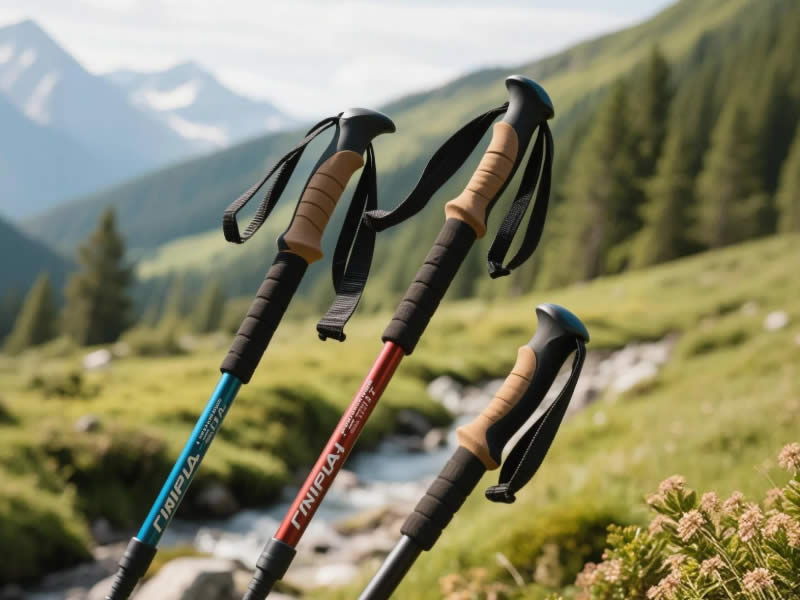
Recommended trekking pole purchase link: https://s.click.aliexpress.com/e/_c4M7OWaN
2-Section Poles: Maximum Strength, Minimal Packability
Design: Two sections that fit together—typically a fixed upper shaft and a lower section that adjusts via a lock. Some 2-section poles are completely fixed length (no adjustment at all). The joint is usually a flick lock or twist mechanism.
Pros:
- Strength: Fewest moving parts and the longest continuous shaft sections mean these are the stiffest, most robust poles. They resist bending and flex better than multi-section alternatives.
- Simplicity: Fewer joints mean fewer failure points. No internal cords, no multiple locks to maintain.
- Lightweight potential: With only one lock mechanism, weight can be kept very low.
Cons:
- Packability: When collapsed, a 2-section pole is still long—typically 24–30 inches. This makes it awkward for airline carry-on, internal pack storage, or strapping to small backpacks.
- Limited adjustment: Many 2-section poles have only one adjustable section, limiting length range compared to 3-section telescoping poles.
Best for: Hikers who prioritize rigidity and simplicity, don’t need to pack poles small, and use poles primarily on consistent terrain.
3-Section Poles: The All-Rounders
Design: The most common configuration. Three sections: upper, middle, and lower. Can be telescoping (each section slides into the next) or folding (three sections connected by cord, often with a single lock). Most telescoping poles use two flick locks—one for the middle section, one for the lower.
Pros:
- Balance: Excellent compromise between packability and rigidity. Collapsed length typically 18–24 inches—short enough for most pack side pockets and carry-on luggage.
- Adjustability: Two locks allow independent adjustment of middle and lower sections, giving a wide length range and fine-tuning for terrain.
- Stiffness: Still quite rigid; the extra joint adds minimal flex compared to 4-section designs.
- Repairability: Flick locks on telescoping models are field-serviceable; parts widely available.
Cons:
- Slightly more weight and complexity than 2-section designs.
- Collapsed length still too long for some ultralight or travel applications (though acceptable for most).
Best for: The majority of hikers—day hikers, backpackers, and general trekkers who want a balance of packability, strength, and versatility.
4-Section Poles: Maximum Packability
Design: Four sections that fold or telescope into a very compact bundle. Most 4-section poles are folding Z-pole style (internal cord, buttons) or ultra-compact telescoping with three or four locks. Collapsed length typically 13–16 inches.
Pros:
- Packability: Fits inside carry-on luggage, small daypacks, or even large jacket pockets. Ideal for travel, bikepacking, and ultralight missions where space is at a premium.
- Versatility: Can be stowed internally without snagging on branches or requiring external attachment points.
- Travel-friendly: Short collapsed length makes airline transport much easier.
Cons:
- Increased flex: More joints introduce more potential flex points. 4-section poles are noticeably less rigid than 3- or 2-section poles, which can affect planting precision on technical terrain.
- More failure points: More joints mean more locks, buttons, or cord connections that can wear or fail.
- Heavier: The additional hardware (locks, buttons, extra shaft material) adds weight compared to a similarly constructed 3-section pole.
- Adjustment complexity: Some 4-section telescoping poles require managing three or four locks, which can be tedious.
Best for: Travelers, ultralight backpackers, trail runners, and anyone who needs poles that disappear into luggage or packs.
Comparative Summary
| Feature | 2-Section | 3-Section | 4-Section |
|---|---|---|---|
| Collapsed length | 24–30″ | 18–24″ | 13–16″ |
| Rigidity | Highest | High | Moderate |
| Weight (typical) | Light | Moderate | Moderate–Heavy |
| Adjustment range | Limited | Wide | Wide (telescoping) or fixed (folding) |
| Failure points | Few | Moderate | Many |
| Best for | Strength-focused, car-camping, home storage | All-around hiking, backpacking | Travel, ultralight, packability priority |
The Verdict
3-section poles are the sweet spot for most hikers. They offer a balanced mix of packability, rigidity, adjustability, and repairability. You can strap them to most packs, fit them in checked luggage, and rely on them for years.
2-section poles are a niche choice. They excel when strength and simplicity are paramount and pack size doesn’t matter—think car camping, home use, or hikers who never fly with poles.
4-section poles shine where packability is the overriding priority. Travelers, bikepackers, and ultralight enthusiasts will accept the trade-offs in rigidity and complexity for the ability to stash poles in carry-on luggage or internal pack pockets.
Choose based on your primary constraint: Do you need maximum strength? Go with 2-section. Do you need a pole that disappears into luggage? 4-section is your answer. For everything else, the 3-section design remains the proven, versatile standard.




