




Weight rating for walking poles – how to find?
If you carry a heavy backpack, are a larger hiker, or simply want gear that will not fail under stress, knowing a trekking pole’s weight capacity is essential. Yet most manufacturers do not prominently list a “max user weight” or “load limit” on their product pages. This is not necessarily a red flag—it reflects how poles are tested and how they fail—but it does leave many hikers wondering how to determine whether a particular model can safely support them. This deep dive explains why weight ratings are rarely advertised, how to interpret the available data, and where to look for trustworthy information.
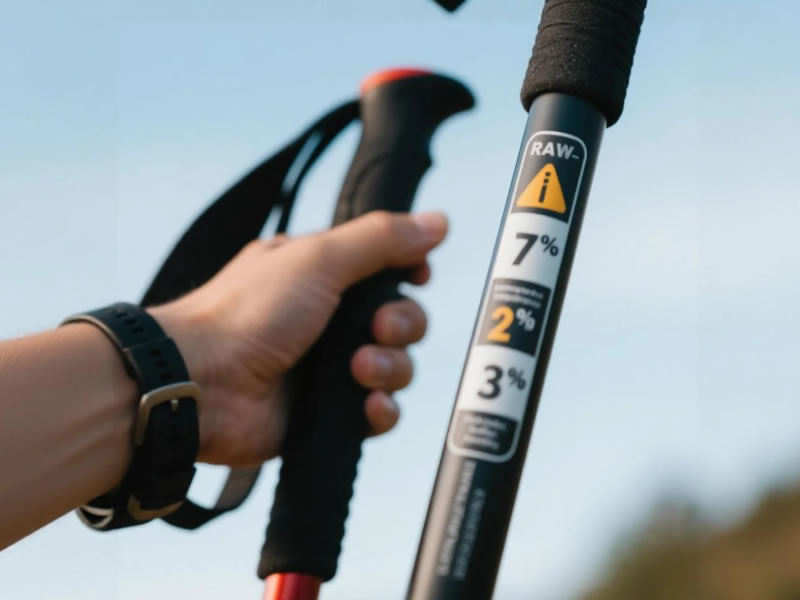
Recommended trekking pole purchase link: https://s.click.aliexpress.com/e/_c4M7OWaN
Why Manufacturers Often Skip a Weight Rating
Trekking poles are not like carabiners or climbing ropes; there is no universal standard for a static weight limit. Poles are tested for:
- Lateral strength (how well they resist bending when planted at an angle)
- Axial strength (compression along the shaft)
- Lock reliability under dynamic, repetitive loads
The actual safe working load depends heavily on how the pole is used—a sudden lateral fall can generate forces far greater than a hiker’s body weight. Because real‑world conditions vary so much, most brands prefer to describe poles with terms like “heavy‑duty,” “expedition,” or “ultralight” rather than publish a number that could be misinterpreted.
What to Look For Instead of a Sticker Rating
1. Materials and Tube Wall Thickness
- 7075 aluminum is the strongest alloy commonly used in poles. It appears in many expedition‑oriented models.
- 6061 aluminum is slightly softer and more ductile; fine for moderate loads but less resistant to bending under heavy packs.
- Carbon fiber can be extremely strong if the layup is designed for high loads, but quality varies. Look for terms like “high‑modulus” or “expedition carbon” rather than “ultralight carbon.”
- Fiberglass is the weakest option; avoid it for any load‑bearing use.
Some premium brands also specify tube wall thickness (e.g., “1.5 mm wall”) in the specs—thicker walls generally mean higher load capacity.
2. Locking Mechanism
- External flick locks (lever locks) are the most reliable under heavy, repetitive loads. They can be tightened if they loosen over time and provide a positive, visible lock.
- Internal twist locks are weaker under heavy loads; they rely on friction that can decrease with wear or cold.
- Push‑button folding systems (Z‑pole style) are strong in axial compression but can be vulnerable to lateral stress; they are best suited for light to moderate loads.
3. Number of Sections
- 2‑section telescoping poles have only one joint, making them inherently stiffer and stronger than 3‑ or 4‑section designs.
- 3‑section folding poles are more compact but introduce more potential flex points.
- 4‑section folding poles offer maximum packability at the cost of some rigidity—generally not recommended for heavy backpacking.
Where to Find Specific Load Information
When a brand does publish a weight rating, it is often buried in:
- Technical specifications on the product page (look for “max load,” “recommended user weight,” or “tested to”)
- FAQs or Q&A sections where customers have asked about capacity
- User manuals (available as PDF downloads) that sometimes include load test results
- Customer service replies—email or call the manufacturer and ask what load the pole was tested to during development
A few brands are more transparent than others. For example, Leki and Black Diamond sometimes provide “tested to” figures for their expedition models (e.g., 300–400 lbs axial load). Smaller cottage brands like Gossamer Gear often respond directly to inquiries about their carbon poles’ strength.
General Strength Guidelines
| Pole Type | Typical Safe Axial Load (static) |
|---|---|
| Budget aluminum (6061, twist locks) | 220–250 lbs |
| Mid‑range aluminum (7075, flick locks) | 250–300 lbs |
| Premium aluminum (7075, thick wall) | 300–400 lbs |
| Ultralight carbon (3‑section folder) | 220–280 lbs |
| Expedition carbon (reinforced layup) | 300–400 lbs |
These are estimates; actual safe loads depend on how aggressively the pole is used. A pole that handles 300 lbs of static weight may still bend if you catch it in a rock crack and torque it sideways.
The Most Important Factor: Real‑World Use
For heavy‑load backpacking, how you use the pole matters as much as the rating.
- Plant poles directly under your shoulder, not far out to the side.
- Avoid using poles as levers to pull yourself up steep steps.
- Inspect locks regularly and tighten them if they loosen.
If you consistently carry packs over 30–40 lbs or weigh over 250 lbs yourself, prioritize:
- 7075 aluminum construction
- External flick locks (not twist or push‑button)
- 2‑section or reinforced 3‑section telescoping designs
- Replaceable tips (so you can maintain the pole without replacing it)
The Verdict
Most trekking pole manufacturers do not publish a simple “weight rating,” but you can reliably gauge a pole’s load capacity by examining its materials, lock type, and number of sections. For heavy‑duty use, choose 7075 aluminum with flick locks and a 2‑ or 3‑section telescoping design. If the manufacturer does not list a load limit, contact customer service directly—they can often share internal test data. Ultimately, a pole that feels solid, locks securely, and is built from proven materials will comfortably support far more than most hikers will ever demand of it, provided it is used with proper technique.




