




Can ultralight poles support heavy hikers?
The short answer is yes—but with important caveats. Ultralight trekking poles (typically weighing under 14 ounces per pair) are engineered for speed, packability, and minimal weight. They are not designed to be indestructible; instead, they are built for efficiency. For a heavier hiker—whether due to body weight, a heavy pack, or both—using ultralight poles requires understanding where their strength lies and where they are vulnerable.
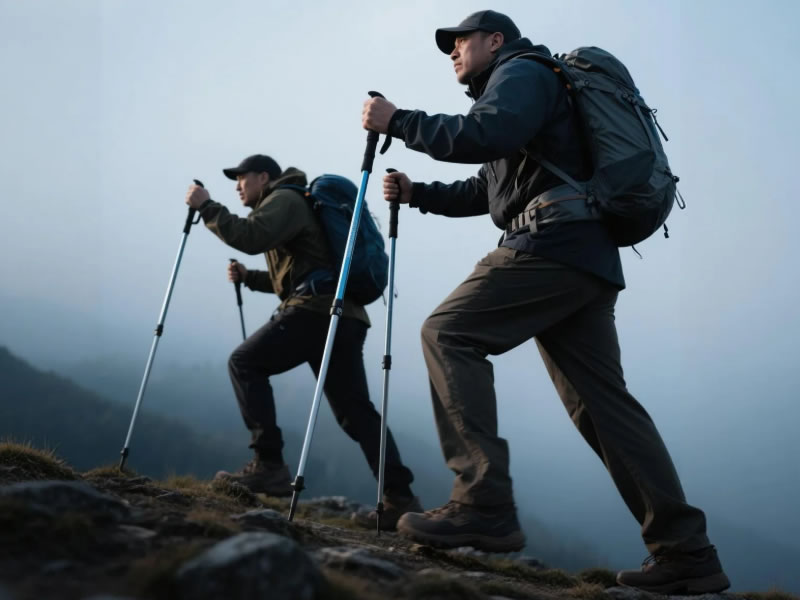
Recommended trekking pole purchase link: https://s.click.aliexpress.com/e/_c4M7OWaN
What “Ultralight” Really Means
Ultralight poles achieve their low weight through:
- Thin‑wall tubing: Carbon fiber or aluminum shafts with minimal material.
- Fewer or smaller locking components: Some use internal buttons or small twist locks instead of robust external levers.
- Folding (Z‑pole) designs: These are compact but introduce multiple joints and rely on an internal cord.
These design choices save grams, but they also reduce the pole’s margin of safety under lateral stress, repeated heavy impacts, or when used as a lever.
Where Ultralight Poles Are Strong
In axial compression—pushing straight down along the shaft—ultralight poles are surprisingly strong. A quality carbon Z‑pole can support 200–300 pounds of static load without buckling. If you plant the pole directly under your shoulder and apply force straight down, the shaft itself will usually hold.
The problem is that real‑world hiking rarely involves perfectly straight, axial loads.
The Real Vulnerability: Lateral Stress and Leverage
When you plant a pole at an angle, catch it in a rock crack, or use it to pull yourself up a step, you introduce lateral (sideways) forces. This is where ultralight poles are weakest:
- Thin‑wall carbon can snap when side‑loaded. Unlike aluminum, which may bend and give warning, carbon can fail suddenly.
- Folding joints (buttons or internal cams) are designed to resist compression, but lateral torque can pop them out of alignment or damage the locking mechanism.
- Twist locks on lightweight telescoping poles can slip under repetitive, angled loads, especially in cold weather.
For a heavier hiker—someone weighing 220+ pounds or carrying a 40‑pound pack—the forces generated during a mis‑planted step can exceed what ultralight poles are designed to handle.
When Ultralight Poles Can Work for Heavy Hikers
Many heavier hikers successfully use ultralight poles by adhering to strict technique and choosing their terrain carefully:
- Perfect planting technique: Always plant the pole slightly ahead of your body, with the shaft directly under your shoulder. Avoid using the pole as a lever to pull yourself up.
- Smooth, non‑technical trails: On well‑maintained trails with few rock gardens or steep steps, lateral stresses are minimal.
- Folding Z‑poles over ultralight telescoping: Some folding designs (e.g., Black Diamond Distance Z) have fewer moving parts and are actually stronger in axial loading than lightweight twist‑lock telescoping poles.
- Regular inspection: Check for cracks in carbon shafts, worn buttons, or loose sections before each trip.
When to Choose a Heavier, Stronger Pole
If you consistently hike with a heavy pack, tackle rocky or uneven terrain, or simply want a greater margin of safety, prioritize strength over ultralight weight.
- 7075 aluminum telescoping poles with flick locks (e.g., Black Diamond Trail Pro, Leki Khumbu) add 4–6 ounces per pair compared to ultralight carbon folders, but they offer:Greater resistance to lateral stress.Serviceable locks that can be tightened or replaced.A warning before failure (aluminum bends; carbon snaps).
For a heavier hiker, the small weight penalty is a wise trade‑off for reliability and peace of mind.
Specific Models and Recommendations
| Model | Type | Weight (pair) | Suitability for Heavy Hikers |
|---|---|---|---|
| Black Diamond Distance Z (aluminum) | Folding Z‑pole | ~15 oz | Good with careful technique; avoid lateral abuse |
| Gossamer Gear LT5 | Folding carbon | <6 oz | Not recommended for consistent heavy loads; too fragile |
| Black Diamond Trail Pro | 2‑section telescoping | ~20 oz | Excellent; built for heavy loads |
| Leki Khumbu | 3‑section telescoping | ~18 oz | Excellent; proven durability |
The Verdict
Ultralight poles can support heavy hikers—provided those hikers use impeccable technique and avoid terrain that generates high lateral forces. For many backpackers, the weight savings are worth the extra care. However, if your hiking involves frequent rock scrambles, steep steps, or you simply prefer gear with a wider safety margin, a slightly heavier telescoping pole with flick locks is the smarter choice.
Ultimately, the question is not whether ultralight poles can support you, but whether you are willing to adapt your technique to their limits. For those who are, ultralight poles can be a reliable tool even under significant loads. For everyone else, a few extra ounces buy a lot of confidence.




