




Nordic Walking Pole Technique vs Traditional Hiking? A Complete Guide to Two Distinct Practices
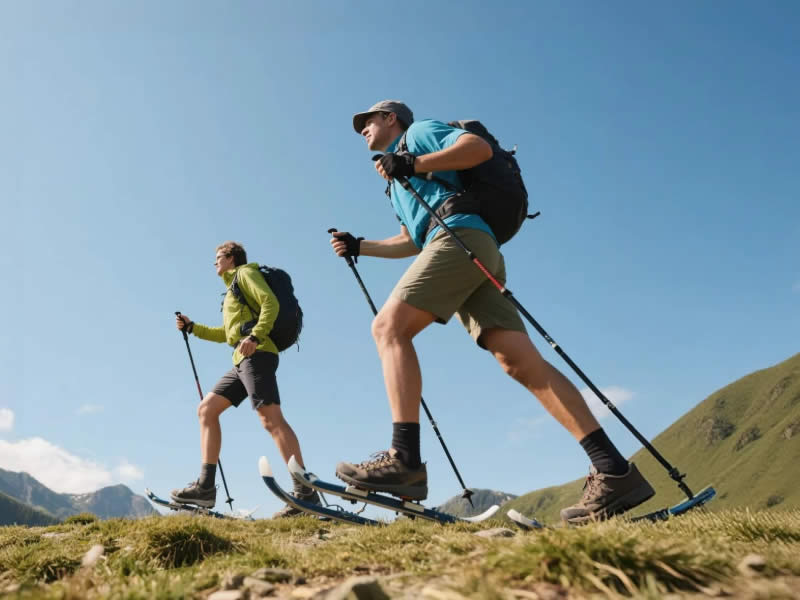
At first glance, Nordic walking and traditional hiking with poles look similar—you're walking with two poles, after all. But the techniques, purposes, and outcomes are fundamentally different. Nordic walking is a specific fitness discipline developed from cross-country skiing, designed to engage the entire body. Traditional trekking pole use is about stability, balance, and reducing joint impact on uneven terrain. Understanding the difference helps you choose the right technique for your goals. This guide explores the distinctions, benefits, and when to use each approach.
Recommended trekking pole purchase link: https://s.click.aliexpress.com/e/_c4M7OWaN
The Short Answer
Nordic walking uses a specialized "plant-and-push" technique with dedicated gloves or straps, engaging your entire body. You plant the pole at an angle behind you, push through the strap to propel yourself forward, and open your hand at the finish—activating core, back, and arms while reducing leg strain. It's a full-body fitness activity performed on level or gently rolling terrain.
Traditional trekking/hiking poles are used for stability and load distribution on varied terrain. You plant the pole ahead or beside you, gripping the handle to support your balance, especially on uneven ground, steep ascents, or descents. The goal is safety, joint protection, and navigating challenging conditions.
Key difference: Nordic walking is a full-body fitness technique with a specific motion pattern; traditional hiking pole use is about stability and joint protection across diverse terrain.
The Origins
Nordic Walking: Developed in Finland in the 1980s as a summer training method for cross-country skiers. It uses poles with specialized straps (not standard trekking straps) that allow the hand to release at the end of the stroke.
Traditional Trekking Poles: Evolved from mountaineering ice axes and ski poles, adapted for hikers seeking stability on rough terrain. Modern trekking poles emerged in the 1970s-80s as lightweight adjustable poles became available.
The Technique Differences
Nordic Walking Technique:
- Diagonal Movement: Left pole forward with right foot (and vice versa)—natural walking rhythm.
- Pole Angle: Poles are planted at an angle behind you, not straight down or ahead.
- Push and Release: You push through the strap, propelling yourself forward. At the finish, your hand opens, and the pole releases back.
- Arm Swing: Arms swing from the shoulders with elbows almost straight—a long, pendulum-like motion.
- Core Engagement: The push engages your core, back, and shoulder muscles.
- Hand Position: Hand goes up through the strap from below; at the finish, the strap bears the load, not your grip.
Traditional Trekking Pole Technique:
- Variable Movement: Can be diagonal (pole with opposite foot) or parallel (both poles forward together) depending on terrain.
- Pole Angle: Poles are planted ahead or beside you for balance and support.
- Support Focus: You use poles to stabilize, test terrain, and reduce impact on descents.
- Arm Swing: Elbows bend more; arms work independently.
- Grip Focus: You grip the handle; straps provide backup, not primary propulsion.
- Length Adjustment: Poles are often shortened for climbs, lengthened for descents.
Equipment Differences
Nordic Walking Poles:
- Specialized Straps: Wide, glove-like straps that allow hand release at the end of the stroke. The strap bears weight during the push phase.
- Often Fixed Length: Most Nordic walkers use poles sized to their height (multiply height by 0.68).
- Rolling Tips: Many use pivoting rubber tips that maintain ground contact at an angle.
- Lightweight: Carbon fiber common for fitness walkers.
Traditional Trekking Poles:
- Standard Straps: Simple loop straps for backup, not primary propulsion.
- Adjustable Length: Essential for varied terrain—shorten for climbs, lengthen for descents.
- Interchangeable Tips: Carbide for trails, rubber for pavement.
- Baskets: Interchangeable for mud, snow, or standard conditions.
Terrain Differences
Nordic Walking:
- Best on: Level or gently rolling terrain—paved paths, gravel roads, well-groomed trails, parks.
- Challenging on: Steep slopes, rocky trails, deep mud, technical terrain where the continuous push technique becomes difficult.
Traditional Trekking Poles:
- Best on: Varied terrain—rocky mountains, steep ascents and descents, stream crossings, off-trail navigation.
- Adaptable to: Almost any hiking condition through length adjustment and tip changes.
Fitness Benefits Compared
Nordic Walking:
- Full-Body Engagement: Uses up to 90% of muscles (versus 50-60% for regular walking)
- Increased Calorie Burn: Up to 20-40% more calories than regular walking
- Cardiovascular: Higher heart rate at same perceived effort
- Upper Body Strength: Engages arms, shoulders, back, core
- Reduced Leg Strain: Pushing through poles reduces impact on knees and hips
- Posture: Encourages upright, open posture
Traditional Trekking Poles:
- Joint Protection: Reduces knee and hip impact by 20-30%, especially on descents
- Stability: Prevents falls on uneven terrain, stream crossings, and slippery surfaces
- Balance: Widens base of support for challenging conditions
- Endurance: Distributes workload, reducing leg fatigue
- Safety: Essential for technical terrain and heavy pack loads
When to Use Each
Choose Nordic Walking When:
- Your goal is fitness, calorie burn, or upper body conditioning
- You're walking on level or gently rolling terrain (parks, paved paths, groomed trails)
- You want a low-impact full-body workout
- You're recovering from lower-body injury and want to reduce leg load while maintaining intensity
- You enjoy the rhythm and flow of the technique
Choose Traditional Trekking Poles When:
- You're hiking on varied, uneven, or technical terrain
- You need stability for steep climbs and descents
- You're carrying a heavy backpack
- You're navigating streams, mud, or snow
- You have knee or hip concerns and need joint protection on descents
- You're doing multi-day backpacking or challenging mountain hikes
Can You Use Trekking Poles for Nordic Walking?
Technically yes, but with limitations:
- Straps: Standard trekking straps don't allow the hand-release motion essential to Nordic technique
- Tips: Rolling tips are optimal for Nordic walking; standard carbide tips work but lack the smooth rolling action
- Length: Adjustable trekking poles can be set to the correct Nordic length, but may be heavier
If you already have trekking poles, you can try Nordic technique, but dedicated Nordic poles with proper straps will provide a better experience.
Can You Use Nordic Poles for Hiking?
Yes, but with trade-offs:
- Fixed Length: Most Nordic poles are fixed-length; you can't adjust for climbs and descents
- Straps: The specialized straps are excellent for propulsion but may feel different for stability-focused use
- Durability: Many Nordic poles are lighter and may not withstand rock impacts as well as aluminum trekking poles
For gentle hiking on maintained trails, Nordic poles work fine. For technical terrain, dedicated trekking poles are better.
What Practitioners Say
"I started with trekking poles for mountain hiking," shares Michael, who now practices both. "When I discovered Nordic walking on local paths, it transformed my fitness. I use trekking poles in the mountains, Nordic poles for fitness walks. Two different tools for two different purposes."
"I use trekking poles for my backpacking trips," says Sarah, a long-distance hiker. "The adjustability is essential for steep terrain. But for my daily walks around the neighborhood, I switch to Nordic poles. They give me a better workout."
The Bottom Line
Nordic walking and traditional trekking pole use are distinct practices with different techniques, equipment, and goals. Nordic walking is a full-body fitness discipline for level terrain, using a specific push-and-release motion. Traditional trekking poles are stability tools for varied, challenging terrain, focused on safety and joint protection.
Neither is better—they serve different purposes. Many outdoor enthusiasts use both: trekking poles for mountain adventures, Nordic poles for fitness walks. Understanding the difference helps you choose the right tool and technique for your activity, maximizing enjoyment and benefits.
Disclaimer: This article provides general information about walking pole techniques. For proper instruction in Nordic walking, consider a lesson from a certified instructor. For technical hiking, ensure proper fit and technique for safety.




