




Repair vs replace Trekking Poles – environmental impact?
Every hiker eventually faces the question: when a trekking pole breaks—a worn tip, a frayed strap, a slipping lock—do you repair it or replace it? While the immediate instinct may be to purchase a shiny new pair, the environmental calculus strongly favors repair. The difference between fixing a pole and buying a new one extends far beyond your wallet. It touches carbon emissions, raw material extraction, manufacturing energy, transportation, and landfill waste. Understanding the environmental impact of repair versus replacement empowers you to make choices that align with sustainable outdoor stewardship.
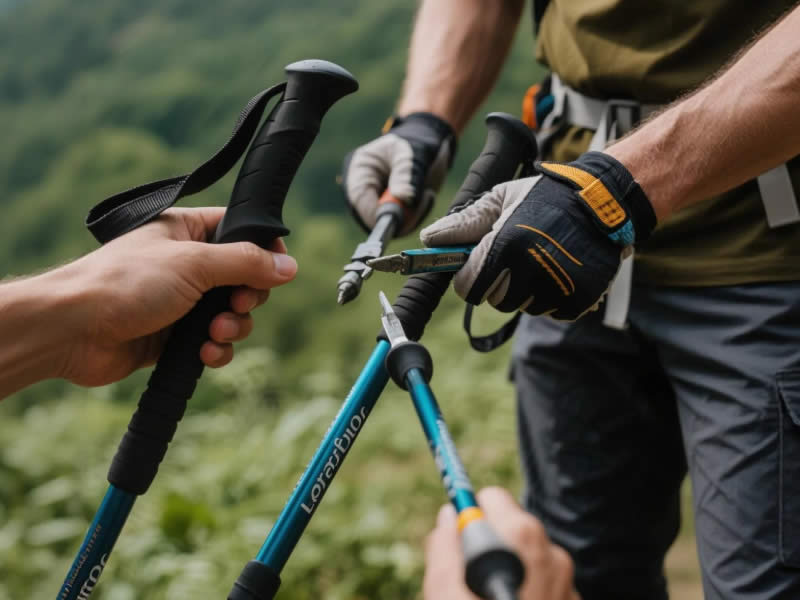
Recommended trekking pole purchase link: https://s.click.aliexpress.com/e/_c4M7OWaN
The Hidden Cost of Manufacturing
Manufacturing a single pair of trekking poles involves a complex industrial chain:
- Aluminum production – Mining bauxite, refining alumina, and smelting aluminum is energy‑intensive. Producing one kilogram of aluminum generates approximately 16 kilograms of CO₂ equivalent.
- Carbon fiber production – Even more energy‑intensive, carbon fiber manufacturing requires high‑temperature processing and produces significant emissions.
- Rubber and plastics – Synthetic rubber grips, straps, and baskets derive from petroleum, with associated extraction, refining, and molding emissions.
- Steel tips – Carbide tips require mining tungsten and cobalt, rare metals with substantial environmental footprints.
- Packaging and shipping – Poles travel from factories (often in Asia) to distribution centers to retailers to consumers, with carbon emissions at every stage.
When you buy a new pair of poles, you are responsible for the entire lifecycle impact of that manufacturing process—even if your old poles are still largely functional.
Repair: Extending Life, Reducing Impact
Repairing a pole avoids nearly all of these upstream impacts. Replacing a worn rubber tip, a frayed strap, or a slipping lock mechanism uses a fraction of the materials and energy required for a full pole. Consider these comparisons:
| Component | Repair Impact | Replacement Impact |
|---|---|---|
| Rubber tip | Small rubber component; minimal packaging | Entire pole assembly; full manufacturing footprint |
| Strap | Short length of webbing; small plastic buckle | Whole pole system; metal, plastic, rubber |
| Lock mechanism | Small plastic or metal part; local shipping | Complete pole; international shipping |
| Grip | Cork or foam component; often replaceable | Entire pole; grip + shaft + tip + basket |
Even if you replace multiple parts over a pole’s lifetime, the cumulative environmental cost remains dramatically lower than manufacturing a new pole.
The Waste Factor
Beyond emissions, there is the matter of waste. Trekking poles are not easily recycled. They combine multiple materials—aluminum or carbon fiber, rubber, plastic, steel—that must be separated for proper recycling, a process few municipal facilities can handle. Most discarded poles end up in landfills, where aluminum and carbon fiber persist indefinitely.
Repair keeps functional poles out of the waste stream. A pole repaired at five years and again at ten years may remain in service for decades, delaying landfill disposal indefinitely.
Repairability as a Design Choice
Not all poles are created equal when it comes to repair. Brands that support repairability—offering spare parts, publishing repair guides, and designing modular components—make the sustainable choice easier.
- Leki – Extensive spare parts catalog; tips, straps, grips, and even shaft sections available.
- Black Diamond – Replacement tips, baskets, and straps widely available.
- Komperdell – European brand with strong repair‑first philosophy.
- Cascade Mountain Tech – Budget option with replaceable tips and baskets.
When choosing new poles, opting for a repairable brand is itself an environmental decision. Conversely, poles with proprietary, non‑replaceable components or sealed assemblies are designed for obsolescence—and a shorter lifecycle.
Cost Considerations: Is Repair Always Cheaper?
Sometimes repair costs approach or even exceed the price of a budget replacement pole. A new set of entry‑level poles might cost $40–$60, while replacing both tips, both straps, and a lock mechanism could total $30–$40 with shipping.
However, the environmental calculus remains clear: even when repair costs are comparable to replacement, the carbon footprint of repair is a fraction of manufacturing new poles. If your budget allows, consider repair the greener choice. For those on tight budgets, buying a repairable second‑hand pair can be an even lower‑impact alternative to new budget poles.
Practical Repair Guide
Most common issues are easily repairable:
- Worn rubber tips – Pry off with pliers; press on new tips designed for your pole brand.
- Frayed straps – Remove old strap; thread new strap through grip following manufacturer’s instructions.
- Slipping lever lock – Tighten the pivot screw; clean the cam and shaft interface.
- Stuck sections – Clean telescoping sections; apply silicone lubricant (never WD‑40).
- Missing baskets – Replace with compatible baskets from the manufacturer.
When Replacement Is the Better Choice
Repair is not always feasible. Replacement is appropriate when:
- Carbon fiber shaft is cracked or splintered – Structural failure compromises safety; carbon fiber cannot be reliably repaired.
- Aluminum shaft is severely bent or kinked – A bent pole may fail under load; replacement is safer.
- Parts are no longer available – Some brands discontinue spare parts; at this point, replacement may be the only option.
- Multiple failures on a low‑quality pole – If you’re repairing the same pole repeatedly, upgrading to a repairable, durable model may have lower long‑term environmental impact.
Final Thoughts
When the choice is between repair and replacement, the environmental verdict is clear: repair first, replace only when necessary. Every repaired pole represents avoided emissions, conserved raw materials, and one less piece of gear in the landfill. By choosing brands that prioritize repairability, learning basic maintenance skills, and valuing longevity over novelty, you align your outdoor practice with the conservation ethic that draws us to the trails in the first place. The most sustainable trekking pole is the one you already own—kept on the trail for years, one repair at a time.




