




Solar-powered Trekking Poles for charging devices?
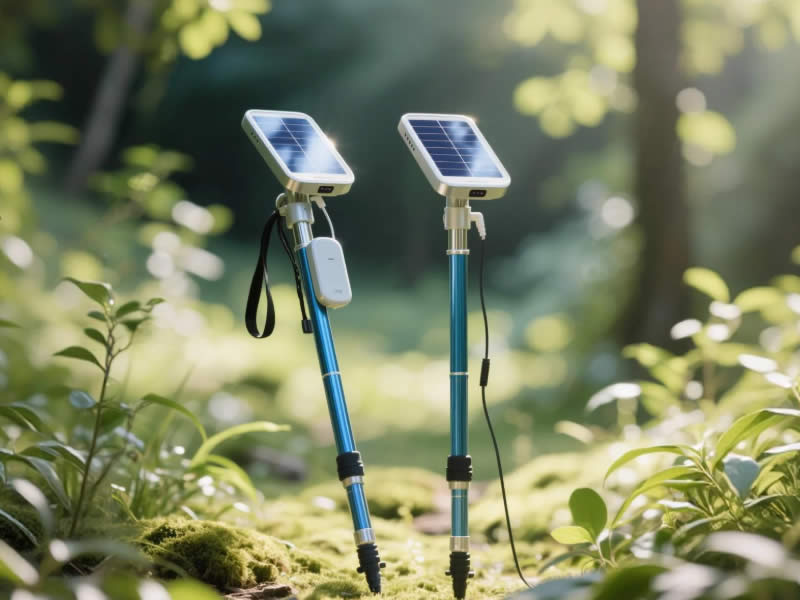
Imagine hiking for days with your phone, GPS, or headlamp running low on battery. Now imagine that your trekking poles—those two sticks already in your hands—could harvest sunlight and keep your devices powered. The concept of solar-powered trekking poles sounds like a brilliant fusion of sustainability and utility. After all, trekking poles have ample surface area exposed to the sky, and you’re already carrying them. Why not integrate flexible solar cells into the shafts? As appealing as this vision is, the reality falls short—for now. This article examines the feasibility, current technology, practical challenges, and better alternatives for keeping your devices charged on the trail.
Recommended trekking pole purchase link: https://s.click.aliexpress.com/e/_c4M7OWaN
How Would Solar Trekking Poles Work?
The basic idea is straightforward: embed thin‑film photovoltaic cells along the upper sections of the pole shafts. These cells would convert sunlight into electricity, stored in a small rechargeable battery (likely in the grip or a detachable module). A USB port would allow you to plug in a phone, watch, headlamp, or other small device. Some concepts also include a power bank function, storing energy for later use.
At first glance, the poles offer several advantages:
- Always exposed – When you hike, the poles are typically pointed skyward or angled, catching direct and diffuse sunlight.
- No extra weight – The solar cells replace some of the shaft material; the battery adds some grams, but you’re already carrying poles.
- Passive charging – You don’t need to stop or deploy separate panels.
The Hard Physics: Surface Area and Efficiency
The fundamental limitation is the amount of sunlight a trekking pole can capture. Let’s do the math:
- A typical trekking pole shaft is about 120 cm long and 1.8 cm in diameter. The cylindrical surface area is roughly π × diameter × length = 3.14 × 1.8 cm × 120 cm ≈ 678 cm². That’s about 0.068 m².
- Even if you cover the entire shaft with solar cells (including the lower section, which often gets muddy or scratched), you have less than 0.07 square meters.
- Under ideal noon sunlight, solar irradiance is about 1000 W/m². So the maximum power hitting the pole is 1000 × 0.07 = 70 watts. However, consumer solar cells are at best 20–25% efficient. That gives a theoretical maximum of 14–17.5 watts from a perfectly oriented pole in direct overhead sun.
But that’s the absolute peak. In reality:
- The pole is vertical or near‑vertical; sunlight comes at an angle. The effective area is the projection, roughly half. So you’re down to 7–9 watts.
- Clouds, shade from trees, morning/afternoon angles further reduce output.
- Part of the pole is covered by your hand, the grip, and the tip.
- Real‑world continuous output is likely 1–3 watts on a sunny day.
Now compare to device needs:
- A typical smartphone battery is around 10–15 watt‑hours (Wh). To charge a phone from empty, you would need 10–15 Wh. At 2 watts, that’s 5–7.5 hours of perfect sunlight—while hiking. But you can’t charge while using the phone; you’d need to stop and leave the poles in the sun.
- A GPS watch might have a 1 Wh battery, so 30 minutes of charging could work. But who stops for 30 minutes to charge a watch?
In practice, the energy harvested over a full day of hiking might be enough for a small device like a headlamp or fitness tracker, but not for a phone or GPS unit. For most backpackers, that’s insufficient.
Practical Challenges
Even if the physics were more favorable, engineering hurdles abound:
- Durability – Trekking poles are slammed into rocks, dragged through mud, and scraped against trees. Flexible solar cells are delicate. They would need a rugged, transparent coating that doesn’t reduce efficiency. Current technology is not up to this abuse.
- Curved surface – Most solar cells are designed for flat panels. Flexible thin‑film cells can bend, but their efficiency drops when curved. The cylindrical shape also means that only a fraction of the cells face the sun at any time.
- Battery and electronics – A rechargeable battery, charge controller, and USB port must be integrated into the grip or a pod. This adds weight (50–100 g per pole), reduces grip comfort, and creates failure points. Waterproofing is critical; IPX7 is a minimum.
- Heat – Solar cells get hot under sunlight. Heat reduces efficiency and can damage batteries. Poles are held in your hand; a hot grip is unpleasant.
- Cost – High‑efficiency flexible solar cells are expensive. Adding custom electronics and ruggedization could push a pair of poles to $300–500, far above the $50–150 for quality standard poles.
Are There Any Products on the Market?
As of 2026, there are no commercially successful solar‑powered trekking poles. A few small startups have launched Kickstarter campaigns, but none have delivered a durable, efficient product. You may find DIY projects or concept prototypes, but nothing you can buy and rely on for backcountry use.
The closest alternatives are:
- Solar‑backpack integration – Backpacks with built‑in solar panels (e.g., Voltaic, Goal Zero). These have much larger surface area (0.2–0.5 m²) and can charge devices more effectively.
- Foldable solar panels – Lightweight, portable panels (e.g., Big Blue, Anker) that you set up at camp or on a break. They offer 10–30 watts, enough to charge phones and power banks.
- Power banks – Simple, reliable, and cheap. A 10,000 mAh power bank can recharge a phone 2–3 times.
The Verdict: Not Ready for Prime Time
Solar‑powered trekking poles are an appealing idea that fails on practicality. The tiny surface area, combined with real‑world sun angles and efficiency losses, yields negligible power for most devices. Durability, cost, and weight penalties further weaken the case. For the foreseeable future, you are far better off carrying a lightweight power bank or a small foldable solar panel that can be deployed at rest stops. Use your trekking poles for their intended purpose: stability and efficiency, not as underpowered solar generators.
Future Possibilities
Advancements in perovskite solar cells (higher efficiency, lower cost) and ultra‑thin, rugged substrates could change the equation. If cells reach 30–40% efficiency and become truly flexible and scratch‑resistant, a pair of poles might generate 5–10 watts continuously. That would be enough to trickle‑charge a power bank over a day. However, such technology is still in research labs. Don’t expect commercial products for at least 5–10 years.
Final Thoughts
While the idea of solar‑powered trekking poles is creative and environmentally attractive, the current technology does not deliver. The energy you’d harvest is too low to justify the added complexity, cost, and fragility. Stick with proven solutions: a high‑capacity power bank for multi‑day trips, or a small foldable solar panel if you’ll be camping in sunny areas. Let your poles be poles—simple, strong, and reliable. When solar technology matures, revisit the concept. Until then, keep your devices charged the old‑fashioned way: with stored energy, not wishful thinking.




