




What is the difference between trekking poles and walking sticks?
At first glance, a trekking pole and a walking stick look similar – both help you balance. But for serious hikers in Germany’s varied terrain (Alpine passes, Black Forest mud, Harz granite), the differences are crucial. Choosing the wrong one can lead to discomfort or even injury. Let’s break down the key distinctions.
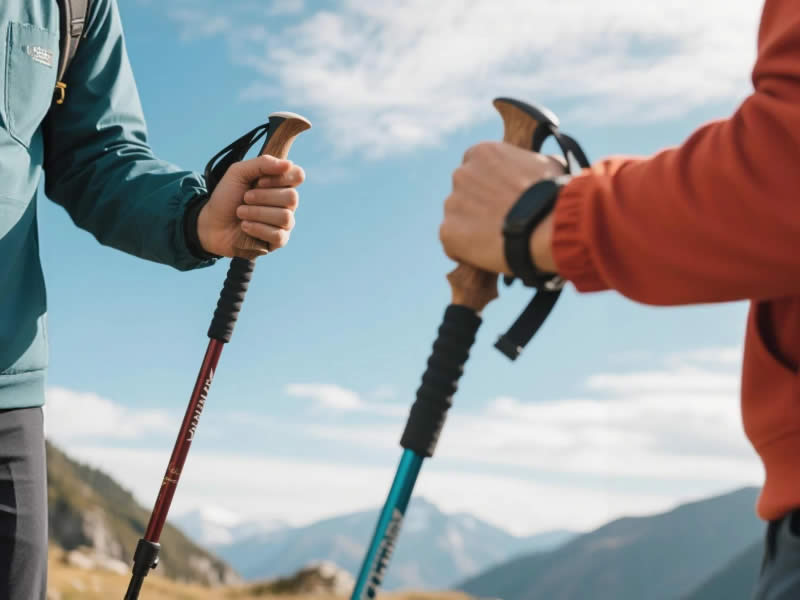
Recommended trekking pole purchase link: https://s.click.aliexpress.com/e/_c4M7OWaN
Number and pairing
Walking sticks are typically used singly – a solitary wooden or metal staff held in one hand. Trekking poles are sold and used in pairs. Two poles provide bilateral support, engaging your upper body, reducing knee impact by up to 25%, and improving stability on uneven slopes. A single stick may suffice for a flat nature walk but fails on steep ascents or descents.
Adjustability
Most walking sticks have a fixed length, often around 130–150 cm. That works for a casual stroll but cannot adapt to changing gradients. Trekking poles feature adjustable sections (two or three) with reliable locking mechanisms (twist or lever). You shorten them for uphill to maintain a natural arm angle, and lengthen them for downhill to plant ahead of your body. This adaptability is essential for serious hiking.
Grips and straps
Walking sticks usually have a simple T‑handle or rounded knob grip, often made of wood or basic rubber. They rarely include wrist straps. Trekking poles come with ergonomic grips (cork, foam, or rubber) shaped to reduce hand fatigue. More importantly, they include adjustable wrist straps – you push your hand up through the strap, then grip it. This allows you to relax your fingers while still transferring force from arm to pole, preventing blisters and improving efficiency.
Tips and baskets
Walking sticks often end in a plain metal ferrule or a rubber foot, suitable for pavement or soft forest floors. Trekking poles feature carbide tips (extremely hard and sharp) that bite into rock, ice, and hardpacked trails. They also come with interchangeable baskets – small plastic discs near the tip – to prevent sinking into snow, mud, or sand. For winter hikes in the Bavarian Alps, trekking poles with snow baskets are invaluable; a walking stick would plunge deep.
Materials and weight
Walking sticks are commonly made of wood or heavy steel – durable but often over 300g per stick. Trekking poles use lightweight aluminum or carbon fiber (150–250g per pole). For a 10‑hour day in the Black Forest, carrying two lightweight poles is far less tiring than a single heavy stick.
When to use which
- Walking stick: Gentle, short nature walks; flat, paved or well‑groomed dirt paths; as a traditional accessory or for photography trips.
- Trekking poles: Mountain hiking, long‑distance trails (e.g., Rennsteig, Westweg), rough or slippery terrain, backpacking with a heavy load, and winter or muddy conditions.
Final verdict
For any serious hiking in Germany – especially in the Alps, Harz, or Black Forest – invest in a pair of adjustable trekking poles with carbide tips and wrist straps. Leave the single wooden walking stick for a leisurely Sunday stroll through a city park. Your knees, arms, and safety will thank you.




