




What length trekking poles do I need for my height?
Getting the right trekking pole length is essential for comfort, efficiency, and injury prevention. Too long, and you strain your shoulders; too short, and you hunch over, stressing your lower back. Fortunately, finding your ideal length is easy – and adjustable poles make it even simpler.
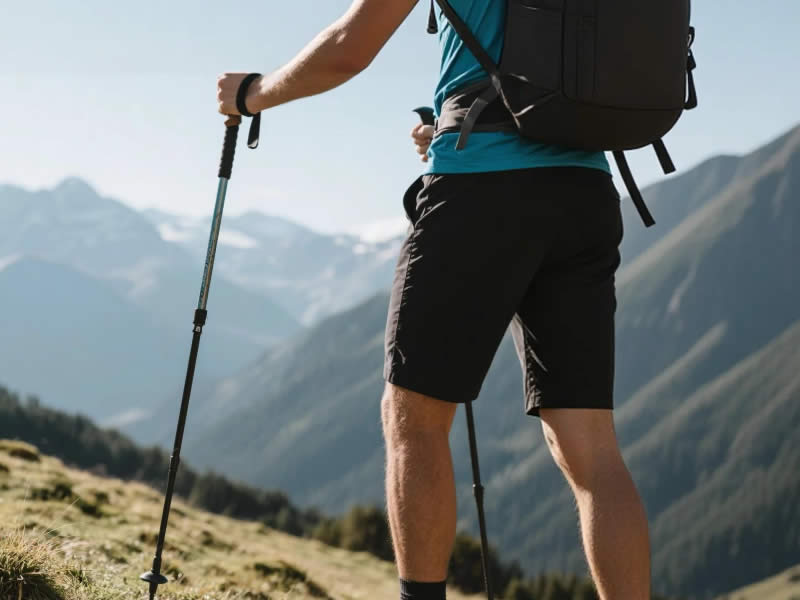
Recommended trekking pole purchase link: https://s.click.aliexpress.com/e/_c4M7OWaN
The basic formula
Stand upright in your hiking boots, holding the pole with your elbow bent at 90 degrees. The tip should rest on the ground beside your foot. That’s your neutral flat‑terrain length. A quick mathematical rule: multiply your height in centimeters by 0.68. For example:
- 160 cm tall → 109 cm (round to 110 cm)
- 170 cm tall → 115 cm
- 180 cm tall → 122 cm
- 190 cm tall → 129 cm
If you use inches: height (in inches) × 0.68 = pole length in inches. Convert to cm by multiplying by 2.54.
Adjust for terrain
Never use the same length for every trail. The golden rule:
- Uphill: Shorten poles by 5–10 cm. This keeps your arms from rising too high and lets you push into the slope.
- Downhill: Lengthen poles by 5–10 cm. You plant the pole ahead of your body, so a longer pole maintains proper arm angle.
- Side‑hilling: Shorten the uphill pole and lengthen the downhill pole to keep both hands level.
How adjustable poles help
Most quality trekking poles have a range of 100–135 cm, which fits heights from 150 cm to 200 cm. Look for marked increments on the shaft – these let you return to your preferred length quickly. Lever locks are easier to fine‑tune than twist locks.
Common mistakes to avoid
- Using a single fixed length for all hikes – always adjust for terrain.
- Basing length on the pole’s maximum extension – never extend past the “STOP” mark; it weakens the pole.
- Copying a friend’s setting – height alone doesn’t account for arm length and boot height. Test for yourself.
Quick field test
On a flat trail, walk normally with your poles. Your elbow should stay at roughly 90 degrees with a slight forward bend. If your shoulder hikes up or your wrist bends sharply, adjust. After 10 minutes, your arms should feel relaxed, not tense.
Final tip for 2026
When buying new poles, prioritize adjustable telescopic models over fixed‑length foldables unless you are a trail runner. The ability to fine‑tune for each descent and ascent is invaluable. And always carry a tape measure on your first few hikes – after a season, your body will know the right length instinctively. Happy trails!




