




How to use trekking poles for crossing streams and rivers?
Stream crossings are one of the most hazardous moments on a hike – slippery rocks, hidden depths, and strong currents can lead to falls, wet gear, or worse. Trekking poles are invaluable tools for crossing safely, acting as depth probes, balance aids, and additional points of support. Here’s how to use them effectively.
Recommended trekking pole purchase link: https://s.click.aliexpress.com/e/_c4M7OWaN
Before you step into the water
- Unbuckle your pack’s hip belt and chest strap – if you fall, you can quickly free yourself from the pack.
- Lengthen your poles by 5–10 cm longer than your flat‑terrain setting. A longer pole gives you more reach and leverage.
- Remove snow baskets (they catch current) but leave small summer baskets on to prevent the pole from sinking into mud.
- Keep your boots on (unless you have dedicated water shoes). Poles help you balance on wet rocks even with boots.
The basic technique: two‑pole downstream brace
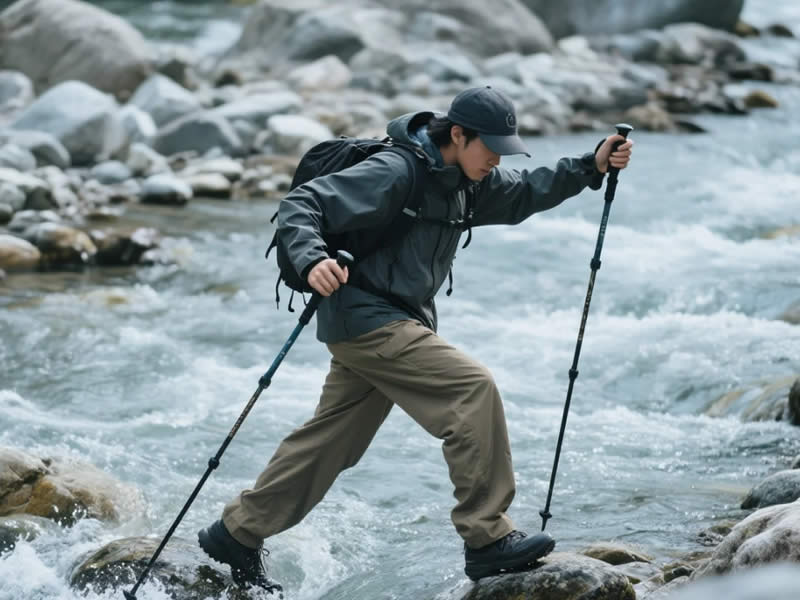
Face upstream or slightly angled. Plant both poles firmly on the downstream side of your body (the side the current flows toward). Lean your weight into the poles, creating a tripod with your two feet. Move one foot at a time, keeping at least three points of contact (two poles + one foot, or one pole + two feet). Never lift both poles at once.
Step‑by‑step for moderate current
- Probe ahead – Before committing your weight, use one pole to feel for rocks, holes, or shifting gravel. The pole tip should touch bottom before you step.
- Plant both poles downstream – Angle them slightly downstream to resist the current’s push.
- Sideways shuffle – Move sideways (facing upstream or across) rather than forward. Shuffle one foot, then bring the other alongside. Keep your feet wide for stability.
- Move poles one at a time – After each step, reposition the poles. Keep at least one pole firmly planted at all times.
- Lean into the poles – Your body weight should press down on the poles, not just hold them lightly.
For very strong currents or deep water
- Use a single pole as a walking staff – Plant it on the upstream side, lean against it, and use your free hand to balance. But two poles are usually better.
- Cross diagonally downstream – Walk at a 45‑degree angle with the current, using poles to brace against the flow.
- Unclip pole straps – In deep, fast water, you don’t want poles strapped to your wrists if you fall. Hold them loosely.
Common mistakes to avoid
- Planting poles upstream – The current pushes the poles back toward you, reducing stability.
- Lifting both poles at once – You lose two points of contact and become a wobbly biped.
- Facing straight across – A sideways shuffle keeps your center of gravity low and wide.
- Using rubber tips – Rubber tips slip on wet rock. Use bare carbide tips for grip.
- Hurrying – Take your time. Wet rocks are unpredictable.
Special cases
- Narrow, shallow streams: You can use poles like a tightrope walker – plant one pole on each side of the stepping stones.
- Muddy bottoms: Summer baskets prevent the pole from sinking too deep. If no baskets, the pole may plunge and get stuck.
- Deep water (over knee‑height): Face upstream, plant both poles wide and lean into them. Move one foot at a time. Consider turning back if water is above mid‑thigh and fast.
After crossing
- Drain your poles – Shake out water from locking mechanisms.
- Dry the grips – Wet cork or foam can be slippery.
- Readjust length back to trail settings.
- Check for damage – If you jammed a pole between rocks, inspect for bends or cracks.
Practice on safe crossings first
Before attempting a real river crossing, practice on a shallow, slow stream with a sandy bottom. Learn how the poles feel, how far you can lean, and how to shuffle sideways. Build confidence gradually.
Final verdict
Trekking poles are essential for safe stream crossings. Use two poles, lengthen them, plant them on the downstream side, and move sideways with a three‑point contact technique. Probe ahead, take slow steps, and never lift both poles at once. With proper technique, you’ll cross safely and keep your gear dry. Always assess the risk – if the current is too strong, turn back or find a better crossing. Your safety is more important than any trail.




