




How to use trekking poles on flat vs steep terrain?
Trekking poles are versatile tools, but the way you use them must change with the terrain. Using the same technique on a flat trail as on a steep mountain slope will waste energy, reduce stability, and even cause injury. Here’s a terrain‑by‑terrain guide to get the most out of your poles.
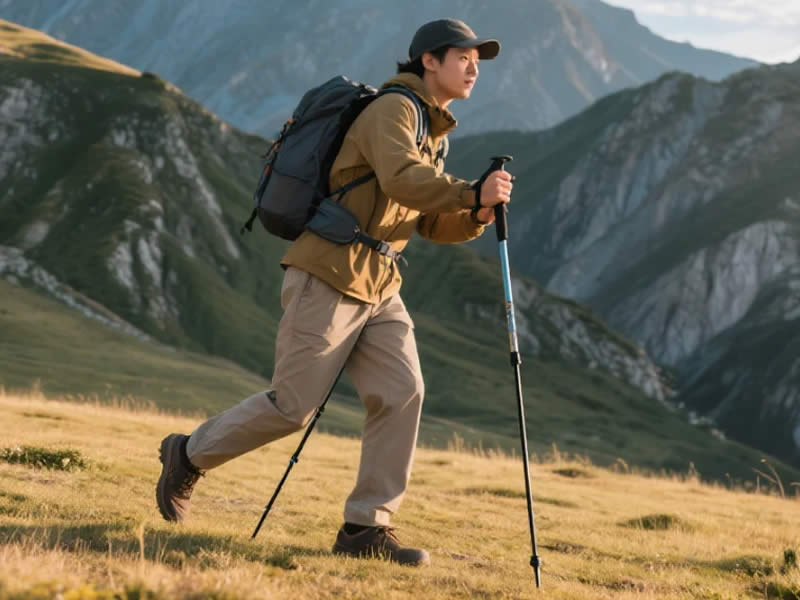
Recommended trekking pole purchase link: https://s.click.aliexpress.com/e/_c4M7OWaN
Flat or gently rolling terrain
On flat ground, the goal is efficiency and maintaining a natural rhythm.
- Length: Set poles so your elbow is at a 90° angle when the tip is on the ground. This neutral position allows a relaxed arm swing.
- Planting rhythm: Use alternate planting – opposite pole to forward foot (right foot forward, left pole down). This mimics your natural walking gait.
- Arm swing: Swing from the shoulder, keeping elbows slightly bent. Plant the pole when your hand is level with the heel of your forward foot. Do not over‑reach.
- Push: Lightly push back after each plant. You should feel a gentle forward propulsion, not a hard stab.
- Wrist straps: Use them correctly (hand up from below) to transfer weight and relax your grip.
Steep uphill terrain
Uphill sections demand more power and a different posture.
- Length: Shorten poles by 5–10 cm from your flat length. This keeps your arms low, allowing you to push down effectively without raising your shoulders.
- Planting rhythm: On steep slopes, use double planting (both poles together) or a quick‑succession plant. Plant both poles ahead of your body, then pull yourself up as you step.
- Arm swing: Your hands will be lower, near your hips. Focus on pushing down and back, engaging your triceps and lats. Keep your torso upright – don’t hunch.
- Grip: Choke down on the extended foam section (if available) for extra leverage.
- Stride: Shorten your steps. Poles help you maintain a steady pace without overworking your quads.
Steep downhill terrain
Downhill is where poles protect your knees and improve balance.
- Length: Lengthen poles by 5–10 cm from flat length. A longer pole allows you to plant ahead of your body, creating a braking effect.
- Planting rhythm: On very steep slopes, use double planting – plant both poles together ahead of you, then step down. For moderate descents, alternate planting works, but keep poles long.
- Arm swing: Reach forward with the pole, plant firmly, then push down as you transfer weight onto your downhill foot. Your arm will be straighter than on flat ground – that’s correct.
- Body position: Lean slightly back from your ankles, not your waist. Keep your chest up. Poles help you resist the forward pull of gravity.
- Knee protection: The push down on the pole transfers load from your knees to your arms. This is the key to reducing impact.
Side‑hilling (traversing a slope)
When walking across a slope, your uphill hand is higher than your downhill hand. Adjust each pole individually:
- Uphill pole: Shorten it by 5–10 cm.
- Downhill pole: Lengthen it by 5–10 cm.This keeps your torso upright and your shoulders level, preventing back strain. Plant alternately, but be prepared to use the uphill pole more for balance.
Transitioning between terrains
As the trail steepens or flattens, adjust your pole length and rhythm smoothly. You don’t need to stop – just reach down and adjust one section while walking (with lever locks). Practice this to make it automatic.
Summary table
| Terrain | Length vs flat | Planting rhythm | Key focus |
|---|---|---|---|
| Flat | Baseline (90° elbow) | Alternate | Natural swing |
| Uphill | Shorter 5–10 cm | Double or quick succession | Push down, pull up |
| Downhill | Longer 5–10 cm | Double on steep, alternate on moderate | Brake, protect knees |
| Side‑hill | Uphill shorter, downhill longer | Alternate | Keep torso level |
Common mistakes across terrains
- Using the same length for everything – the most common error.
- Planting poles too far forward (over‑reaching) on any terrain.
- Gripping too tightly – let the strap work.
- Ignoring wrist straps – they are essential for load transfer.
Final verdict
Adapting your trekking pole technique to terrain is easy once you learn the basics. On flat ground, use alternate planting with elbows at 90°. On steep uphills, shorten poles and use double planting to pull yourself up. On steep downhills, lengthen poles and plant both together to brake and save your knees. For side‑hills, adjust each pole individually to keep your torso level. With practice, these adjustments become second nature, and your hiking will be safer, more efficient, and far more enjoyable.




