




How to use trekking poles for descending steep scree slopes?
Descending a steep scree slope – loose, ankle-deep rubble of small rocks – is one of the most unnerving experiences in mountain travel. Every step feels like a potential slide, and without proper technique, you risk falls, twisted ankles, or uncontrolled tumbles. Trekking poles are not just helpful on scree; they are critical safety tools. But most hikers use them incorrectly, planting poles too far ahead and losing all stability. This guide will teach you the exact method to descend scree confidently, efficiently, and safely.
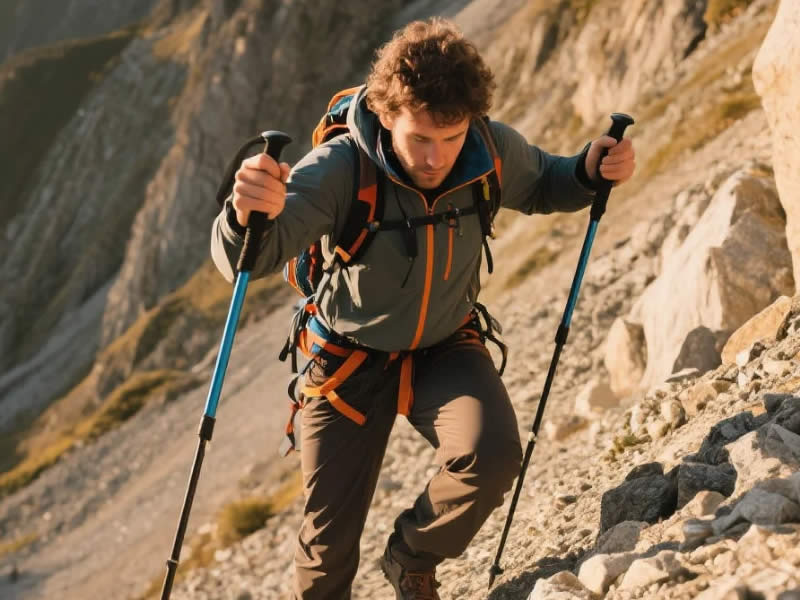
Recommended trekking pole purchase link: https://s.click.aliexpress.com/e/_c4M7OWaN
Why Scree Is So Dangerous
Scree (or talus) consists of loosely packed, angular rocks that shift underfoot. When you step down, the rocks roll, slide, or collapse. Your natural instinct is to lean back and dig your heels in – but that actually makes you less stable. Without poles, you have only two points of contact (your feet) on a constantly moving surface. Adding two trekking poles gives you four points of contact, dramatically improving your safety margin.
Step 1: Adjust Pole Length for Descending Scree
On normal trails, you lengthen poles for descents. On steep scree, you need even more length. Here’s why: when you plant a pole below you on a slope, the ground is farther away than on a moderate trail. If your poles are too short, you’ll have to lean forward excessively, shifting your center of gravity downhill – a recipe for a face-plant.
Rule of thumb: Extend your poles 5–10 cm (2–4 inches) longer than your standard downhill setting. Your elbows should be slightly bent when the pole tip touches the slope about 60–90 cm (2–3 feet) in front of your feet. Test the length on a safe section before committing to the steep scree.
Step 2: The “Plant-and-Slide” Technique
Forget the normal walking rhythm. On steep scree, you do not lift and place your feet normally. Instead, follow this sequence:
- Plant both poles simultaneously about 60–90 cm (2–3 feet) below your current foot position. Push the tips firmly into the scree until they hit solid substrate (or at least penetrate 5–10 cm). The poles should be shoulder-width apart.
- Shift your weight onto the poles. Lean slightly forward, pressing down through the wrist straps. You should feel the poles taking a significant portion of your body weight – up to 30–40%.
- Slide your feet, don’t step. With most of your weight on the poles, simply “ski” your feet down the slope. Allow your boots to glide over the scree rather than stepping. Keep your knees slightly bent and your torso upright.
- Repeat – plant poles again farther down, slide feet, and continue.
This technique transforms a chaotic scramble into a controlled, almost rhythmic descent. The poles act as anchors, preventing your feet from accelerating out of control.
Step 3: Body Positioning – The “Chair” Stance
Many hikers make the mistake of leaning backward on scree, thinking it will prevent a forward fall. In reality, leaning back pushes your feet out in front of you, causing the scree to roll under your heels and accelerate your slide. The correct posture is a slight forward lean – imagine sitting in an invisible chair. Your hips should be lower than your shoulders, but your chest faces downslope. This position allows the poles to transfer force directly into the ground, maximizing braking.
Step 4: Avoiding Common Mistakes
- Planting poles too far ahead: If you reach far downslope (1.5+ meters), you’ll have to lunge to reach them, losing all stability. Keep plant distance moderate – about one long stride.
- Using rubber tips: On scree, you need carbide tips for grip. Rubber tips will skid. Ensure your tips are sharp and the baskets (small rings) are attached to prevent the pole from sinking too deep.
- Locking elbows: Straight, locked elbows transmit shock directly to your shoulders and can cause a joint injury if a pole suddenly jams. Keep elbows slightly soft.
- Moving both poles and one foot simultaneously: Always maintain three points of contact. Plant both poles, then move both feet together (or one foot at a time). Never lift a pole while a foot is in the air.
Step 5: When to Remove Baskets
Most trekking poles come with small baskets (circular plastic discs) near the tip. On soft snow, they prevent sinking. On scree, baskets can be problematic – they catch on rocks and prevent the tip from reaching deeper, stable layers. For steep, loose scree, consider removing the baskets. The bare tip will penetrate farther, giving you a more secure anchor. Test this on a small section first, as some scree is too shallow for deep penetration.
Safety Precautions
- Wear gloves: Scree is sharp. Planting poles forcefully can send small rocks flying at your hands.
- Keep your pack light: A heavy backpack shifts your center of gravity backward, fighting the forward lean you need. Tighten your hip belt and lean into the poles.
- Practice on moderate scree first: Find a 15–20 degree scree slope before attempting a 30+ degree chute.
- Know when to glissade: On very steep, uniform scree (sometimes called “scree skiing”), you may be better off sitting and sliding on your boots or glissading with poles as rudders. This is advanced – learn from a guide.
Final Thoughts
Descending steep scree slopes with trekking poles is a skill that transforms terror into control. The keys are: lengthen your poles, plant both below you, shift weight onto them, and slide your feet rather than stepping. Maintain a slight forward lean, keep elbows soft, and always keep three points of contact. With just 15 minutes of practice on a safe slope, you’ll wonder how you ever descended scree without poles. They won’t make you invincible, but they will turn a potential ankle-breaking disaster into a manageable, even enjoyable, part of your alpine adventure.




