




Can broken carbon trekking poles be repaired?
Few sounds are as disheartening on the trail as the sickening crunch of a carbon fiber trekking pole failing under load. Unlike aluminum shafts that bend and deform, carbon fiber tends to fail suddenly and catastrophically—splintering, cracking, or snapping clean in two. The question every hiker asks in that moment is: can it be fixed? The honest answer requires nuance.
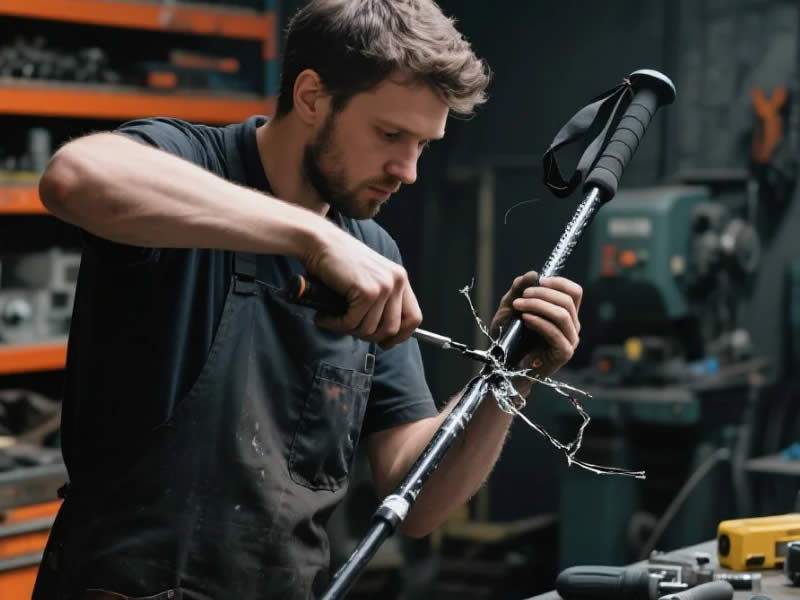
Recommended trekking pole purchase link: https://s.click.aliexpress.com/e/_c4M7OWaN
The Short Answer
Generally speaking, broken carbon trekking poles should not be DIY repaired. Carbon fiber is not like aluminum. It cannot be bent back into shape or welded. Once the continuous fibers that give carbon its strength are severed, no glue or epoxy can fully restore the pole's original structural integrity. However, in specific circumstances—particularly minor surface cracks or through manufacturer replacement programs—repair may be possible.
Why Carbon Fiber Is Different
Carbon fiber poles are sophisticated composite structures. The fibers are laid in precise orientations and cured in resin to optimize strength, flex, and weight distribution-4. This means:
- No effective DIY glue fix: The structural integrity lies in the continuous fibers. Once they are severed, glue cannot restore the original strength. A glued joint creates a hard, brittle point that will fail again under stress—potentially dangerously-4.
- Precision engineering matters: Each pole model has unique diameters, wall thicknesses, and taper profiles. A mismatched section will not fit correctly with locking mechanisms or adjacent sections, compromising safety-4.
- Hidden delamination: Carbon fiber can develop invisible internal damage (delamination) that progressively weakens the structure. A pole that looks fine may snap without warning on your next descent.
Assessing the Damage: Repairable vs. Unrepairable
Before any repair attempt, honestly evaluate the damage.
Potentially Repairable (Minor Damage Only)
- Hairline cracks under 2 inches (5 cm) – Surface cracks that haven't penetrated fully can sometimes be stabilized-1.
- Surface chips without full penetration-1.
- Loose ferrules (metal end pieces) that have detached but remain intact-1.
Not Repairable (Replace)
- Shattered or splintered sections – Once fibers are frayed or separated, the pole is structurally compromised-1.
- Cracks near locking mechanisms – These areas experience the highest stress during use-1.
- Bent carbon poles – Carbon does not bend plastically; a bent pole has already suffered internal fiber failure-1.
- Complete snap or break – No DIY method can reliably restore strength.
- Cracks extending more than 50% around the pole – Too extensive for any repair-1.
The Safe Approach: Manufacturer Replacement
For most broken carbon poles, the only truly reliable path is obtaining an exact, model-specific replacement section from the original manufacturer-4.
- Contact customer service – Brands like Black Diamond, LEKI, and Komperdell offer spare parts programs.
- Provide details – Pole model, broken section, photos of the damage.
- Purchase replacement section – A single carbon section typically costs $40–80, significantly less than a new $150–200 pair-4.
- Transfer components – You'll move the grip, strap, lock, and tip from the broken section to the new one.
Some manufacturers offer exceptional repair services. Komperdell, for instance, provides a unique 3-year free repair service. They will repair poles regardless of where they were purchased, whether the damage occurred by accident, incorrect handling, or product defect—no receipt required-18. If you own Komperdell poles, always check warranty coverage first.
If You Must DIY (Not Recommended for Safety-Critical Use)
Some experienced hikers have attempted DIY repairs with varying success. These methods may work for light-duty use or as backup poles, but should never be trusted on steep, technical terrain where a sudden collapse could cause serious injury.
Epoxy resin fix for hairline cracks: Sand the cracked area to remove gloss, apply two-part epoxy (e.g., JB Weld), wrap tightly with fiberglass tape, and cure for 24+ hours. This may last 6–12 months with moderate use on minor surface cracks-1.
Internal sleeve repair: One successful approach uses an internal aluminum arrow shaft as a splint. A repair documented online involved cutting a 5‑inch piece of 3/8‑inch aluminum arrow shaft that fit snugly inside the broken carbon tube, gluing it in place with slow‑drying JB Bond epoxy. The user reported that the repair held up for years of continued use-7. Another hiker used rolled aluminum from beverage cans as an internal sleeve, wrapping the exterior with additional aluminum and Leukotape before coating with epoxy-5.
Carbon fiber sleeve reinforcement: For larger cracks (2–4 inches), a heat‑shrink carbon sleeve can be slid over the damaged area and heat‑bonded. Kits cost approximately $20-1.
What to avoid: Never use carbon fiber that shows any splintering, fraying, or soft spots—these are signs the pole is unsafe. Avoid clamping carbon shafts in vices or using excessive force. Even minor damage requires careful handling.
The Risk of "Repairing" Broken Carbon
The outdoor gear community is divided. Some argue any DIY repair creates a dangerous false sense of security. Others have successfully repaired poles and used them for years.
The key question: What are you risking? A repaired carbon pole that fails on a gentle forest path may be an inconvenience. The same failure on a steep, exposed mountainside could cause a serious fall resulting in broken bones or worse.
Many manufacturers explicitly state that carbon poles with structural damage should be retired immediately. The Consumer Product Safety Commission has issued voluntary recalls on certain carbon poles due to breakage risks—underscoring that even factory‑new carbon can fail under certain conditions-21. If a brand‑new pole can be recalled for breakage, a DIY‑repaired one represents an even greater unknown.
When to Simply Replace
- The model is discontinued and no parts are available-4.
- The break is at or near a joint where the locking mechanism is bonded-4.
- It's a budget carbon pole (e.g., Cascade Mountain Tech) where a replacement section approaches 80–100% of a new pair's cost-4.
- You frequently hike technical or exposed terrain—don't gamble.
Final Verdict
Can broken carbon trekking poles be repaired? For a clean snap or significant splintering—no, not safely. For minor hairline surface cracks, some DIY methods exist, but they carry risk. The gold standard is manufacturer replacement of the broken section, which restores the pole to factory integrity. If you're determined to attempt a DIY repair, reserve the repaired pole for non‑critical use and inspect it thoroughly before every outing. A repaired carbon pole may surprise you with its durability—or it may fail when you need it most. For serious hikers, the peace of mind that comes with a properly replaced or new carbon pole is often worth the cost.




