




What is the correct height for trekking poles?
Setting your trekking poles to the correct height is essential for comfort, efficiency, and injury prevention. Poles that are too short force you to hunch forward, straining your lower back. Poles that are too long make you raise your shoulders, causing neck and arm fatigue. The good news: finding the right length is easy with a few simple rules. This guide covers the basic flat‑ground setting, adjustments for uphill and downhill, and how to fine‑tune for your body.
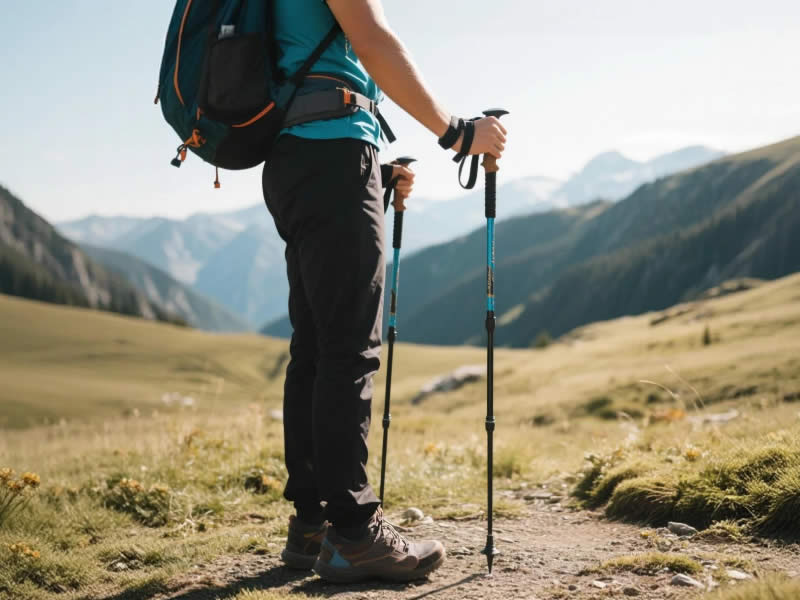
Recommended trekking pole purchase link: https://s.click.aliexpress.com/e/_c4M7OWaN
The basic flat‑ground rule: 90° elbow angle
Stand upright on a flat surface, holding your pole vertically with the tip resting on the ground. Your elbow should be bent at a 90‑degree angle (forearm parallel to the ground). This is the universal starting point.
- Why 90°? This angle provides the best mechanical advantage for pushing off while keeping your shoulder and arm muscles relaxed. It also allows you to easily shorten or lengthen the pole for slopes.
To achieve this, loosen the locking mechanism (flick‑locks are easiest), adjust the pole length, then lock it securely. Test by planting the pole with a light grip – your elbow should stay bent at 90°.
A simple formula based on your height
If you don’t have a pole to test, use this height‑based guideline (for the standard flat‑ground setting):
| Your height | Pole length range (flat ground) |
|---|---|
| < 160 cm (5’3″) | 100‑110 cm |
| 160‑170 cm (5’3″‑5’7″) | 110‑115 cm |
| 170‑180 cm (5’7″‑5’11″) | 115‑125 cm |
| 180‑190 cm (5’11″‑6’3″) | 120‑130 cm |
| > 190 cm (6’3″+) | 130‑140 cm |
These are starting points. Adjust slightly up or down based on your arm length and personal comfort.
Adjusting for uphill sections
When hiking uphill, you plant the pole higher up the slope in front of you. A shorter pole keeps your torso upright and prevents overreaching.
- Shorten your poles by 5‑10 cm (2‑4 inches) from the flat‑ground setting.
- The steeper the slope, the shorter you should go.
- Your elbow angle will be greater than 90° (more bent) – this is correct.
- Plant the pole close to your foot, not far ahead.
If you have flick‑locks, you can adjust length on the fly. For twist‑locks, it’s more cumbersome, so many hikers pre‑set a compromise length.
Adjusting for downhill sections
On descents, you need to plant the pole further downslope to act as a brake and to keep your center of gravity over your feet.
- Lengthen your poles by 5‑10 cm from the flat‑ground setting.
- Your elbow will be almost straight when the tip contacts the slope – that’s fine.
- Plant firmly, keeping the pole tip below your foot.
Going downhill with poles that are too short forces you to lean forward, increasing the risk of a face‑plant and putting extra stress on your knees.
Adjusting for traversing (side‑hilling)
When walking across a slope, one side of the trail is higher than the other. Use a bilateral adjustment:
- Shorten the uphill‑side pole by about 10‑15 cm.
- Lengthen the downhill‑side pole by a similar amount.
- This keeps both poles in good contact with the ground, preventing you from leaning sideways.
How to measure and mark your settings
- Use a permanent marker or coloured tape to mark your ideal flat‑ground length on the inner shaft of each pole.
- Make additional marks for “uphill” and “downhill” settings (e.g., 5 cm shorter and longer).
- This allows rapid adjustment without counting centimetres each time.
Common mistakes to avoid
- Using the same length for all terrain – This is the most frequent error. Always adjust for slope.
- Poles too long on the flat – Causes shoulder hunching and neck pain.
- Poles too short on downhills – Leads to forward lean and potential falls.
- Ignoring the wrist strap – Even at the correct length, a poorly adjusted strap (should come from below) reduces load transfer.
- Setting poles based on someone else’s height – Your arm length and torso proportion matter. Always test the 90° angle yourself.
Tips for different pole types
- Flick‑locks (external levers): Quick and easy to adjust on trail. Ideal for variable terrain.
- Twist‑locks: Harder to adjust accurately; many hikers set them once and leave them. Not recommended for steep, changing slopes.
- Folding Z‑poles: Fixed length. If you choose these, measure your flat‑ground height carefully and accept that you cannot adjust for climbs and descents. Some hikers use two different sets (longer for descents, shorter for ascents) – impractical for most.
The “fist test” alternative
If you don’t have a protractor handy, a quick field method: With your arm hanging naturally, raise your forearm until it is level (horizontal). The top of the pole grip should be at the height of your lowest rib or just below your navel – but the 90° rule is more precise.
Final summary
| Terrain | Adjustment from flat setting | Elbow angle |
|---|---|---|
| Flat ground | Baseline (90°) | 90° |
| Uphill | Shorten 5‑10 cm | >90° (more bent) |
| Downhill | Lengthen 5‑10 cm | <90° (straighter) |
| Traversing | Uphill pole shorter, downhill longer | Varies per side |
Take 30 seconds at the start of each hike to set your flat‑ground height. Then adjust for each major slope change – your knees, back, and shoulders will thank you. With the correct height, trekking poles become a seamless extension of your body, reducing fatigue and improving safety on every trail.




