




Can children use trekking poles safely?
Yes, children can use trekking poles safely – with the right equipment, proper instruction, and adult supervision. Trekking poles can enhance a child’s balance, reduce fatigue, and make hiking more enjoyable. However, children are not just small adults; they have different biomechanics, coordination levels, and risk awareness. This guide explains how to introduce trekking poles to kids safely, what features to look for, and when to avoid them.
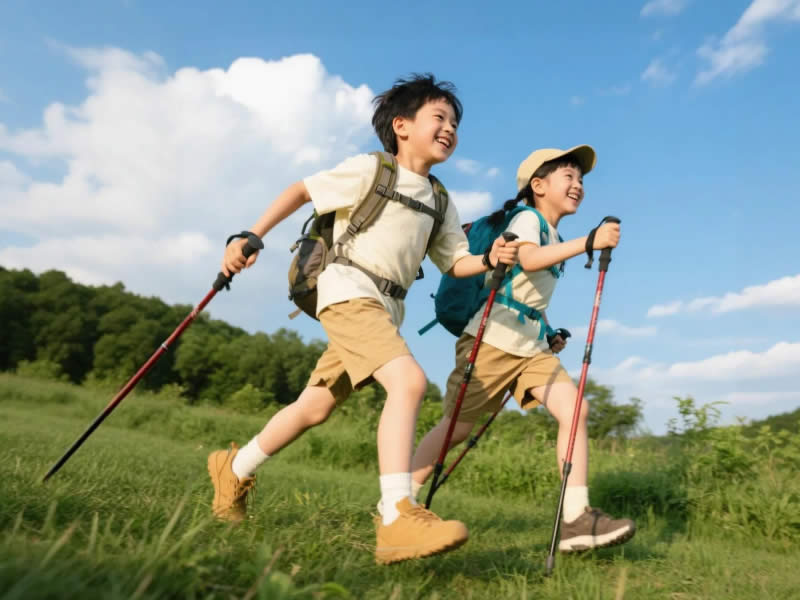
Recommended trekking pole purchase link: https://s.click.aliexpress.com/e/_c4M7OWaN
At what age can a child start using poles?
There is no fixed age, but most children develop the coordination for two‑pole walking around 5–7 years old. Some 4‑year‑olds can manage with very lightweight poles on flat, easy trails. Before age 5, many kids lack the hand‑eye coordination and attention span to use poles effectively; they may trip or poke others. Start with short, fun walks and be ready to take the poles away if they become a distraction.
Signs a child is ready:
- Can walk steadily on uneven ground without poles.
- Follows simple instructions (“plant the pole next to your foot”).
- Has enough hand strength to grip a lightweight pole.
- Shows interest in using poles like adults.
Choosing safe poles for children
Never give a child adult‑length poles. Oversized poles are dangerous (they catch on roots, throw off balance) and frustrating. Look for:
- Adjustable, lightweight aluminium poles – Carbon is brittle and expensive for kids. Aluminium is durable and forgiving.
- Short minimum length – Most children’s poles adjust from about 60 cm to 110 cm. Brands like Leki (Leki Voyager Kids), Black Diamond (Kids Trail), and Komperdell (Kids Powerlock) offer dedicated children’s models.
- Flick‑locks, not twist‑locks – Kids lack the hand strength to twist locks securely. Flick‑locks are easy and provide a clear visual confirmation.
- Foam grips – Foam is soft, warm, and easier for small hands to hold than cork or rubber.
- Non‑sharp tips – Some kids’ poles come with rubber tips only. If carbide tips are present, ensure rubber covers are used on hard surfaces or when not in active hiking.
- Light weight – Aim for under 200g per pole. Heavy poles will quickly tire a child’s arms.
Teaching safe technique
Start with a simple rule: Never swing the poles like a sword. Explain that poles are tools, not toys. Then practice on a flat, soft surface (grass or packed dirt) before hitting the trail.
Step‑by‑step instruction:
- Correct length – With the child standing upright and the pole tip on the ground, their elbow should be bent at about 90°. Write down the length or mark the pole.
- Wrist strap use – For very young children, many parents skip the strap (risk of entanglement). If using, teach to insert hand from below and not to pull the strap tight around the wrist. A loose strap is safer.
- Reciprocal motion – “Right pole with left foot, left pole with right foot.” Demonstrate slowly. Most kids get it after a few tries.
- Light planting – Plant the pole near the foot, not way ahead. This prevents tripping.
- Lifting, not dragging – Teach to lift the pole cleanly, not drag the tip. Dragging creates ruts and can catch on roots.
Safety rules to enforce:
- Keep poles to the sides of the body, not behind (where they could trip someone) or in front (where they could poke).
- Do not run with poles until the child has mastered walking with them.
- On steep or rocky sections, consider collapsing and stashing the poles.
- Never use poles to pull another child or as a tug‑of‑war rope.
Where to buy children’s trekking poles
| Brand | Model | Weight (per pole) | Length range | Features |
|---|---|---|---|---|
| Leki | Voyager Kids | ~200g | 65‑110 cm | Flick‑lock, foam grip, rubber tip covers |
| Black Diamond | Kids Trail | ~190g | 65‑110 cm | Flick‑lock, foam grip, small baskets |
| Komperdell | Kids Powerlock | ~210g | 60‑105 cm | Powerlock, foam grip |
| Decathlon | Forclaz Kids | ~230g | 65‑110 cm | Flick‑lock, budget option |
When to avoid poles for children
- Very young children (under 4) – They lack coordination and may poke themselves or others.
- Busy, crowded trails – Poles can be a hazard to other hikers (and dogs). Leave them in the pack.
- Technical scrambling or hands‑and‑feet sections – Poles are a hindrance; stow them.
- If the child loses interest – Forcing pole use can create a negative association with hiking.
Benefits of poles for kids
When used safely, poles offer real advantages:
- Improved balance – Children with low muscle tone or coordination issues gain confidence.
- Reduced fatigue – Longer hikes become feasible.
- Stream crossing safety – Poles provide extra stability.
- Fun factor – Many kids feel “grown‑up” using gear like parents.
- Injury prevention – Reduces trips and falls on uneven ground.
Parental supervision tips
- Model proper use – If you use poles correctly, your child will mimic you.
- Keep poles short on uphills, long on downhills – Adjust for them.
- Inspect poles before each trip – Ensure locks are tight, tips not loose.
- Carry a spare rubber tip – They get lost easily.
- Praise good technique – Positive reinforcement works wonders.
Final verdict
Trekking poles can be used safely by children, typically from age 5 or 6 onward, provided they are given properly sized poles (children’s models), taught correct technique, and supervised by an adult. Start on gentle terrain, keep sessions short, and always prioritise fun over distance. With patience, poles can become a tool that helps young hikers build confidence, endurance, and a lifelong love of the trail. If in doubt, wait another year – there is no rush. A child who enjoys hiking without poles is better off than one who is forced to use them.




