




What length trekking poles do I need for my height in cm?
Choosing the correct trekking pole length is essential for comfort, efficiency, and avoiding injury. The most reliable method is the 90‑degree elbow rule, but a simple formula based on your height in centimetres provides an excellent starting point. This guide explains both methods, offers a quick‑reference table, and tells you how to adjust for uphill, downhill, and traversing.
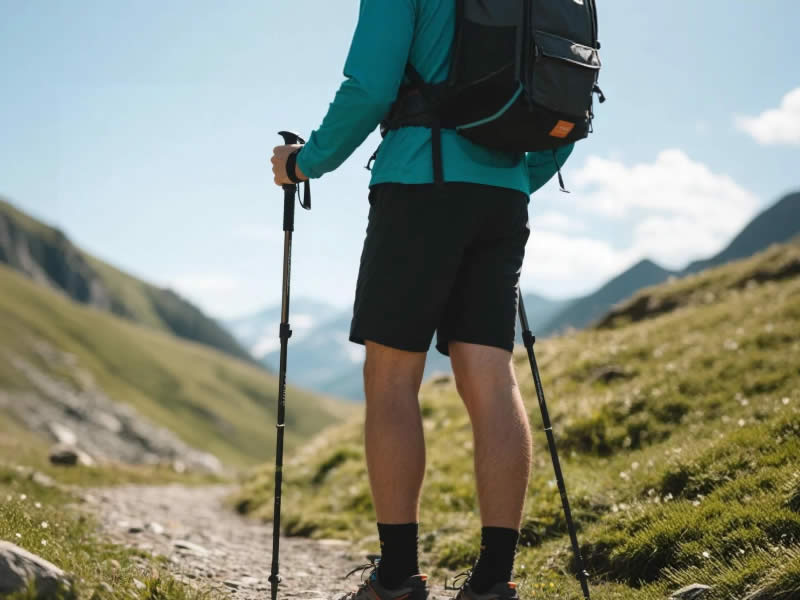
Recommended trekking pole purchase link: https://s.click.aliexpress.com/e/_c4M7OWaN
The quick formula: height × 0.68
A widely used approximation is to multiply your height in centimetres by 0.68. This gives the pole length in centimetres (measured from the tip to the top of the grip).
Example: For a hiker who is 170 cm tall:
170 × 0.68 = 115.6 cm → round to 115 cm (or 116 cm).
For a 160 cm tall person: 160 × 0.68 = 108.8 cm → 109 cm.
For a 185 cm tall person: 185 × 0.68 = 125.8 cm → 126 cm.
This formula assumes a typical arm‑to‑body ratio and is intended for flat terrain. You will adjust up or down for slopes.
Height‑to‑length reference table
| Your height (cm) | Recommended pole length (flat ground) |
|---|---|
| 150 – 155 | 100 – 105 cm |
| 155 – 160 | 105 – 110 cm |
| 160 – 165 | 108 – 112 cm |
| 165 – 170 | 112 – 116 cm |
| 170 – 175 | 115 – 120 cm |
| 175 – 180 | 118 – 123 cm |
| 180 – 185 | 122 – 126 cm |
| 185 – 190 | 125 – 130 cm |
| 190 – 195 | 130 – 135 cm |
| 195 – 200 | 135 – 140 cm |
These ranges account for variations in arm length and personal preference. Always fine‑tune with the elbow test.
The 90° elbow rule (most accurate)
Stand on a flat, hard surface wearing your hiking shoes. Hold the pole vertically with the tip on the ground. Your elbow should be bent exactly 90 degrees (forearm parallel to the ground). Adjust the pole until this angle is achieved. Mark that length – it is your baseline for flat terrain.
- If your elbow is less than 90° (too bent), the pole is too short.
- If your elbow is more than 90° (almost straight), the pole is too long.
This method automatically accounts for unusual arm lengths or torso proportions.
Adjusting for terrain (critical for real hiking)
Do not use the same length everywhere. You must adjust:
- Uphill: Shorten poles by 5–10 cm from your flat‑ground setting. This keeps your torso upright and prevents overreaching.
- Downhill: Lengthen poles by 5–10 cm. This allows you to plant downslope and act as brakes, reducing knee impact.
- Traversing (side‑hilling): Shorten the uphill‑side pole and lengthen the downhill‑side pole by about 10–15 cm each.
What about folding (Z‑poles) with fixed length?
If you buy folding poles, you cannot adjust them on the trail. Choose a length based on your flat‑ground measurement – but accept that you will not have optimal length for climbs and descents. Many fastpackers choose a length that splits the difference (e.g., 5 cm shorter than flat) and learn to adapt. For true all‑terrain hiking, telescoping poles with flick‑locks are far better.
Common mistakes
- Using poles that are too long – Raises your shoulders, causing neck and shoulder pain.
- Using poles that are too short – Forces you to hunch, straining your lower back.
- Never adjusting for slopes – The most common error among beginners.
- Basing length on someone else’s height – Arm length differs; always test for yourself.
Final advice
Start with the height‑based formula (height × 0.68) or the height table. Then do the elbow test on flat ground to fine‑tune. Mark your poles (tape or permanent marker) with the flat, uphill, and downhill lengths. With flick‑locks, you can change settings in seconds on the trail. Correct pole length transforms hiking from a chore into a joy – your knees, back, and shoulders will thank you.




