




Do I need shock absorbing trekking poles for muddy British paths?
If you have ever slogged through a deep, sticky mud bath on a British trail – think the boggy sections of the Pennine Way or the quagmires of the South West Coast Path after heavy rain – you may have wondered whether your trekking poles need extra help from shock‑absorbing (anti‑shock) technology. The short answer is no, for most muddy British paths, shock absorption is unnecessary and even counterproductive. This article explains why, and when it might be worth considering.
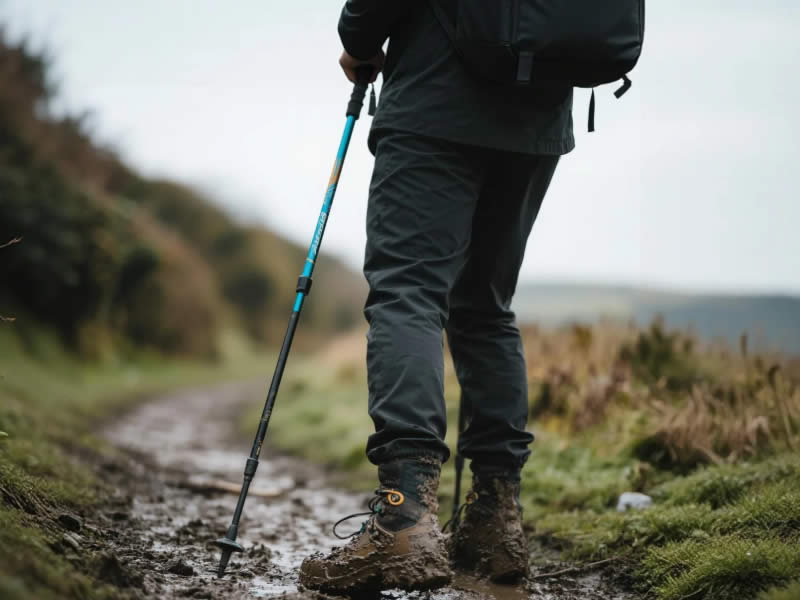
Recommended trekking pole purchase link: https://s.click.aliexpress.com/e/_c4M7OWaN
What are shock‑absorbing trekking poles?
Shock‑absorbing poles contain an internal spring (usually in the lower section) that compresses when you plant the pole. The idea is to reduce the jarring impact that travels up your arm, wrist, and shoulder – particularly on hard surfaces like pavement, rock, or frozen ground. Brands like Leki (with their “Anti‑Shock” system) and Black Diamond offer such models.
Why muddy paths do not need shock absorption
Mud is nature’s shock absorber. When you plant a pole into soft, wet earth, the ground itself gives way, cushioning the impact far more effectively than a tiny spring. The tip sinks slightly, and the muddy surface absorbs the energy. There is virtually no hard jarring to dampen. In fact, adding a spring mechanism creates a mushy, vague feel – you lose the solid feedback that helps you balance in slippery conditions. On a muddy slope, you want a firm, predictable plant, not a bouncy one.
The downsides of anti‑shock on muddy trails
- Weight – Anti‑shock mechanisms add 30‑50g per pole. On a long, muddy day, that extra weight is noticeable but offers no benefit in mud.
- Complexity and maintenance – Springs can become clogged with mud and grit, jamming or failing. Seals can break, allowing water and dirt inside. Standard poles have no such moving parts.
- Reduced feel – The slight compression can mask the exact moment your tip hits a firm layer below the mud, making it harder to find solid ground.
- Higher cost – Anti‑shock models are typically £20‑30 more expensive than their rigid counterparts.
When shock absorption might help on British paths
On hard, dry, or frozen surfaces – such as rocky sections of the Lakes, ice in winter, or compacted chalk trails – a spring can reduce wrist and elbow fatigue. If your route includes long stretches of pavement or hardpack, anti‑shock could be beneficial. Also, hikers with arthritis or previous wrist/elbow injuries sometimes find that even the small reduction in vibration helps. But for pure mud, it is unnecessary.
What to focus on instead for muddy paths
For muddy British trails, prioritise:
- Carbide tips – They dig into the firm layer beneath mud. Rubber tips are useless.
- Reinforced baskets – Small baskets prevent the pole from sinking too deep; larger baskets can be swapped for winter, but standard ones work in mud.
- Robust flick‑locks – Mud clogs twist‑locks; flick‑locks are easy to clean.
- Easy‑to‑clean shafts – Smear of mud? Wipe with a cloth. Anti‑shock springs trap mud inside.
Recommended poles for muddy UK trails
- Leki Khumbu Lite (no anti‑shock) – simple, reliable, easy to clean.
- Black Diamond Trail Pro (no anti‑shock) – bomb‑proof flick‑lock, foam grip.
- Decathlon Forclaz MT500 (no anti‑shock) – excellent budget choice.
When you might still consider anti‑shock
If you frequently hike on mixed terrain that includes both mud and long rocky/road sections, and you also have wrist issues, look for poles with a switchable anti‑shock mechanism. Some Leki models allow you to turn the spring on or off. You can deactivate it in mud (rigid feel) and activate it on hard ground. This gives versatility, but at extra cost and weight.
Final verdict
For the vast majority of muddy British paths, you do not need shock‑absorbing trekking poles. The mud itself cushions the impact. Anti‑shock adds weight, complexity, and a vague planting feel – exactly what you do not want in slippery conditions. Save your money and buy a good pair of standard flick‑lock aluminium poles. Focus on sharp carbide tips and reliable locks. Your knees and wallet will thank you.




