




Are trekking poles with built-in anti-shock good for bad knees?
If you suffer from knee pain – whether from osteoarthritis, past injuries, or general wear and tear – you have likely heard that trekking poles can reduce the load on your joints. But what about poles with built‑in anti‑shock (shock‑absorbing) mechanisms? Do they offer additional benefits for bad knees? The short answer is yes, they can help, but they are not a magic solution. For most people with knee issues, proper pole technique and correct length adjustment are more important than anti‑shock. This article explains how anti‑shock works, its pros and cons for knee pain, and when it might be worth the extra cost.
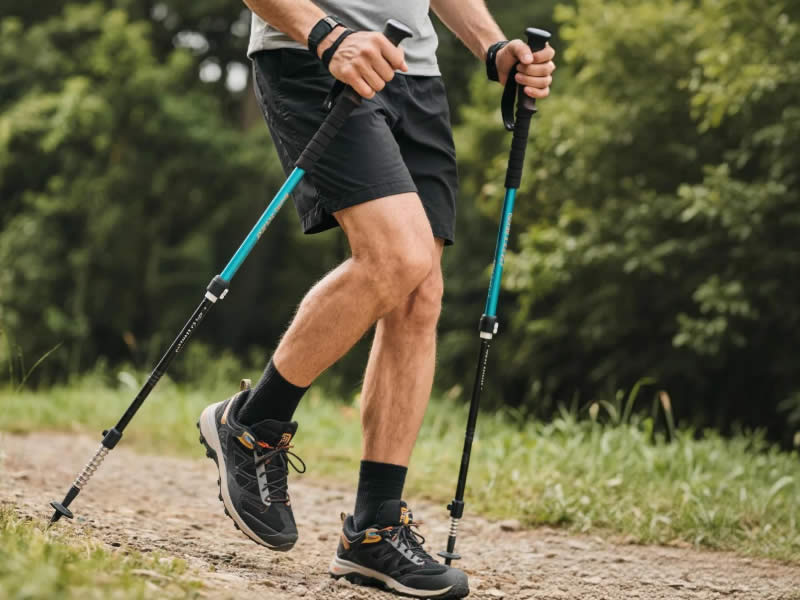
Recommended trekking pole purchase link: https://s.click.aliexpress.com/e/_c4M7OWaN
How anti‑shock works
Anti‑shock poles contain an internal spring (usually in the lower section) that compresses when you plant the pole. This spring absorbs a portion of the impact that would otherwise travel up your arm, through your shoulder, and – indirectly – affect your posture and gait. The idea is to reduce jarring, especially on hard surfaces like pavement, compacted trails, or rocky descents.
Potential benefits for bad knees
- Reduced impact transmission – When you walk downhill, each foot strike sends a shock wave up your leg. By absorbing some of the impact through your arms and poles, anti‑shock can theoretically reduce the total force that reaches your knees. However, the direct effect is on your upper body; the knee load reduction comes mainly from offloading weight (20‑25%) via the poles, not from the spring itself.
- Smoother feel on hard ground – On rocky, frozen, or paved surfaces, the spring makes the plant feel less abrupt. This can encourage a more relaxed walking rhythm, which may indirectly reduce knee strain.
- Comfort for arthritic hands/wrists – If you also have arthritis in your hands or wrists, the shock absorption can ease discomfort when planting on hard ground. Less hand pain means you can use the poles more effectively to offload your knees.
Limitations and downsides
- Anti‑shock does not reduce knee load directly – The primary mechanism for saving your knees is transferring weight from your legs to your arms. A standard (non‑anti‑shock) pole does this just as well. The spring only affects the feel of the impact.
- Adds weight and complexity – Anti‑shock mechanisms add about 30‑50g per pole and have moving parts that can fail (springs can wear out or clog with mud). For backcountry reliability, simpler poles are often better.
- Mushy feel on soft ground – On mud, grass, or snow, the spring compresses unnecessarily, giving a vague, less responsive plant. Many hikers find this annoying.
- Not a substitute for technique – If you use poles that are the wrong length, plant them incorrectly, or fail to use wrist straps, anti‑shock will not save your knees. Correct technique is far more impactful.
When anti‑shock might be beneficial for bad knees
- You walk a lot on hard, unforgiving surfaces – e.g., paved paths, rocky mountain trails, or frozen ground. The reduction in jarring can be noticeable.
- You have concurrent wrist or elbow pain – The spring can make each plant less painful, allowing you to use poles more consistently.
- You are a heavier hiker – More body weight means more impact force; anti‑shock may help dampen the shock transmitted through the poles.
When you can skip anti‑shock
- Most of your hiking is on soft trails (mud, grass, soil) – The ground already absorbs impact; anti‑shock adds little.
- You are on a tight budget – Anti‑shock poles cost £20‑40 more than equivalent non‑anti‑shock models. That money could be spent on better knee braces or physical therapy.
- You prioritise simplicity and durability – Fewer moving parts means less to break.
What matters more for bad knees than anti‑shock
- Using two poles, always – Single pole creates asymmetry.
- Correct length – Shorten for uphill, lengthen for downhill. Elbow at 90° on flat.
- Wrist strap technique – Hand from below, strap across back of wrist. Relax grip.
- Planting below your body – Don’t reach far ahead; keep the pole near your foot.
- Carbide tips – Ensure they are sharp for grip on rock and ice.
- Lightweight poles – Heavy poles fatigue your arms, reducing your ability to offload knees.
Recommended anti‑shock models for knee pain
- Leki Makalu Anti‑Shock – Classic aluminium pole with reliable SpeedLock and cork grip. The anti‑shock can be switched off for soft ground.
- Black Diamond Trail Shock – FlickLock Pro with internal spring. Sturdy and durable.
- Komperdell Contour Anti‑Shock – Good value, cork/foam grip.
Final verdict
Trekking poles with built‑in anti‑shock can be helpful for people with bad knees, especially if you frequently hike on hard, rocky, or frozen terrain. They add a layer of comfort and may reduce upper body fatigue, which indirectly supports better knee‑saving form. However, anti‑shock is not essential; proper technique, correct pole length, and using two poles are far more important. If you have a limited budget, spend your money on a good pair of standard flick‑lock aluminium poles and learn proper technique. If you have extra funds and hike on hard surfaces, anti‑shock is a nice bonus – but never a substitute for the fundamentals.




