




Is it worth buying trekking poles with carbide tips for rocky paths?
Absolutely yes – if you regularly walk on rocky trails, carbide tips are not just worth it; they are essential. On hard, abrasive surfaces like rock, scree, or compacted gravel, carbide tips dramatically outperform rubber or steel alternatives. They provide superior grip, last far longer, and offer safety benefits that justify the slightly higher initial cost. This article explains why carbide tips are the right choice for rocky terrain, how they compare to other tip materials, and why skimping on tips can ruin your hiking experience.
Recommended trekking pole purchase link: https://s.click.aliexpress.com/e/_c4M7OWaN
What are carbide tips?
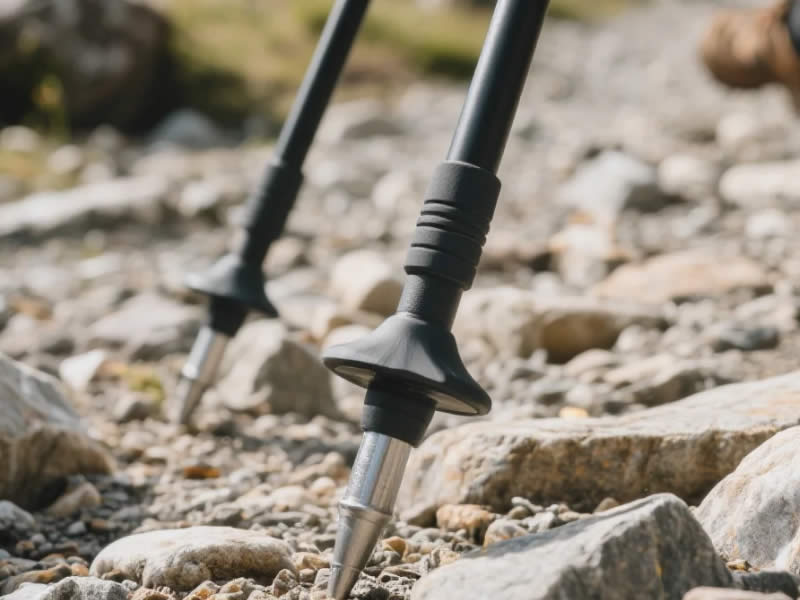
Trekking pole tips are typically made of tungsten carbide – an extremely hard, wear‑resistant compound (hardness ~8.5‑9 on Mohs scale, just below diamond). The tip is usually a small carbide insert embedded in a steel ferrule that attaches to the pole shaft. They come as standard on almost all quality trekking poles, from budget models (e.g., Decathlon MT500) to premium brands (Leki, Black Diamond).
Why carbide tips excel on rocky paths
1. Superior grip on smooth rock
Rubber tips are designed for pavement and indoor floors. On wet or dry rock, rubber is slippery – you may feel the pole skid sideways, reducing stability and increasing fall risk. Carbide, being hard and slightly pointed, bites into microscopic irregularities on rock surfaces, providing a secure plant. On lichen‑covered or damp rock, this difference is even more pronounced.
2. Exceptional wear resistance
Rock is abrasive. A rubber tip can wear down to a nub in as little as 10‑20 km of rocky walking. A steel tip might last 100‑200 km before rounding. Tungsten carbide, however, can withstand hundreds of kilometres of rocky abuse. Many hikers get 500‑1,500 km from a single carbide tip, depending on terrain. This longevity means you spend less money and time on replacements.
3. Helps you find secure footing
On loose scree or broken rock, you need to probe ahead to find a stable placement. A carbide tip gives you precise tactile feedback – you can feel whether you have hit a solid rock or a shifting pebble. A blunt rubber tip cannot provide this sensitivity.
4. Reliable on mixed terrain
Rocky paths often include mud, grass, and ice. Carbide tips work on all these surfaces (though on ice, add an ice gripper for extra bite). Rubber tips fail on mud (caking) and ice (slippery). Carbide is a true all‑terrain solution.
Carbide vs. alternatives
| Tip material | Grip on rock | Durability on rock | Terrain suitability | Typical cost |
|---|---|---|---|---|
| Carbide (tungsten) | Excellent | Very high (500‑1500 km) | All (rock, dirt, mud, ice*) | Included on good poles; replacement ~£5‑10/pair |
| Steel | Moderate | Medium (100‑300 km) | Rock acceptable, but wears faster | Rare (some budget poles) |
| Rubber (road tips) | Poor (slippery) | Low (10‑50 km) | Pavement only | Cheap, but not for trails |
| Ceramic | Good | High, but brittle | Rock acceptable, but can chip | Uncommon |
*For pure ice, add an ice gripper over the carbide tip.
Are there any downsides to carbide?
- Can scratch rock – In environmentally sensitive areas (e.g., rock art, polished alpine slabs), carbide tips can leave marks. Use rubber covers or avoid poles there.
- Noisy on rock – They produce a distinct tapping sound. Not a functional issue.
- Can damage floors – Never use bare carbide indoors or on car roofs; always fit rubber covers.
- Slightly higher initial cost – Poles with good carbide tips are typically £30+, while ultra‑cheap twist‑lock poles may have steel or no tips. The extra cost is justified by safety and longevity.
Do you really need carbide for rocky paths?
If you hike exclusively on soft forest trails with no rock, you might get away with steel tips (or even rubber if the trail is pavement). But as soon as you encounter rock – and most British hills, Scottish mountains, or alpine paths are full of it – carbide is strongly recommended. The improved grip and durability directly reduce fall risk and pole wear.
How to care for carbide tips
- Inspect regularly – When the tip becomes visibly rounded or the carbide insert is worn flush with the steel ferrule, replace it. A dull tip loses grip.
- Use rubber covers on pavement – Walking on asphalt wears carbide much faster. Put on the “paws” as soon as you hit paved sections.
- Replace in pairs – For symmetry, replace both tips at the same time.
- Buy the correct shape – Some carbide tips are pointed (better for rock), others are blunt (for dirt). For rock, choose a sharp, tapered tip.
Bottom line: worth every penny
For anyone who hikes on rocky paths – whether in the Peak District, Lake District, Scottish Highlands, or any mountain region – carbide tips are absolutely worth buying. They provide superior grip, last many times longer than rubber or steel, and offer safety benefits that no other tip material can match. Most quality trekking poles come with carbide tips as standard; never replace them with rubber or cheap steel alternatives. A small investment in a fresh set of carbide tips every few years keeps your poles performing safely on the rockiest terrain.




