




Are aluminium trekking poles more durable than carbon for scrambling?
Yes – for scrambling, aluminium trekking poles are significantly more durable than carbon. Scrambling involves steep, rocky terrain where you may jam your pole between boulders, lever yourself up a slab, or drop the pole onto sharp edges. In these conditions, carbon fibre’s brittleness becomes a liability, while aluminium’s ability to bend rather than snap is a critical safety advantage. This article explains why aluminium is the superior choice for scramblers and mountaineers.
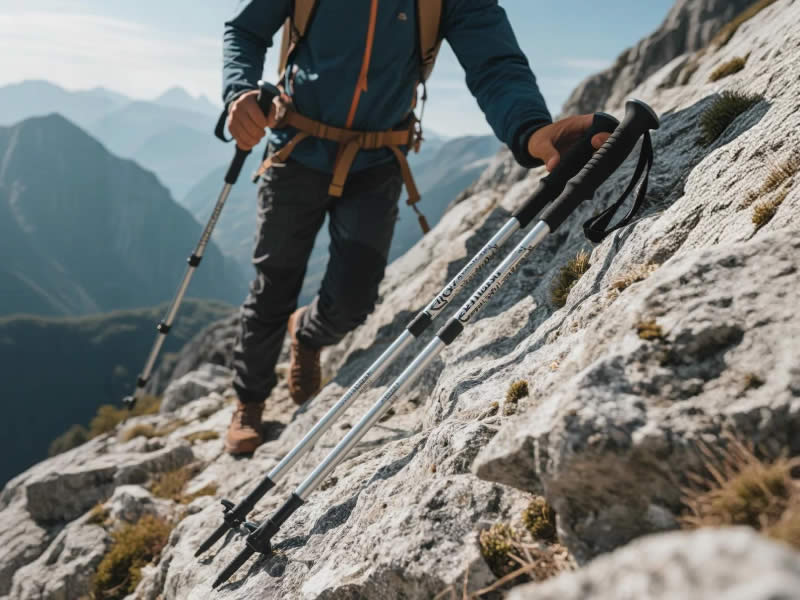
Recommended trekking pole purchase link: https://s.click.aliexpress.com/e/_c4M7OWaN
What is scrambling?
Scrambling sits between hiking and climbing. You use your hands for balance, traverse loose scree, and sometimes pull on rocks. Your trekking poles are often used as a third or fourth point of contact, planted in cracks or wedged against holds. The forces involved are not just vertical compression (as on a normal path) but lateral torques and impacts.
Why carbon fibre is vulnerable on scrambles
Carbon fibre is a composite of carbon fibres embedded in a polymer resin. It is exceptionally stiff and strong in compression along the axis of the fibres. However, it is weak in tension and brittle under lateral impact.
On a rocky scramble:
- You might plant the pole and then lean sideways, torquing the shaft.
- You might drop the pole onto a sharp boulder edge, concentrating force on a tiny point.
- You might wedge the tip between two rocks and then pull to free it, bending the shaft.
In these scenarios, aluminium will dent or bend. Carbon fibre, lacking ductility, will often crack or snap completely. A snapped carbon pole is unusable; a bent aluminium pole can often be straightened (carefully) and continue to serve.
How aluminium behaves differently
Aluminium (especially 7075‑T6 alloy) is a metal that undergoes plastic deformation before failure. When overloaded, it bends, absorbing energy. The shaft may be bent out of true, but it remains one piece. You can often bend it back (though this weakens it slightly). For the remainder of a scramble, a bent pole is far better than no pole.
Moreover, aluminium shafts are typically thicker‑walled than carbon equivalents to achieve the same stiffness. This extra material gives them greater resistance to denting and abrasion from sharp rock.
Real‑world evidence from scramblers
Online forums (UKClimbing, Mountain Project, Reddit) are filled with anecdotes of carbon poles snapping on scrambles:
- “I was on the Crib Goch ridge, my partner’s carbon pole snapped when it got wedged between two rocks. He had to finish the scramble with one pole.”
- “My Black Diamond carbon Z‑pole cracked after a minor drop onto a scree slope. My friend’s decade‑old aluminium Leki pole has been straightened twice and still works.”
Guides in the Alps and the Lake District almost universally recommend aluminium flick‑lock poles for scramblers. Carbon is seen as a “fair‑weather” material for groomed trails.
When carbon can still work
Carbon poles can survive scrambles if you:
- Use them only for vertical planting, never for levering.
- Carry them in your pack for the actual scrambling sections and use your hands.
- Are a very lightweight, careful user.
But the risk of a sudden failure is always present. For a multi‑day trip where a broken pole could become a serious problem, aluminium is the safer bet.
Comparing specific models
| Material | Example | Weight (per pole) | Behaviour on impact | suitability for scrambling |
|---|---|---|---|---|
| Aluminium | Leki Makalu Lite | 240g | Bends, can be straightened | Excellent |
| Aluminium | Black Diamond Trail Pro | 275g | Bends, very tough | Excellent |
| Carbon | Black Diamond Distance Carbon Z | 165g | Snaps or cracks | Poor |
| Carbon | Leki Micro Vario Carbon | 190g | Snaps or cracks | Poor |
Tips for choosing poles for scrambles
- Lock type: External flick‑locks (SpeedLock, FlickLock). Twist‑locks can slip when dirty. Flick‑locks are field‑serviceable.
- Grip: Cork or foam with an extended section so you can choke down.
- Tip: Carbide with replaceable tip. Scrambling wears tips quickly.
- Baskets: Small baskets or none – larger baskets catch on rocks.
Maintenance after scrambles
After a rocky day, check your aluminium poles for straightness. If bent, gently straighten by hand (wear gloves). Inspect for cracks around the flick‑lock area. Rinse off grit.
Final verdict
For scrambling – defined as hands‑on, rocky, uneven terrain where poles are subjected to lateral forces and impacts – aluminium trekking poles are undeniably more durable than carbon. Their ability to bend rather than snap, combined with lower cost and easier repairability, makes them the rational choice for anyone who tackles rocky hills, ridges, or mountain scrambles. Leave carbon poles for smooth trails, road walking, or situations where every gram counts and rocks are scarce. On a knife‑edge ridge, trust aluminium.




