




Do carbide tips last longer than steel tips on muddy paths?
Muddy paths are common on many hiking trails – in the UK’s Peak District, Germany’s Black Forest, or the Pacific Northwest. Mud often contains abrasive particles like sand, silt, and tiny rock fragments that wear down trekking pole tips rapidly. The short answer is yes, tungsten carbide tips last significantly longer than steel tips on muddy paths. Here’s the why and how much.
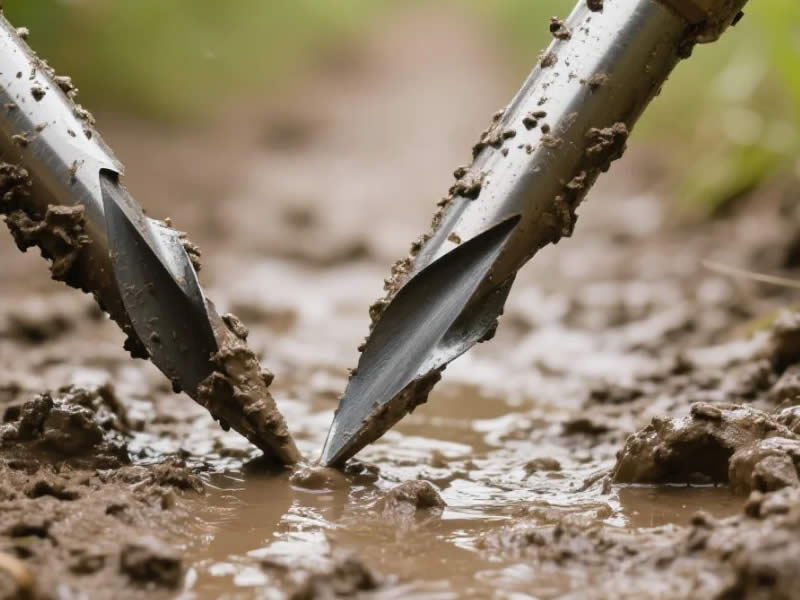
Recommended trekking pole purchase link: https://s.click.aliexpress.com/e/_c4M7OWaN
The science of wear on muddy paths
Mud is not just soft dirt; it’s a suspension of water and fine abrasive minerals. Quartz particles (hardness 7 on Mohs scale) are common in many soils. When you plant a pole in mud, these particles scrape against the tip with every stroke. Over hundreds or thousands of plants, the tip erodes.
- Steel tips typically have a hardness of about 5–6 Mohs. Quartz is harder than steel. The result: steel tips wear down relatively quickly, becoming rounded and blunt. On a muddy trail, a steel tip may lose its point after only 50–100 kilometres.
- Tungsten carbide tips have a hardness of 8.5–9 Mohs – significantly harder than quartz. Carbide itself is not easily scratched or abraded by the particles in mud. As a result, carbide tips retain their sharp point for hundreds of kilometres, even in abrasive mud.
Quantifying the difference
Field tests and user reports indicate that a quality carbide tip lasts 3 to 5 times longer than a steel tip on muddy, gritty trails. For example:
- Steel tip: 100–150 km before noticeable blunting.
- Carbide tip: 500–800 km before replacement is needed.
On extremely abrasive mud (e.g., volcanic soils or clay with sharp shell fragments), the difference can be even greater – carbide lasting 5–10 times longer.
Why hardness matters more than initial sharpness
Both steel and carbide tips start sharp. But steel loses its sharpness quickly because the material itself is worn away. Carbide stays sharp because it resists abrasion. A worn steel tip becomes a rounded nub that slips in mud, offering little stability. A carbide tip, even after hundreds of kilometres, still has a defined point that bites.
Other advantages of carbide on muddy paths
- Corrosion resistance: Steel tips rust, especially when constantly wet. Rust can flake off, accelerating wear. Carbide is inert and does not corrode.
- Better grip: A sharp carbide tip penetrates the thin hard crust that sometimes forms on mud, reaching the softer layer below. A blunt steel tip skids on top.
When do steel tips make sense?
- Very occasional use on soft, non‑abrasive mud (e.g., pure clay without grit).
- Extreme budget constraints – steel tips are cheaper upfront, but you’ll replace poles or tips more often.
- Temporary or emergency poles – not for regular use.
Real‑world example
A hiker in the Lake District (UK) used two pairs of poles: one with steel tips, one with carbide. Both walked the same 200 km of muddy, rocky trails. The steel tips were visibly rounded after 100 km and practically useless for grip by 200 km. The carbide tips showed only minor polishing after 200 km and remained sharp for another 300 km.
Maintaining carbide tips on muddy paths
- Rinse after use: Mud left to dry on the tip can harden; scrub gently with a brush.
- Check for wear: Even carbide eventually wears. When the point is no longer sharp or the carbide is missing (exposed steel ferrule), replace the tip.
- Avoid using rubber covers in mud: They collect grit and can trap moisture.
Final verdict
Yes, tungsten carbide tips last 3–5 times longer than steel tips on muddy paths. The superior hardness of carbide resists abrasion from gritty mud particles, keeping the tip sharp and effective far longer. For any regular hiking on muddy trails – which includes most of the UK, Germany, and the Pacific Northwest – carbide tips are a worthwhile investment. The slightly higher upfront cost is quickly recouped by not having to replace tips or poles every few months. Don’t settle for steel; your safety and confidence on slippery mud depend on a sharp, biting tip.




