




Do trekking poles make walking uphill more or less tiring?
Ask a dozen hikers, and you might get different answers. Some feel poles are a burden on climbs; others swear by them. The scientific and practical consensus is clear: trekking poles make walking uphill less tiring – provided you use them correctly. Here’s why.
Recommended trekking pole purchase link: https://s.click.aliexpress.com/e/_c4M7OWaN
The energy transfer principle
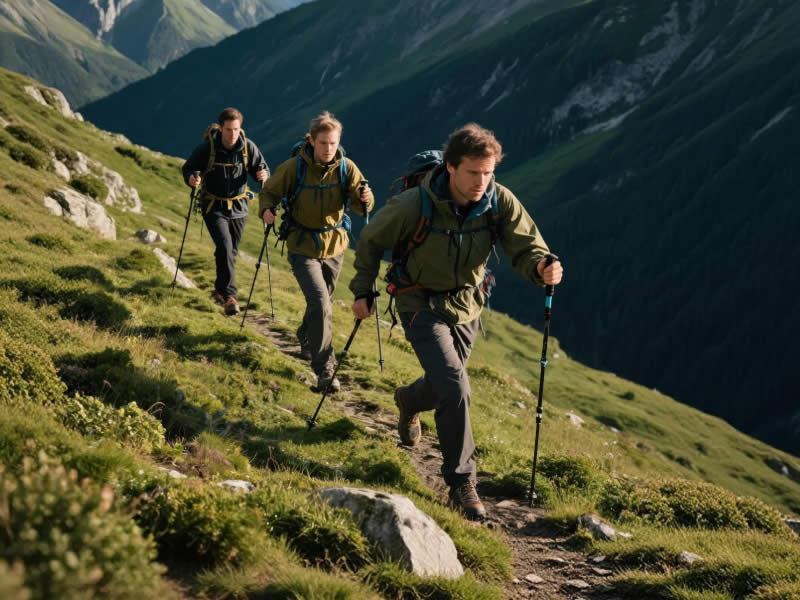
Walking uphill without poles relies almost entirely on your leg muscles (quadriceps, hamstrings, calves, and glutes). Each step lifts your body weight against gravity, requiring significant effort. When you add trekking poles and use them actively, you engage your arms, shoulders, and back muscles. This distributes the workload across more muscle groups, reducing the strain on any single group. Studies show that using poles on steep climbs can lower perceived exertion by 10–15% and reduce heart rate by 5–8 beats per minute for the same pace.
How poles make uphill easier
- Push and pull: Plant both poles ahead of you and pull yourself up. This uses your strong latissimus dorsi and triceps to help your legs. On very steep slopes, you can almost “climb” using your arms.
- Rhythm and momentum: Poles create a natural, steady rhythm. The alternate planting (opposite pole to forward foot) helps you maintain a consistent cadence, preventing the stop‑start fatigue that comes from over‑striding.
- Reduced quadriceps load: By pushing down on the poles, you transfer some of your body weight from your thighs to your upper body. This reduces the burn in your quads, allowing you to climb longer without stopping.
- Better posture: Poles encourage an upright torso, which keeps your airways open and improves breathing efficiency. Leaning forward without poles compresses your chest, making each breath harder.
Why some people find poles more tiring
- Incorrect length: If your poles are too long on an uphill, your arms will be raised too high, straining your shoulders and neck. Shorten poles by 5–10 cm for climbing.
- Poor technique: Tapping the pole lightly does nothing. You must actively push down and back. Also, using wrist straps incorrectly (hand in from above) forces you to grip tightly, tiring your forearms.
- Weak upper body: If you’re not used to using your arms, the new muscle engagement can feel tiring at first. After a few hikes, your upper body adapts, and the net fatigue decreases.
- Over‑reaching: Planting the pole too far ahead pulls you forward and wastes energy. Plant near your forward foot.
What research says
A 2015 study in the Journal of Sports Medicine compared oxygen consumption and heart rate on a 15% incline. Participants walking with poles had a 7% lower heart rate and reported feeling less tired than those without, despite the same speed. Another study found that poles reduced the perceived difficulty of a steep climb by 20% in novice hikers.
Practical test you can do
Find a moderate hill (10–15% grade). Climb it once without poles, noting how your legs feel. Rest, then climb again with poles, shortening them by 5–10 cm and using an active push. Most people report significantly less leg burn and feel they can climb longer. The difference is immediate.
When poles might not help (much)
- Very short, steep pitches – you may need hands free for scrambling.
- Flat or gentle inclines – the benefit is smaller, but still present.
- If you already have strong legs and poor upper‑body strength – you’ll still benefit, but you may need to build arm conditioning.
Final verdict
Trekking poles make walking uphill less tiring for the vast majority of hikers. They spread the workload to your upper body, reduce quadriceps fatigue, improve rhythm, and lower perceived exertion. To maximise the benefit, shorten your poles for climbs, use an active push, and master the wrist strap technique. With a little practice, you’ll climb longer, feel fresher, and enjoy the ascent far more. Don’t leave them in your pack – use them actively, and your legs will thank you.




