




How to use trekking poles correctly for steep ascents in Snowdonia?
Snowdonia’s steep, rocky ascents – from the Pyg Track up Snowdon to the boulder fields of Tryfan or the sharp ridges of the Glyderau – demand more from your trekking poles than a gentle woodland stroll. Using poles incorrectly can waste energy, strain your shoulders, and even cause a fall. Here’s how to master the technique for steep Snowdonia climbs.
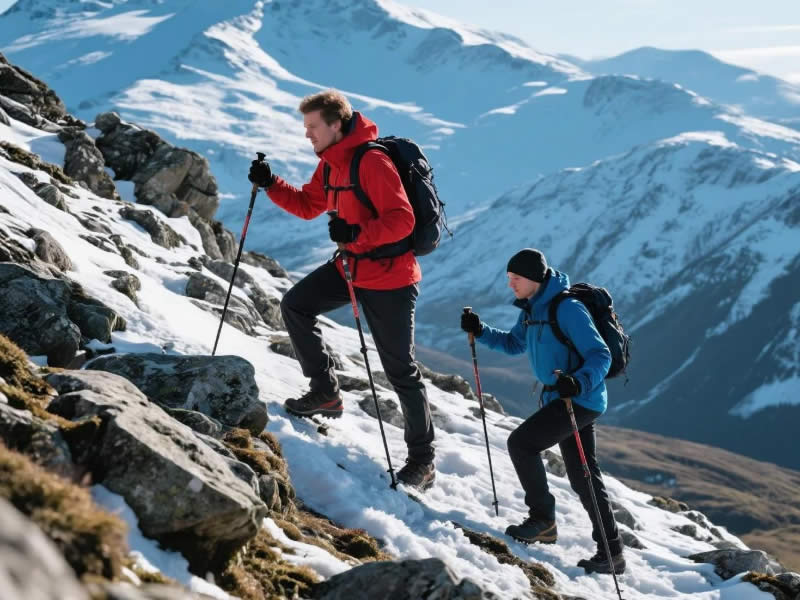
Recommended trekking pole purchase link: https://s.click.aliexpress.com/e/_c4M7OWaN
Step 1: Shorten your poles
On flat ground, your elbows should be at 90° when the tip touches the ground. For steep ascents, shorten your poles by 5–10 cm (2–4 inches). Why? A shorter pole keeps your arms low, preventing shoulder strain and allowing you to push down effectively. If your poles are too long, you’ll raise your arms too high, and each plant will tire your shoulders.
Step 2: Use the wrist straps correctly
Insert your hand up through the strap from below, so the strap sits between your thumb and index finger. Grip the handle lightly – the strap should bear your weight. On a steep climb, you’ll be pushing down hard; the strap transfers that force from your arm to the pole without needing a death grip.
Step 3: Choose your planting rhythm
- On moderate steep slopes (10–15%): Use an alternating rhythm – plant the opposite pole to your forward foot (right foot up, left pole down). This maintains a natural walking gait.
- On very steep slopes (20%+): Switch to double planting – plant both poles together ahead of you, then pull yourself up using your arms. This engages your triceps and lats, saving your quads for the hardest steps.
Step 4: Plant ahead, but not too far
Plant the pole when your hand is level with the toe of your forward foot – not way out in front. Over‑reaching pulls you forward and wastes energy. Press down and back, as if you’re pushing the ground behind you.
Step 5: Stay upright and look ahead
Avoid hunching over your poles. Keep your chest open, shoulders back, and eyes on the trail ahead. Poles should help you maintain an upright posture, which improves breathing and efficiency.
Practical tips for Snowdonia’s unique terrain
- On loose scree (e.g., Y Gribin ridge): Plant firmly, test the ground before committing weight, and use double planting for stability.
- On wet, mossy rock (common in Snowdonia): Ensure your carbide tips are sharp. Make vertical plants – angled plants skid.
- On very steep, short pitches (e.g., the final push to Carnedd Llewelyn): Choke down on the extended foam section (if your poles have one) for extra leverage.
Common mistakes to avoid
- Keeping poles at flat‑terrain length – this forces your arms up and reduces power.
- Planting poles beside your feet – gives no forward propulsion. Plant ahead.
- Gripping too tightly – let the strap work; relax your fingers.
- Using rubber tips – they slip on rock. Use bare carbide.
Practice drill
Find a steep grassy or rocky slope (e.g., the lower slopes of Moel Siabod). Walk up without poles, then with poles shortened correctly. You’ll feel an immediate reduction in leg burn. After a few repetitions, the rhythm becomes automatic.
Final verdict
For steep ascents in Snowdonia, correctly used trekking poles make climbing easier, safer, and more efficient. Shorten your poles, use the straps, choose the right planting rhythm, and plant firmly ahead of your feet. With a little practice, you’ll glide up even the steepest paths – leaving your quads fresh for the summit and the descent.




