




How to use trekking poles to reduce knee pain on the South West Coast Path?
The South West Coast Path in England is a stunning but punishing trail – 630 miles of constant ups and downs, with steep, relentless descents that can turn knees into agony by day two. Whether you’re tackling a section in Devon or Cornwall, trekking poles are your best defence against knee pain. But you must use them correctly. Here’s how to protect your knees on this iconic path.
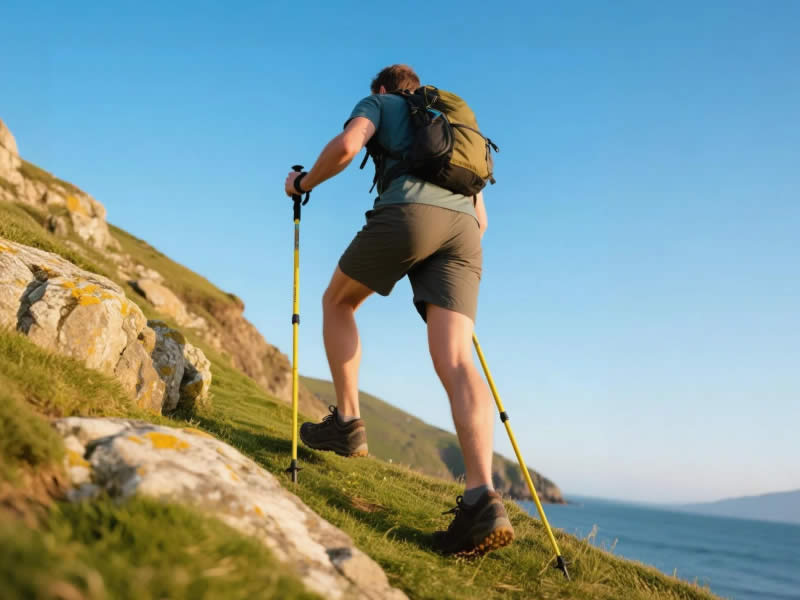
Recommended trekking pole purchase link: https://s.click.aliexpress.com/e/_c4M7OWaN
Why the Coast Path hurts knees
The path follows the cliffs, which means you’re either climbing or descending. Descents are the real knee‑killers: each step down subjects your knee joint to 3–5 times your body weight. Without poles, every downhill step is a hammer blow. The cumulative effect over miles of Cornish or North Devon cliffs can lead to sharp pain, swelling, and weeks of recovery.
The key: lengthen poles for every descent
Most hikers keep their poles at one length all day – a big mistake. On flat or gentle slopes, your elbow should be at 90° when the tip is on the ground. For a descent, lengthen your poles by 5–10 cm (2–4 inches). This does two things:
- It allows you to plant the pole ahead of your body (not beside your feet), creating a braking angle.
- It transfers load from your knees to your arms, reducing joint force by up to 25%.
On the Coast Path, you can adjust descent length once and leave it for the whole downhill section. Mark your “descent” length with tape on the shaft for quick resets.
Plant ahead and push down
Do not plant your poles beside your feet – that does nothing for your knees. Instead, reach forward and plant the tip about 30–50 cm ahead of your forward foot. Then, as you step down, push down firmly on the pole. You should feel your arms and shoulders taking weight. This active push is the magic that spares your knees.
Use wrist straps correctly
Insert your hand up through the strap from below, so the strap sits between thumb and index finger. Grip the handle lightly – the strap should bear the load. On a descent, you’ll be pushing down hard; the strap transfers that force without you having to death‑grip.
Double planting on steep sections
On the very steep, loose descents common on the Coast Path (e.g., near Tintagel or the Lizard), use double planting: plant both poles together ahead of you, then step down with both feet. This gives maximum braking and knee relief. On moderate descents, you can alternate (opposite pole to foot), but keep the poles long.
Other tips for Coast Path knees
- Shorten your stride – smaller steps reduce impact.
- Keep your chest up – avoid leaning forward, which shifts weight onto your knees.
- Use carbide tips – they bite into the often-damp rock and gravel.
- Take breaks – stretch your quads and shake out your legs.
Practice on a local hill
Before your Coast Path trip, practice the descent technique on a steep, grassy or rocky slope. Feel how lengthened poles and active pushing transform the jarring into a smooth, supported step. Once mastered, you’ll descend with confidence and finish each day without ice packs.
Final verdict
To reduce knee pain on the South West Coast Path, lengthen your poles for every descent, plant ahead of your feet, push down actively, and use wrist straps correctly. This simple technique transfers up to a quarter of your body weight from your knees to your arms. Over 15 miles of Cornish cliffs, that’s the difference between finishing with a smile and hobbling into the next pub. Protect your knees – they’re the only ones you’ve got.




