




Should I plant both poles together or alternately on flat sections?
For hikers new to trekking poles, one of the most common questions is about planting rhythm: should you plant both poles at the same time, or alternate them like a walking gait? The answer for flat, rolling, or gentle terrain is clear: plant alternately, using an opposite arm‑leg rhythm. Planting both poles together on flat ground is inefficient, wastes energy, and disrupts your natural stride. Here’s why.
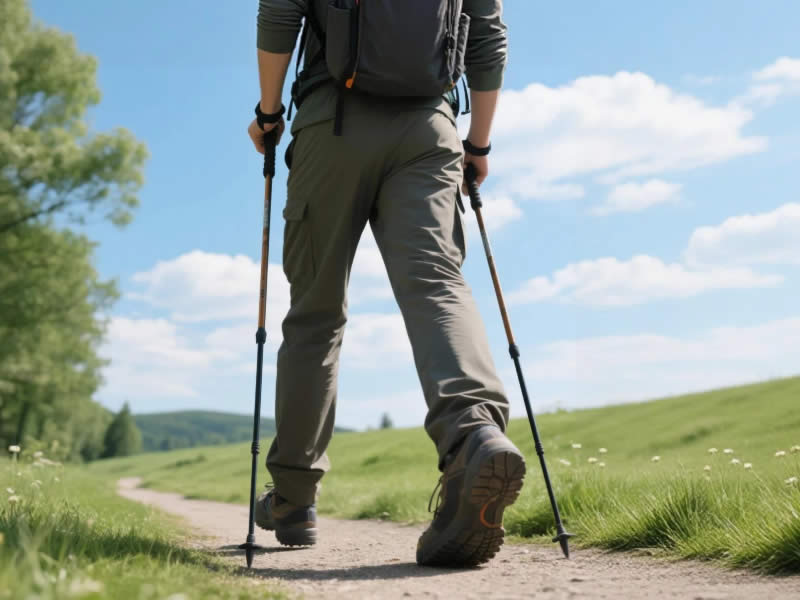
Recommended trekking pole purchase link: https://s.click.aliexpress.com/e/_c4M7OWaN
The natural walking rhythm
When you walk without poles, your arms swing naturally opposite your legs: right foot forward, left arm forward; left foot forward, right arm forward. This diagonal pattern is hardwired into your nervous system – it’s the most energy‑efficient way to move. Trekking poles should simply extend this natural arm swing. With alternate planting, you plant the pole on the same side as your forward arm – which is opposite your forward foot. So when your right foot steps forward, you plant your left pole. This feels intuitive and requires no extra mental effort.
Why alternate planting is more efficient on flat ground
- Uses momentum: Your body is already rotating slightly with each step. Alternate planting harnesses that rotation, adding a small forward boost without extra work.
- Maintains rhythm: You can walk at a steady, comfortable cadence without stopping or pausing between plants.
- Reduces vertical bounce: Double planting tends to lift your body slightly with each push, wasting energy. Alternate planting keeps your centre of gravity more constant.
- Less arm fatigue: The load is distributed continuously rather than in bursts, so your muscles work steadily rather than in intense spikes.
Why double planting (both poles together) is wrong for flat ground
Double planting means you plant both poles simultaneously, then take one or two steps, then plant again. This technique has its place – on steep ascents or descents – but on flat ground it’s inefficient for several reasons:
- Breaks your stride: You either have to pause or hurry your steps to fit the double plant, disrupting your natural rhythm.
- Wastes energy: Lifting and planting both poles at once requires more upper‑body effort than alternating. You also lose the forward momentum from the contralateral swing.
- Increases stress on the poles and locks: The sudden double load can accelerate wear.
- Reduces stability per step: With alternate planting, you always have one pole in contact with the ground. With double planting, there’s a moment when both poles are in the air between plants, leaving you with only two feet on the ground – less stable.
When to use double planting (not on flat ground)
Double planting is excellent for:
- Steep ascents: Planting both poles together and pulling yourself up transfers work to your arms.
- Steep descents: Both poles ahead act as brakes, protecting your knees.
- Deep snow or mud: Two poles together create a stable platform.
- Stream crossings: Both poles planted downstream provide a solid brace.
But on flat, hard‑packed trails, stick with alternate.
How to practice alternate planting
- Set your poles to the correct flat‑ground length (elbow at 90° with tip on ground).
- Walk normally, letting your arms swing.
- As your right foot goes forward, plant your left pole about level with your forward heel.
- Push back lightly and then lift the pole as your left foot comes forward.
- Repeat with the other side. Within a few minutes, it should feel automatic.
Common mistakes on flat ground
- Planting both poles together – inefficient, as explained.
- Planting the same‑side pole as your forward foot – creates a waddling gait and wastes energy.
- Planting too far forward – over‑reaching strains shoulders.
- Gripping too tightly – use wrist straps to relax your fingers.
Final verdict
On flat sections, always plant your trekking poles alternately – opposite pole to forward foot. This matches your body’s natural walking rhythm, conserves energy, and reduces fatigue. Save double planting for steep hills, snow, or tricky crossings. Learn the difference, and you’ll hike more efficiently and comfortably on every flat mile.




